
Series · Why AI is stalling
Why the knowledge build stalls
Writing down how a team really works is where most AI implementation time goes, and almost none of it is spent writing. Four stalls account for most of the delay, and the method is built around each one.
Inovagio team · Published · Updated · 7 min read

On this page
The usual list of AI implementation challenges covers data quality and skills gaps as well as integration and governance. The ones that cost the most time, though, are calendar problems.
The project to write down how the export review team at Tarrow Aerospace works is in its ninth week. The draft covers the routine supplier packages and few of the hard ones, because the reviewer who handles drawings with mixed classifications has been on leave since Tuesday, and nobody else knows which ones she clears and which she holds. Internal audit wants to review the draft before anyone uses it. Legal has frozen part of the shared drive for a contract dispute. The sponsor has missed three reviews to deal with a system outage. (Tarrow Aerospace · Example company)
Nothing that week involved the AI, and that is the pattern behind most AI implementation challenges. The model was ready months ago. The hard part is getting a business's rules out of its people's heads and onto paper, approved. Done by hand, that can take a year for a single team, and very little of the year goes to writing; most of it goes to waiting.
The waiting has four causes, and they show up so reliably that the method is built around them.
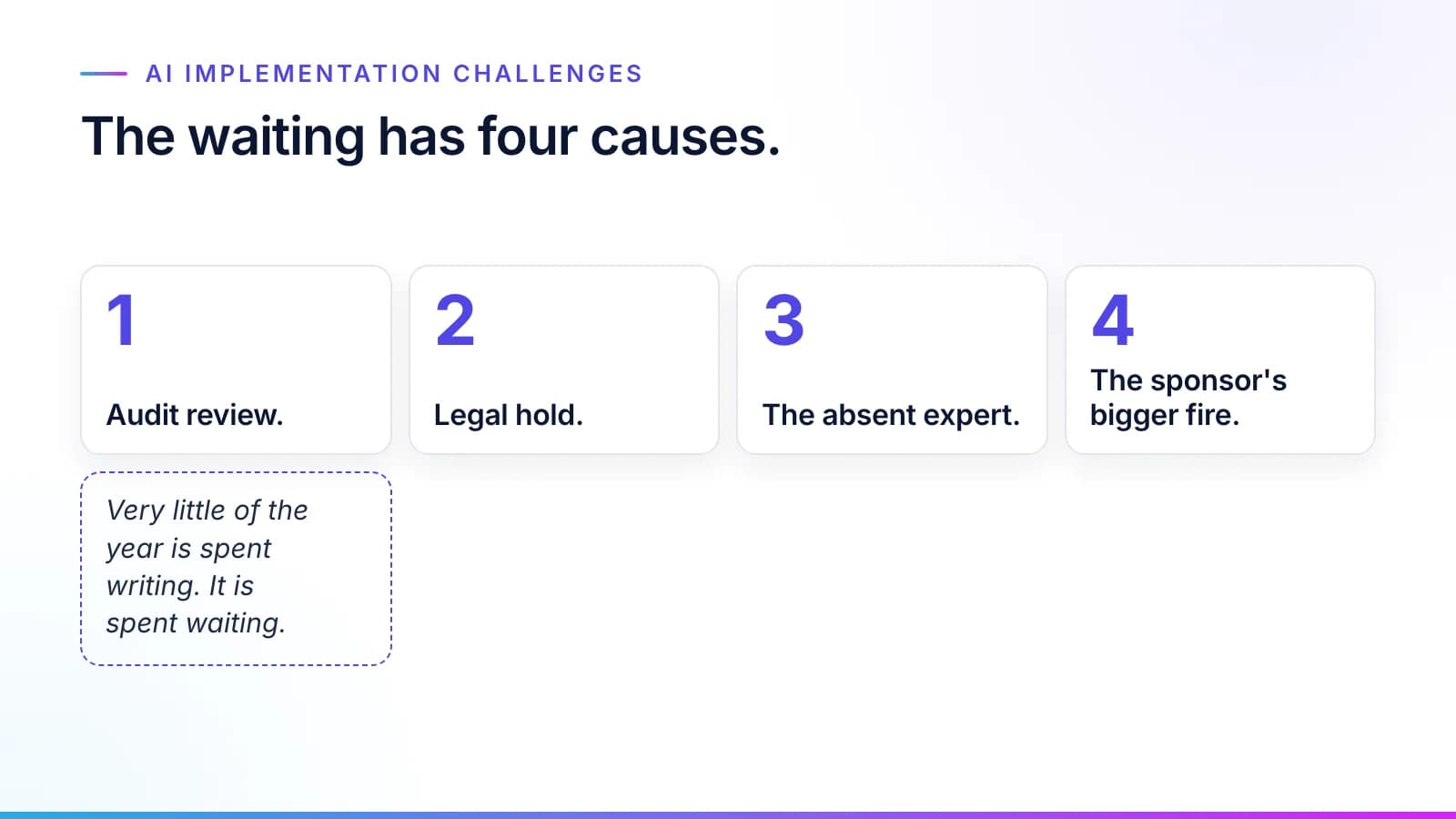
AI implementation challenges are mostly calendar problems
#A separate piece on AI stakeholder alignment covers the setup half of a project, from the agreements and the security review to system access and the escalation rule. This one is about what happens after setup, when a team's knowledge has to be written down so a Virtual Employee can work from it.
That knowledge build is usually run as workshops. An analyst or an engineer gathers the experts in a room and captures what they say, then writes it up and circulates it for review. Every step waits on the one before it, and every review waits on a calendar. One missing person stops the whole document.
Audit review waits for a finished document
#Internal audit, quite rightly, wants to see the rules before anything runs on them. In a workshop project, audit reviews a finished document. So audit waits until the document is finished, and the document waits for audit's comments, which arrive as a fresh set of edits to all of it.
In our method, audit review is an approval step inside the rulebook. A rule that needs audit's eye goes to audit when that rule is drafted, and audit signs that rule. A rule can require more than one approver, and nobody approves their own change. Audit sees its share of the work as it arrives, and every other rule keeps moving.
A legal hold freezes the shared folder
#Legal places a hold on a set of files for a dispute or an investigation, and the project loses the records it was reading. Or legal wants to review how a rule touching customer data was written before it is used. In a document project, either one freezes everything that shares a folder or a draft with the affected material, which is usually most of it, because workshop notes and drafts tend to live together in one place.
When rules are drafted and approved one at a time, a hold touches only the rules that depend on the held records. Legal review becomes another approval step on the rules that need it, with its own named approver. The rest of the rulebook doesn't wait.
The one expert is out for two weeks
#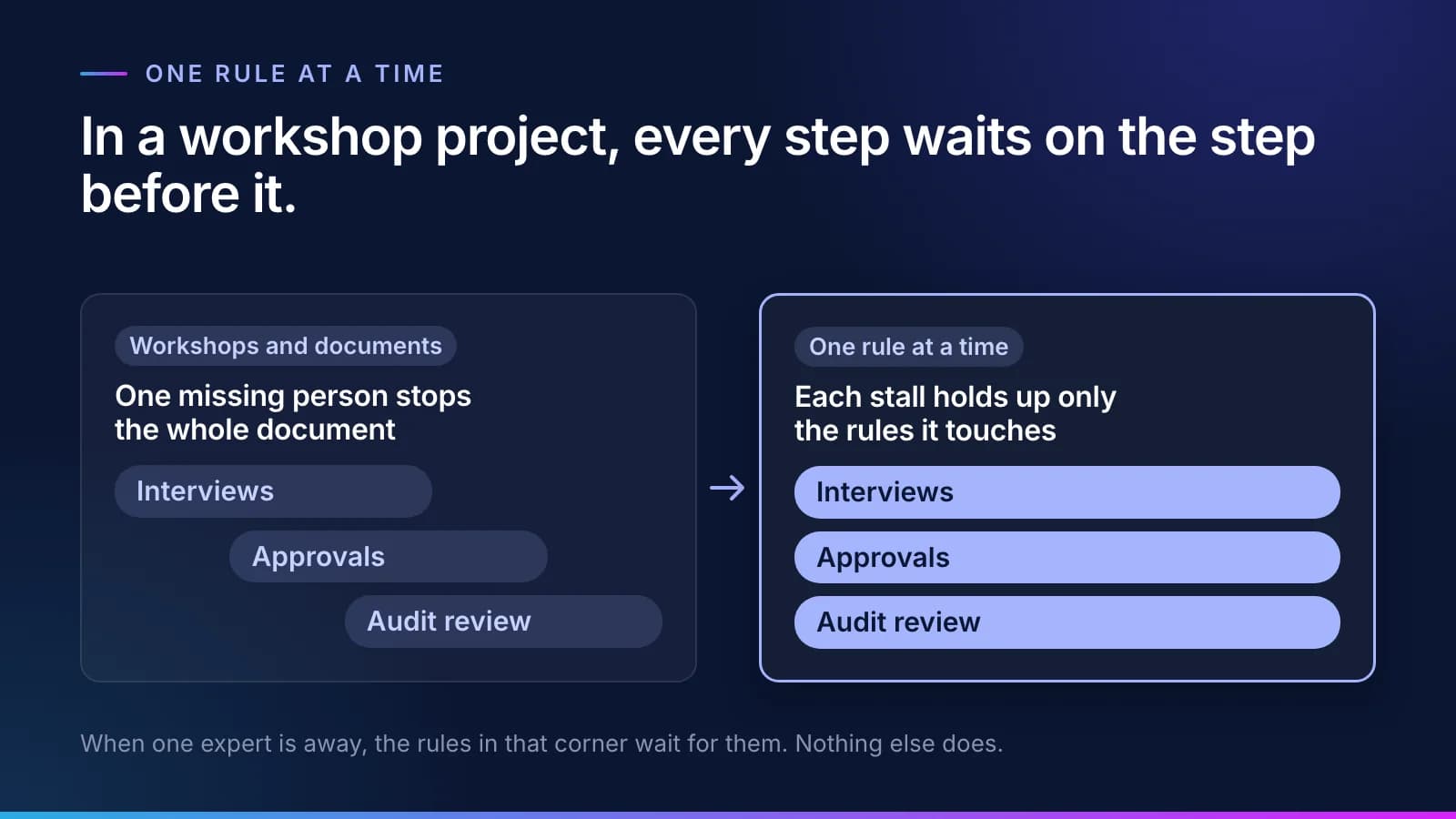
Every team has one person who knows how a particular kind of case is really handled, and that person is out for two weeks at exactly the wrong time. In a workshop, the session is rescheduled, and the dates behind it slide.
Our agents interview people one at a time, fitting around their calendars. Rules are approved one at a time too. When the person who knows one corner of the work is away, the rules in that corner wait for them. Nothing else does. And once that person's knowledge is written down and approved under their name, the team no longer depends on their calendar, or on their staying, which is often why a department asked for the work in the first place. How to onboard an AI employee shows where these interviews sit in the whole process. What the approved rules become, together with your vocabulary and records and who may see what, is a context layer: the part of your systems an AI agent reads before it acts.
The sponsor has a bigger fire
#The sponsor who signed the project has a bigger problem this month: an outage, a regulator's letter, a quarter-end. Reviews slip. Decisions that only the sponsor can make sit unmade, and the team waits politely.
Two things help here. The sponsor approves the scope and the escalation rule up front, so most decisions don't need them week to week. And because progress is counted in rules approved, with the median days from draft to approval, the sponsor can see in one line whether the build is moving, without sitting through a meeting to find out.
Agents do the legwork, so experts only approve
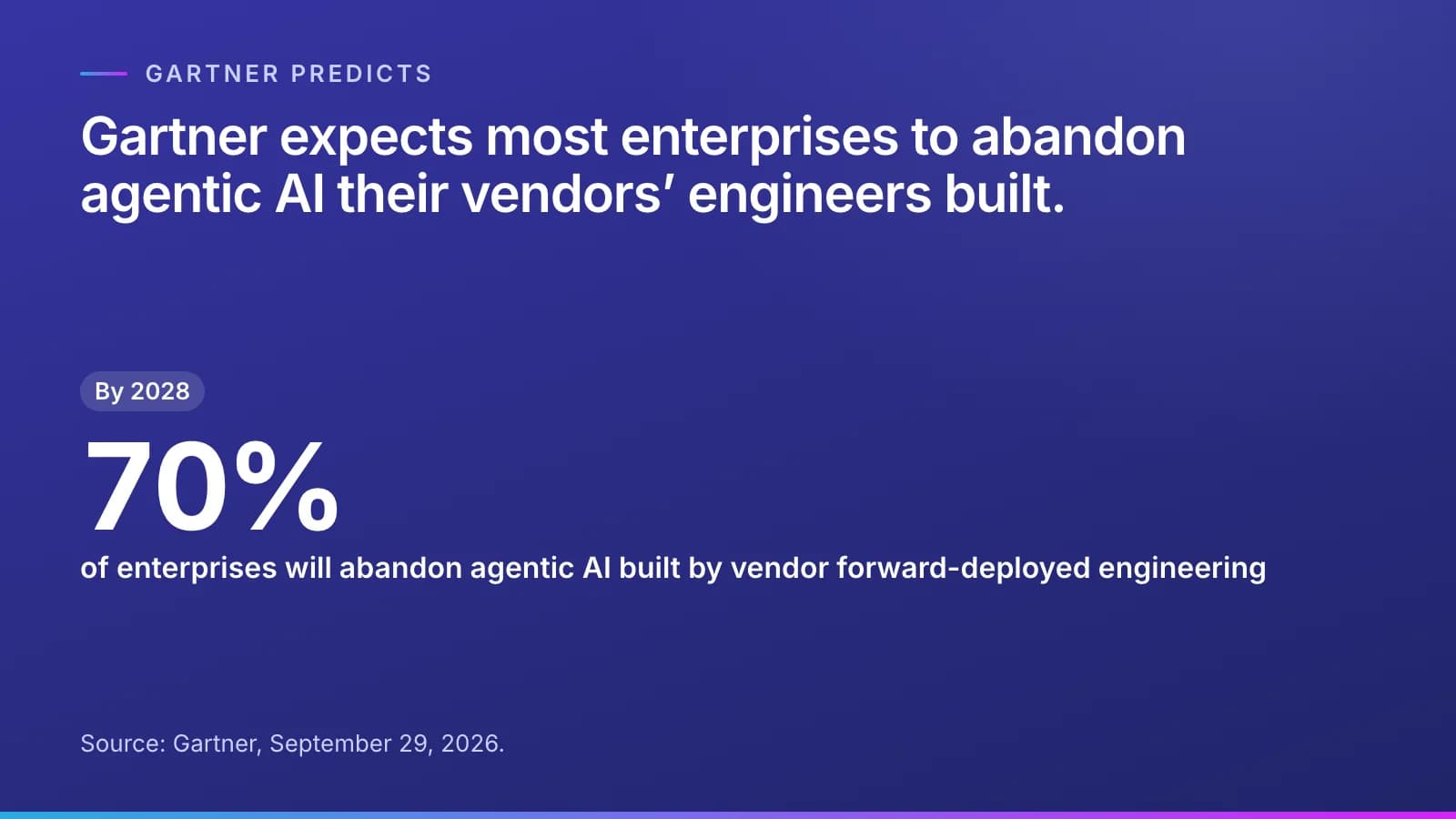
#Whoever does the drafting, the knowledge has to stay with your team. Where a vendor's engineers build it on site, it often leaves with them, and nobody inside can keep it current; what you should own when they leave lists what to ask for. "Gartner predicts 70% of enterprises will abandon agentic AI built by vendor forward-deployed engineering by 2028" (Gartner, September 29, 2026).
Our agents start from a role that is already trained: software does the interviewing and drafting, and keeps track of every rule. The right people on your side do the approving, and the rulebook that results is yours, in open formats. Synesis is the knowledge layer. It runs the interviews and keeps each rule tied to who said it, and the guide to how a rule is approved shows what each rule contains.
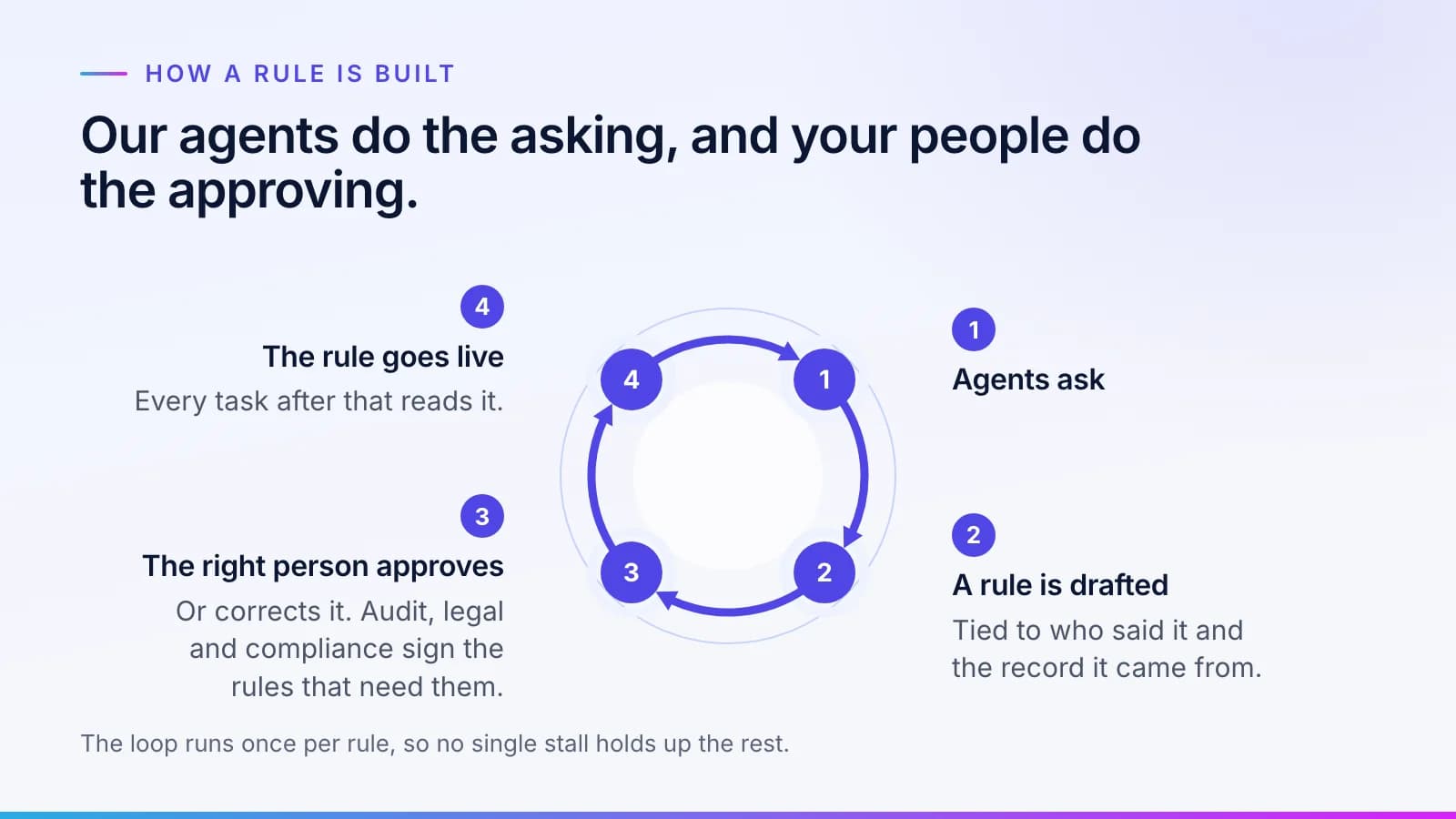
Counting delays by cause
#The method doesn't make any of the four go away. It limits each one to the rules it touches.
| The stall | How the method is built around it |
|---|---|
| Audit review | An approval step on the rules that need audit, signed as each is drafted |
| Legal hold | Only the rules that depend on the held records wait |
| The absent expert | Interviews and approvals run one rule at a time, around calendars |
| The sponsor's bigger fire | Scope and escalation agreed up front; progress shown as rules approved |
We also count the delays that remain, by cause: days lost to audit review, legal, access, competing priorities, absent experts and our own defects. Those categories are on the scoreboard, beside time to first correct task and cost to first correct task, because a buyer should be able to see where the time went.
Tip
Before you sign for any AI implementation, ask the vendor how the rules get out of your people's heads, who approves them, and what happens to the schedule when one of those people is away.
How it works is our answer in full, and how Virtual Employees learn your rules shows the method from interview to work. Shorter answers are in Virtual Employees: questions and answers, and why AI projects fail covers what happens when this step is skipped.
Questions
What people ask.
What are the biggest AI implementation challenges?
The biggest AI implementation challenges are usually not technical. They are getting a team's rules out of people's heads and approved, and keeping that work moving through audit review, legal holds, absent experts and sponsors pulled onto other problems. The model is often ready long before the business knowledge it needs is written down.
Why do AI projects take so long to implement?
AI projects take so long because the knowledge build usually runs as workshops and documents, where every review waits on the one before it. A single absent expert or a pending audit review can stop the whole document. Drafting and approving rules one at a time limits each delay to the rules it actually touches.
How do you capture expert knowledge before people retire?
You capture expert knowledge by interviewing the people who do the work, writing their rules down one at a time, and having them approve each rule under their name. Inovagio's agents do the interviewing around people's calendars and tie each rule to who said it, so the knowledge outlasts any one person.
What is a forward-deployed engineer in AI?
A forward-deployed engineer is a vendor engineer placed at a customer to build and connect an AI system, often including the business knowledge it relies on. Whoever builds it, the rules and who approved each one should stay with you when the project ends.
How does Inovagio handle audit and legal review of AI rules?
Audit, legal and compliance review are approval steps inside the rulebook, not meetings outside it. Each rule that needs a reviewer goes to that reviewer when it is drafted, and they approve or correct that rule. You decide who approves which kind of rule, a rule can require more than one approver, and the agents that draft rules never approve them. Every other rule keeps moving, and every approval is recorded with the reviewer's name.
The products, industries and examples it covers.
- Knowledge layerSynesisTurns your policies, procedures, records and your people’s know-how into a rulebook your experts approve, which you own and can take anywhere.
- Data engineMNEMOSRecords, documents, vectors, graph and agent memory in one engine, with a ledger behind every write.
- IndustryDefenseFirst articles checked against the drawing and purchase order, each supplier’s required cybersecurity level tracked, and outgoing drawings compared with your release rules. Engineers and reviewers decide.
- OverviewHow it worksTen checked steps from your first decision to the day it handles real cases.
Read next.
 Article · ApproachEnterprise AI doesn't fail on the AITwo things decide whether AI works in a regulated business. One is a platform that can handle the data and do the work. The other is getting every team that has to say yes to say it, on dates. This is how we run the second half. · updated November 20, 2026 · 9 min read
 Article · ApproachWhy AI at work stallsMost AI at work stalls because it doesn't know your team's rules and waits to be asked. Here is why AI projects fail in operations, and what changes when the routine queue goes to a worker that knows them. · updated November 18, 2026 · 8 min read
 Guide · GovernanceHow an AI business rule is written and approvedEvery Virtual Employee works from rules approved one at a time by the people you make responsible. What a rule contains, who signs it, how a correction becomes a new version, and how any change is rolled back. · updated November 18, 2026 · 9 min read
See it on your work
See how one of your tasks runs, start to finish.
A 30-minute walkthrough of one of your workflows, the approval step and the audit record, with the people who build the platform.