
SynesisKnowledge layer
Write down what your company knows.
Agents interview your people and read your records. Your experts approve every rule, and the result is yours to keep.
We’ll spend 30 minutes with you on one of your workflows, and you don’t need to share any data.
Where Synesis works
Turns interviews into decided rules and the knowledge layer (Synesis). These are the onboarding steps it works in, from your first decision to live work.
What Synesis does
Synesis is Inovagio’s knowledge layer: it learns how your company really works from your policies, procedures, records, systems and people, turns that into rules your experts approve, and every Virtual Employee follows them.
Interviews at four levels
The C-suite gives the mission, goals and risk appetite; senior leadership the policies and decision rights; department heads the processes and approval chains; team members the real steps and exceptions.
Reads your records
Policies, procedures and the documents your teams already use become the source for every rule, with a link back to where each rule came from.
Practice meets policy
Where people work differently from the written procedure, Synesis flags the gap for an expert to decide instead of guessing. The decision becomes a versioned rule.
Yours to export
What Synesis learns belongs to you: inspect it, export it, and keep it if you leave.
Four levels of interviews, one business model.
The C-suite, senior leadership, department heads and team members, in that order. Goals flow down, so every rule links to the goal it serves. Reality flows up: where practice differs from policy, a proposal goes to a steward.
Synesis · interview in progress
Meridale Health · Example company- ✓ C-suite
- ✓ Senior leadership
- Department heads
- Team members
Agent
When an MRI order comes in, what has to happen before it is booked?
James · Director of Revenue Cycle
It needs prior authorization first.
Agent
Your specialists said some plans waive it for outpatient imaging. How do you handle those?
James
They check the payer’s list. If it’s waived, they book it.
Captured so far
Vocabulary
Prior authorization · waiver list
Gap raised
Policy: every MRI is authorized. Practice: waived scans are not.
Draft rule · for the steward
Check the payer’s list; if waived, book and attach the check.
- C-suite and senior leadership
- The mission, goals and the KPIs that prove them, risk appetite, the objectives each function owns, policies and decision rights.
- Department heads
- Processes, roles, approval chains, service levels and the systems each step uses.
- Team members
- The real steps, the exceptions, the workarounds and where the data really lives. Each answer is a proposal a steward approves.
Synesis at work
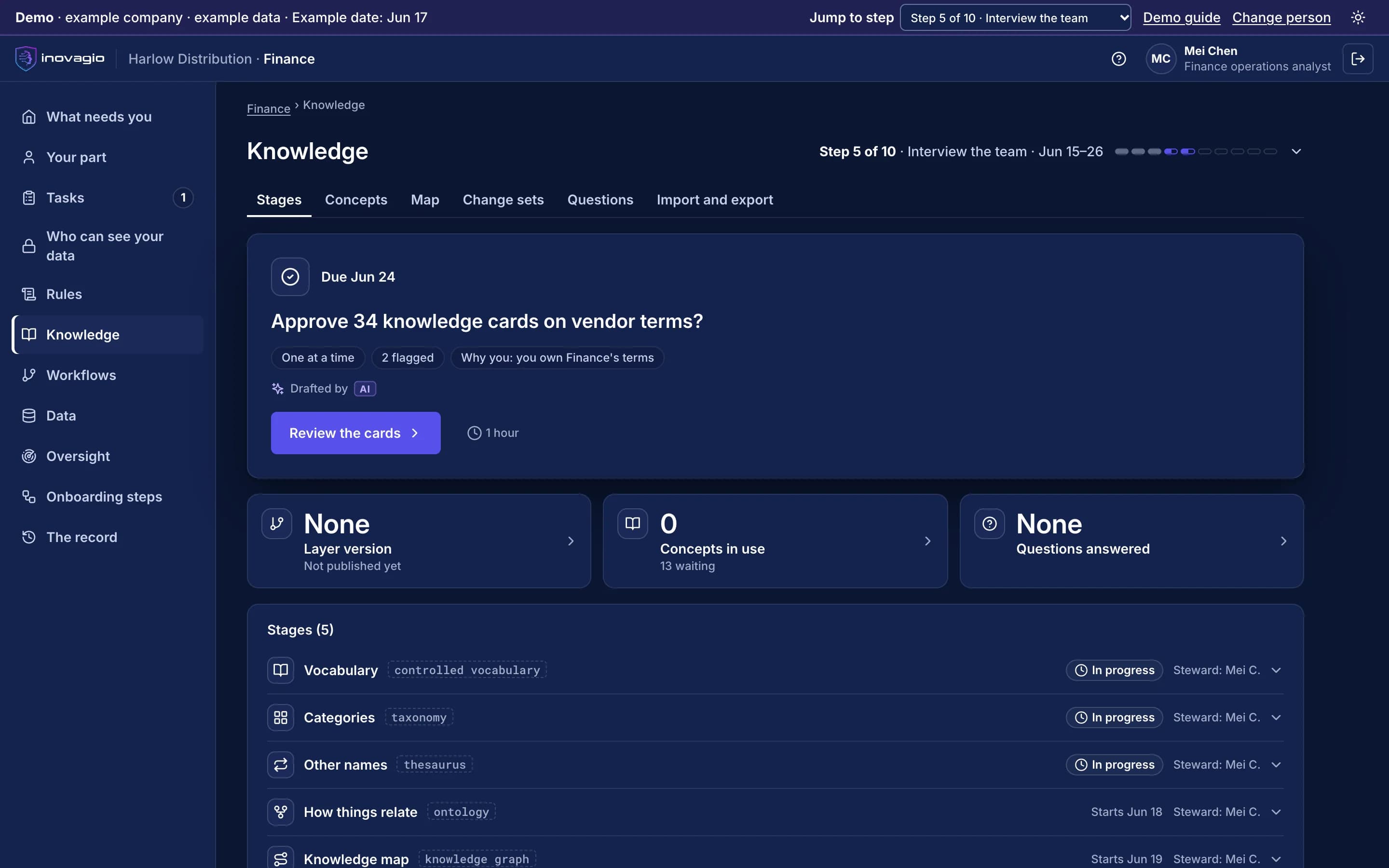
In the App at step 5: Learn from your people.
- Five stages: vocabulary, categories, other names, how things relate and the knowledge map.
- Each stage has a steward, and nothing is published until its gate passes.
- The steward decides 34 knowledge cards on vendor terms, one at a time.
Inside Synesis
The views Synesis gives the people who run it, on sample data from Inovagio’s example companies.
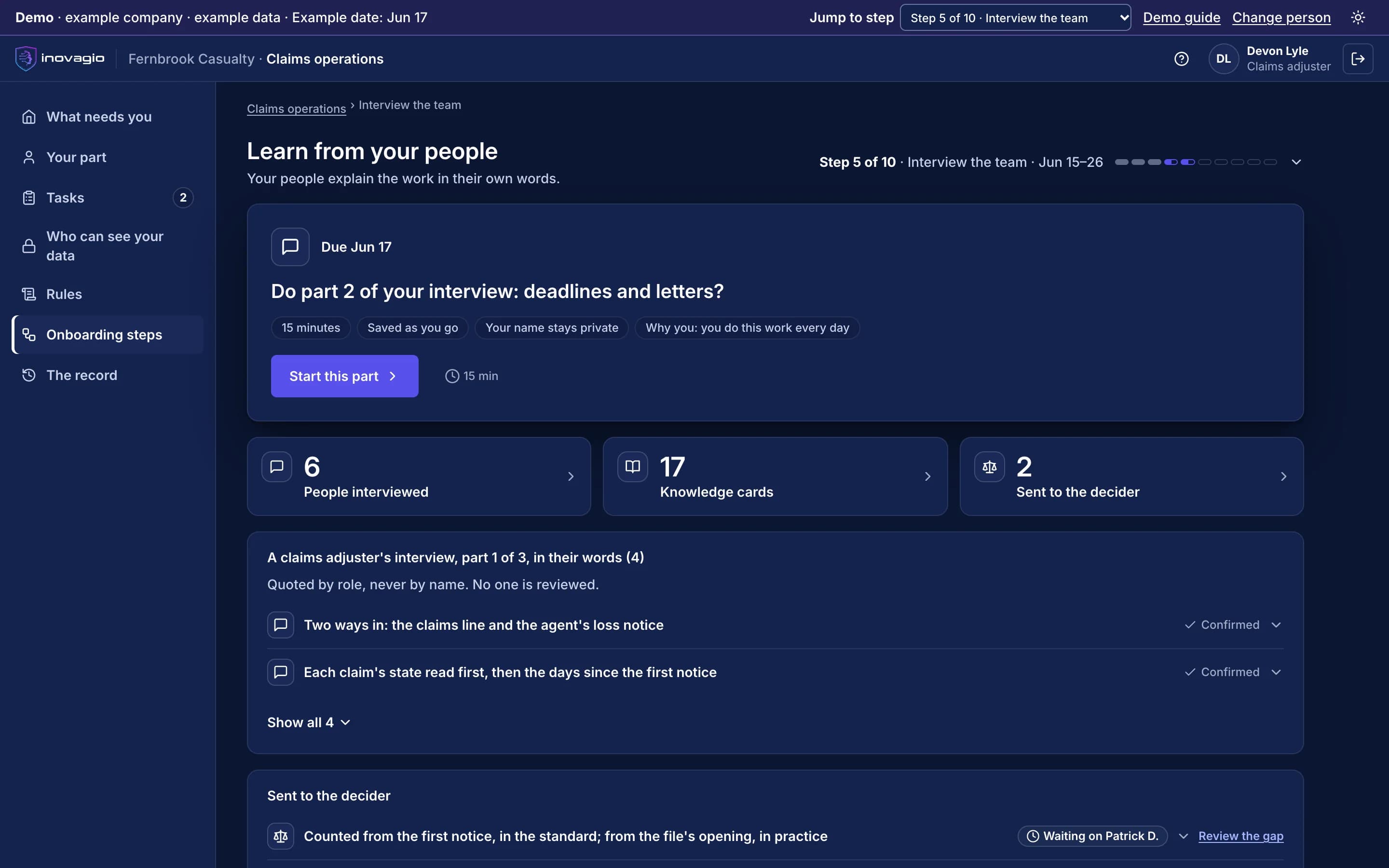
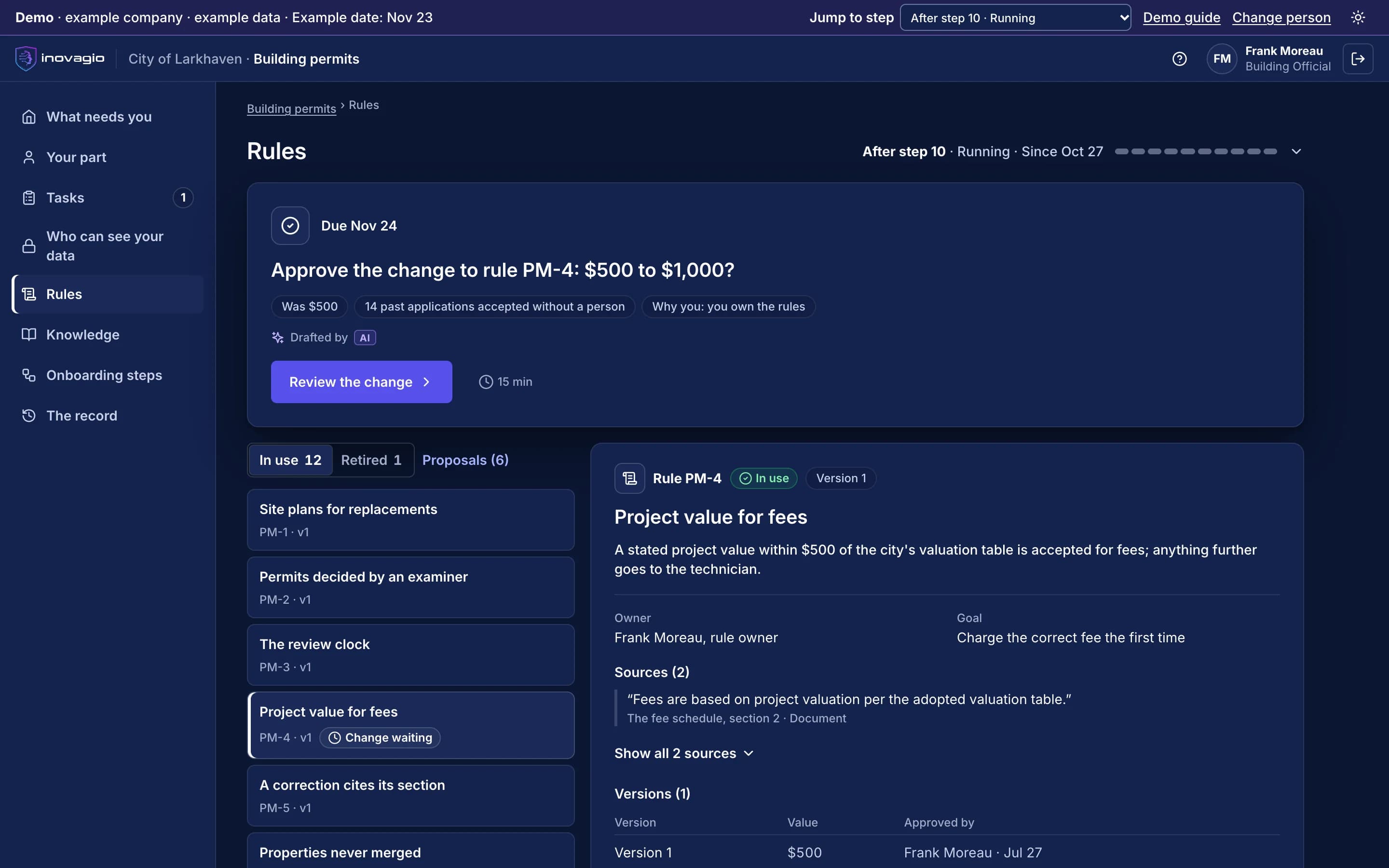
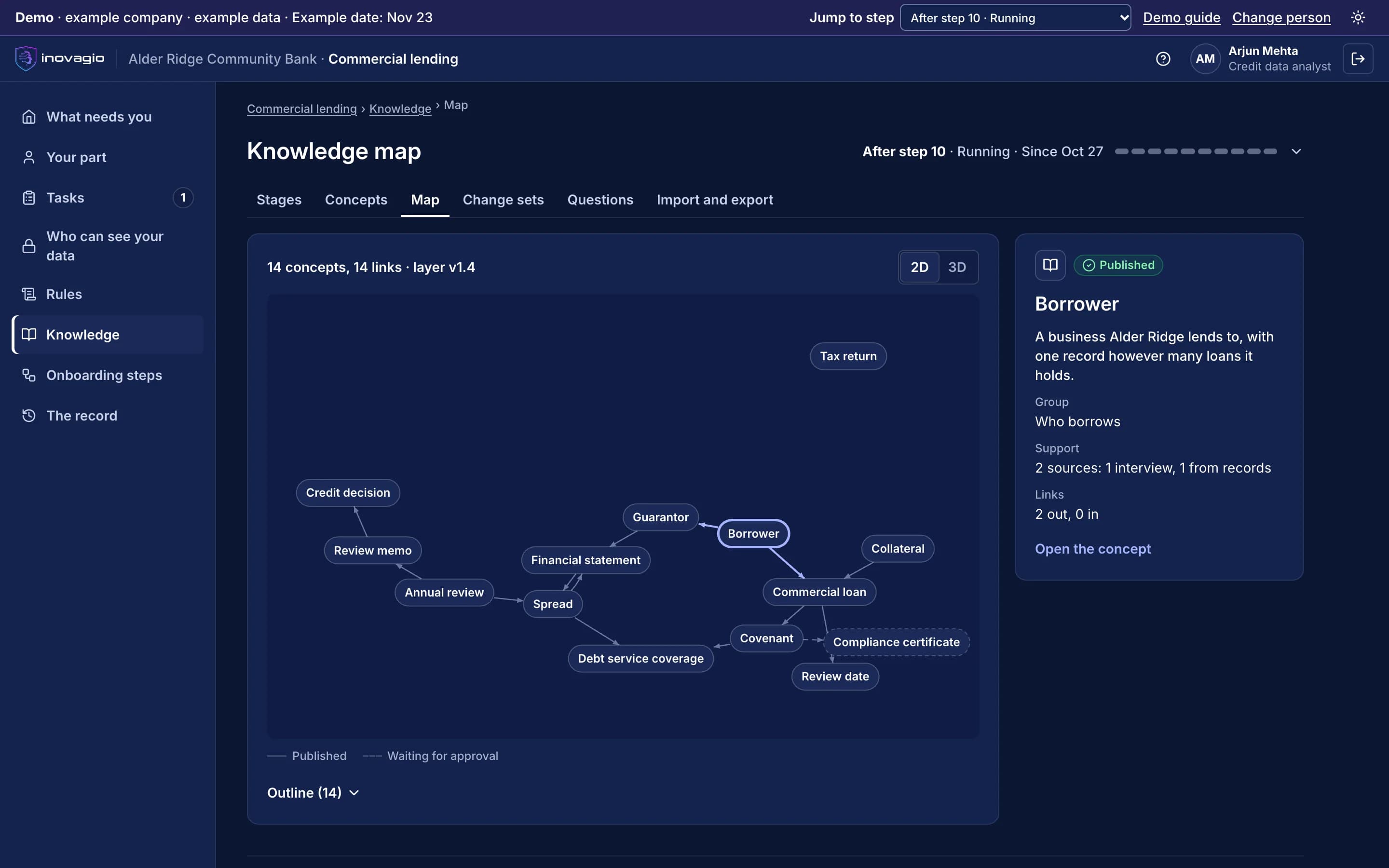
Synesis › Interviews: the next part of a claims adjuster’s interview, how many people were interviewed, and the team’s own words, each confirmed. Sample data from Inovagio’s example companies.
The products that make up Synesis.
Synesis
- PerceptionData ingestionTurn documents, scans, email and system data into cited knowledge.
- MNEMOSData engineRecords, documents, vectors, graph and agent memory in one engine, with a ledger behind every write.
What you get with Synesis
Capturing how work is done
Agents interview your people and read your records, and your experts approve each rule.
When practice differs from policy
The gap is flagged as a proposal for the expert who owns that area (its steward) to accept or reject.
Keeping it current
Refreshed from your data, with a version and an owner on every concept.
Who owns it
You do, in a format you can export.
Same request, two agents.
An agent stays aligned by knowing the goal, the process and the rules. Here is one request handled without the knowledge layer and with it.
Same request, two agents
Alder Ridge Community Bank, an example company · commercial lending
The request
“Renew the Harlow Supply Co. line on LN-3187 at the higher limit they asked for, and send the commitment letter today.”
Without the knowledge layer
What it sees
The request, the commitment letter template and Harlow’s last renewal, LN-1877, on the same terms.
What it does
- 1.Treats it as a same-terms renewal
- 2.Checks for the 2025 business tax return, which is on file
- 3.Fills the template and sends the letter
Outside policy, found at the next exam
New money promised on one year of returns, before the loan committee decided: the gap examiners already noted in exam finding 2025-04.
With Synesis
Loads the context first
- GoalNo repeat exam findings
- ProcessCommercial renewal
- RuleRenewal documents rule v2 · credit policy §3.2
- RecordsLoan file LN-3187 · the 2025 return and the Sep 2026 interim statement on file
Its plan, checked before it runs
- 1.A higher line is a renewal with new money
- 2.Rule v2: two years of business tax returns and this year’s interim statements
- 3.The 2024 business tax return is still requested: hold the letter and ask for it
- 4.Route the file to the credit analyst, then the loan committee
Within policy before anything was sent
The credit analyst sees the goal, the rule and the file in one card.
Knows why
Every step links to the goal it serves.
Knows how
It follows the approved process and rule, not an old file.
Can prove it
The plan passed the checks, and the context chain is stored as evidence.
Fewer tokens
A small typed slice of the graph instead of pages of documents.
Everything Synesis does, by area.
Knowledge capture
- Interviewer agent in chat or voice on every Inovagio app
- Interviews with the C-suite, senior leadership, department heads and team members
- Document ingestion through Inovagio’s perception pipeline
- API schema and database introspection and profiling
- Ontology-guided entity and relation extraction
- Entity resolution with explainable, reversible merges
- Governed, retryable ingestion with dead-letter lanes
Governance
- Change sets: proposed, in review, approved, published
- Review cards for concepts, relationships, taxonomy trees and conflicts
- Department areas with an organizational alignment gate
- Stage, status, confidence and version on every concept
- Audited stage transitions with demotion and re-interview
- Classification and redaction of sensitive interview content
- Each model version evaluated before publish; regressions are blocked
Reasoning and use
- OWL 2 RL inference materialized incrementally
- SHACL constraint validation
- SPARQL 1.1 queries (SELECT, CONSTRUCT, ASK, property paths)
- R2RML bindings map each class and property to tables, graph labels and document collections
- Competency questions as executable queries
- Bi-temporal 'as of' queries
- Concept-expanded search across SQL, full-text and vector
- Graph-walking retrieval over the typed knowledge graph
- Governed metrics and dimensions bound to tables
Formats
- Turtle, N-Triples, N-Quads, TriG, RDF/XML, JSON-LD
- RDFS and OWL 2 (RDF, OWL/XML, Functional, Manchester)
- SKOS and SKOS-XL; glossaries from CSV or spreadsheets
- SHACL and a native shape form
- PG-Schema / GQL graph types and JSON Schema
- OBO for life sciences
How the knowledge layer is built.
Interviews and records become department graphs your stewards approve, federated into one company core. Agents read only what has passed every stage.
What Synesis replaces
Synesis does the work of these, inside one platform with one identity, one policy and one record:
- Process discovery done by hand
- Business glossary and data catalog tools
- Taxonomy and ontology management tools
- Standalone knowledge graph projects
- Semantic layer and governed metrics tools
- Static policy and procedure manuals
From the words people use to a model agents can follow.
Five gated stages: vocabulary, the words people use with one agreed definition and their synonyms; taxonomy, broader and narrower concepts; thesaurus, which terms relate across teams; ontology, the classes, properties and rules every agent plan must pass; and the knowledge graph, real records linked to the model and refreshed from your data.
- Each stage has a gate and a steward
- Department stewards approve terms and taxonomies, the organization’s steward approves the ontology, and regulated rules need two approvers.
- Every concept carries its history
- Its stage, confidence, version, owner and source: the interview or document it came from.
- Agents read only approved knowledge
- Nothing reaches an agent until it has passed every gate, and all of it exports in open standards.
The controls Synesis brings
Every Inovagio product keeps the same five commitments, because regulated work needs all five at once.
Security
Interviews, records and rules stay in your environment; nothing trains a shared model.
Governance
Every rule has an owner and a version, and nothing is used until an expert approves it.
On the record
Each rule links to the interview or document it came from.
Monitoring
Coverage, open gaps and approvals are visible per department.
Cost per task
Agents look up approved facts instead of re-reading long documents, so each task uses fewer tokens, measured for every knowledge version before it publishes.
Synesis in your industry
Every industry runs the same ten steps, so Synesis does the same job in each, on that industry’s own work.
- Financial servicesBanks, credit unions, lenders and insurersWorked example: Alder Ridge Community Bank · Example company
- Healthcare providersHealth systems, hospitals and physician groupsWorked example: Meridale Health · Example company
- Health plansMedicare Advantage, Medicaid and commercial plansWorked example: Ashgrove Health Plan · Example company
- LegalLaw firms and in-house legal teamsWorked example: Calloway Finch · Example company
- GovernmentState, county and city agenciesWorked example: City of Larkhaven · Example company
- DefenseDefense contractors and their suppliersWorked example: Keelstone Aerospace · Example company
- Finance operationsFinance teams in any industry
For developers: Synesis at a glance
- Standards
- W3C SKOS, OWL 2 RL / EL, SHACL, PROV-O, R2RML; ISO 25964; ANSI/NISO Z39.19
- Pipeline
- Vocabulary → taxonomy → thesaurus → ontology → knowledge graph, each stage approved by the person your organization names
- Storage
- MNEMOS catalog objects, tenant- and area-scoped, fail-closed isolation
- Review surfaces
- Cards in web, desktop and mobile apps
- Interfaces
- Agent semantic API; import and export in RDF, OWL, SKOS and SHACL formats
- Deployment
- Local-first on your hardware, or hosted
Synesis in the platform.
Where Synesis fits
One platformAgent HarnessAgent harness
Inovagio CLIInovagio DesktopWeb ChatInovagio SDK
OpsisExperience layer
FolioMorphe
Virtual EmployeesVirtual Employee layer
NexusErgon
Synesis (this layer)Knowledge layer
PerceptionMNEMOS
OriginModel layer
Inference ServerForge
PhylaxTrust layer
AuthInovagio SecretsGuard
OperationsOperations
PanoptesArchon
Platform servicesPlatform services
ServerAPI ManagementConnect
Questions
Synesis questions
How long does it take to learn a workflow?
A five-day working session runs the onboarding on one slice of the work, inside your account: our agents read the documents, interview the people who do the work, and draft the rules for your experts to approve. The whole workflow is then built, tested, signed off and run in shadow mode before it goes live.
What happens when people do things differently from the written policy?
Synesis records both. Where practice differs from policy, it raises a proposal for the expert who owns that area, so the rulebook reflects what you decide rather than what was written years ago.
Can we take the knowledge with us?
Yes. It is your asset and exports free, in open standards: OWL for the model, SKOS for vocabularies and taxonomies, RDF for the records.
How is the knowledge structured?
In five gated stages: vocabulary, taxonomy, thesaurus, ontology and knowledge graph. Department stewards approve terms and taxonomies, the organization’s steward approves the ontology, regulated rules need two approvers, and agents read only what has passed every gate.
Guides and posts on Synesis
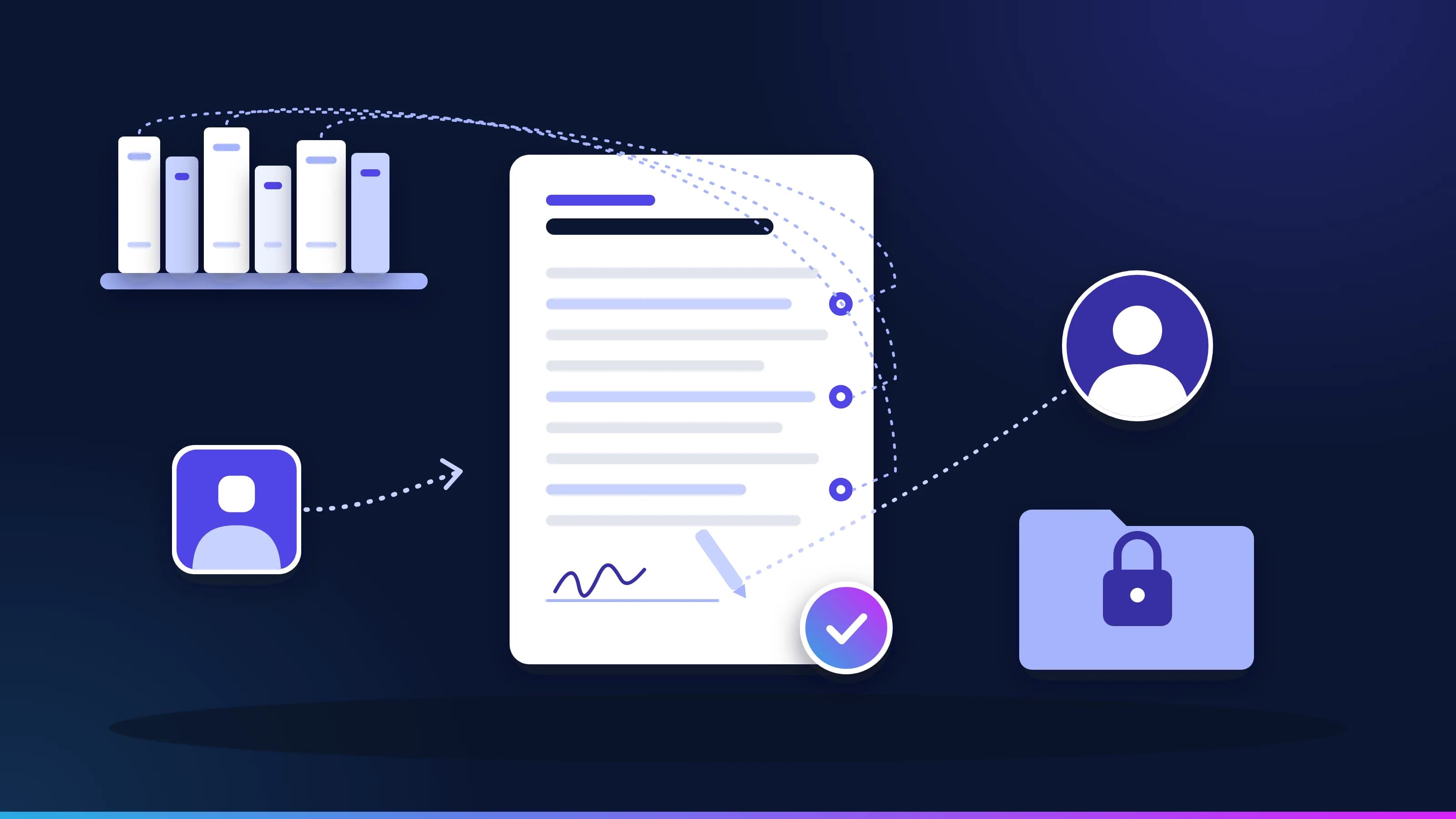 Guide · GovernanceABA Formal Opinion 512: an AI checklist for law firmsABA Formal Opinion 512 applies the duties lawyers already have to generative AI. This guide turns competence, confidentiality, client communication, supervision and fees into questions a firm can answer, and lists what to ask of any AI tool before client work goes near it. · 5 min read
 Article · GovernanceAI in a market conduct exam: what insurers get askedA state insurance department can ask about any AI system that makes or supports decisions affecting consumers, in an investigation or a market conduct exam. This post covers what the NAIC model bulletin says examiners may request, and how to have each answer ready before the letter arrives. · 5 min read
 Article · GovernanceAI in Medicare Advantage coverage decisions: what CMS allowsCMS lets a Medicare Advantage plan use AI to help with coverage decisions. Each decision must rest on the member's own record and the plan's published criteria, and a physician or other qualified clinician must review any medical necessity denial before it goes out. Here is what to ask a vendor. · 5 min read
 Guide · Data qualityAI-ready data checklist for regulated teamsTwenty-eight checks to run against the data an AI process will read, before it goes live and at set intervals after. Grouped by stage, from sources and owners to documents, mapping and run-time checks, each with why it matters to an examiner and how to test it. · updated November 18, 2026 · 8 min read
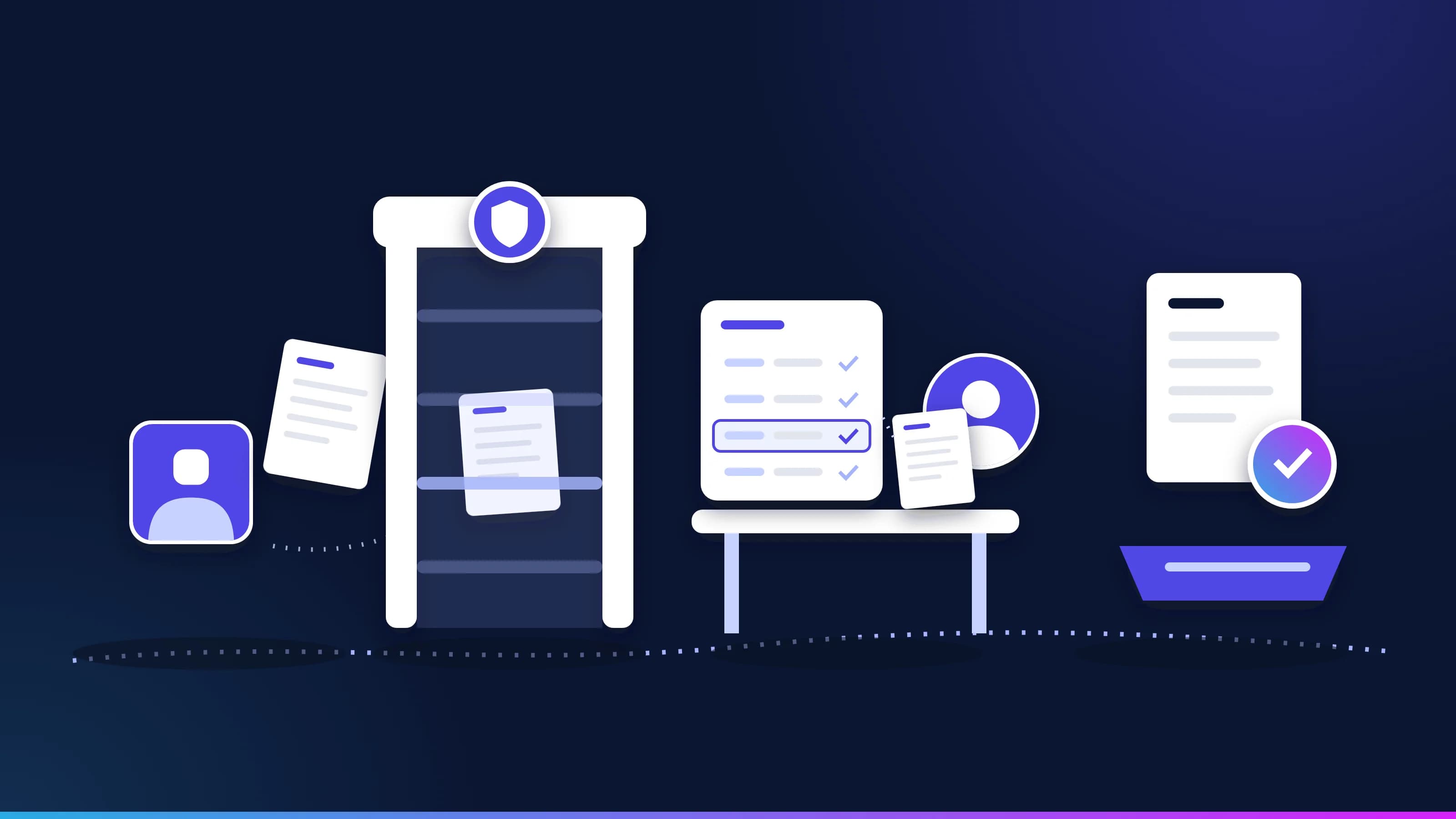 Article · GovernanceBusiness rules or AI guardrails? Why regulated work needs bothGuardrails filter what an AI model takes in and says. Business rules check what the work itself must satisfy. In regulated work you need both, plus a model's judgment for the messy parts. What each one catches, a worked example, and what to ask a vendor. · updated November 18, 2026 · 12 min read
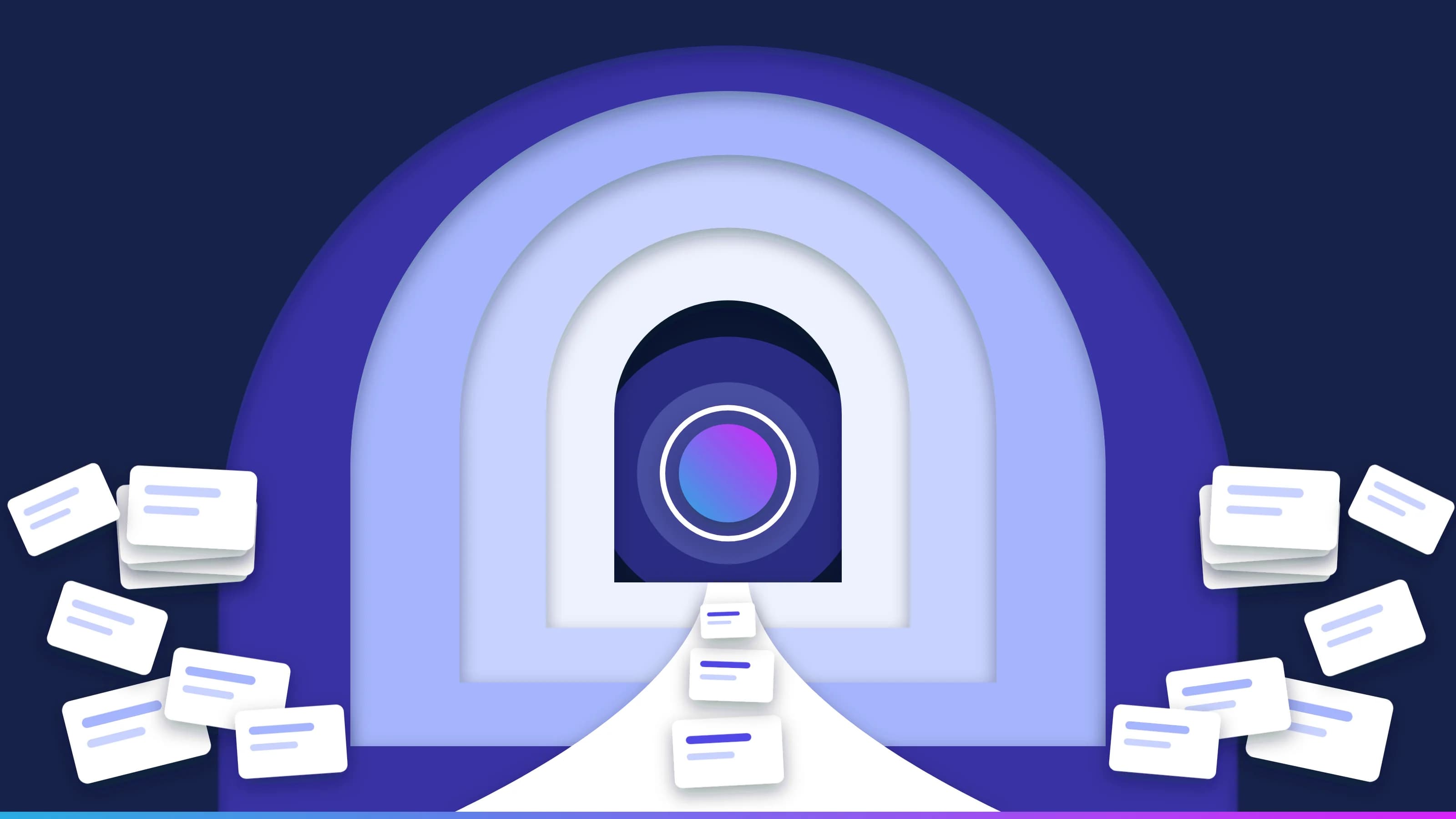 Guide · Context engineeringContext engineering for enterprise AI agentsContext engineering decides what an AI agent sees at each step of a task. The research on why long contexts fail, the techniques that keep context small, how agent memory fits in, and the controls that stop context from becoming an attack path. · updated November 18, 2026 · 18 min read
See Synesis on one of your workflows.
Every project starts with one workflow your people know well, measured against what it costs you today.