

AuthIdentity and sign-in
One sign-in for every person, service and AI agent.
Works with the identity provider you already run, and gives every agent its own scoped, expiring credential.
We’ll spend 30 minutes with you on one of your workflows, and you don’t need to share any data.
Where Auth works
One sign-in for people, services and Virtual Employees (Auth). These are the onboarding steps it works in, from your first decision to live work.
What Auth does
Auth is Inovagio’s identity server: it signs in people, services and AI agents over OpenID Connect and OAuth 2.0, federates to the identity provider you already run, and issues the tokens every Inovagio service trusts.
Standards-based sign-in
OpenID Connect discovery, authorization code with PKCE (S256 only), client credentials, refresh and token exchange, with the implicit and password grants left out by design.
Refresh-token theft detection
Refresh tokens rotate on every use; replaying a retired one revokes its whole family and raises a critical audit event.
Your identity provider, federated
People sign in through enterprise identity providers over OIDC or SAML 2.0, while Inovagio stays the one issuer and the one point of revocation.
Multi-factor and passkeys
TOTP with recovery codes, step-up authentication and passkeys, mandatory for platform administrators.
Agents act for a person
Signed, scoped, expiring delegation grants let the audit trail say which person an agent acted for, and within which grant.
Device sign-in for terminals
The CLI signs in with the device authorization grant, and that session authorizes its requests.
Keys you can rotate and protect
Signing keys move through pending, active, retiring and retired stages with overlap validation, held in an OS keystore, KMS or HSM in server deployments.
Provisioning and offboarding
SCIM 2.0 creates, updates and removes accounts and groups from your directory, and deactivation revokes access in the same request.
Every decision audited
Each sign-in, token issue and admin change is written to the platform’s tamper-evident audit trail, which cannot be turned off.
Auth at work
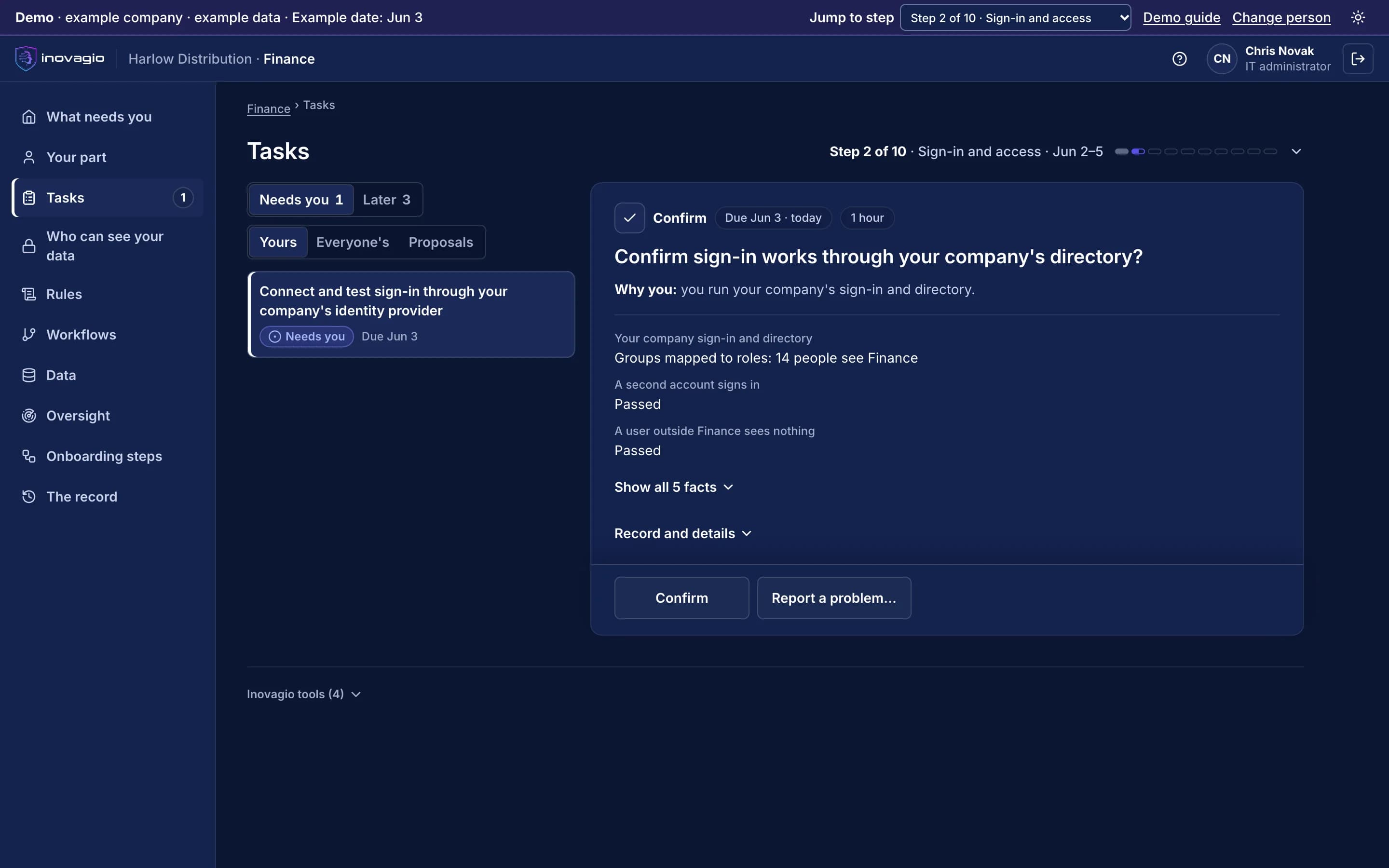
In the App at step 2: Set up sign-in and access.
- Groups mapped to roles: 14 people see Finance.
- A second account signs in: passed.
- A user outside Finance sees nothing: passed.
Inside Auth
The views Auth gives the people who run it, on sample data from Inovagio’s example companies.
- Synesis
- Virtual Employees
- Agent Harness
- Opsis
- Origin
- Phylax
- Operations
- Platform services
Roles and permissions
People and agents in one model · checked on every request
Agents act for a person
- Permit worker
- Acts for a permit clerk
- Records worker
- Acts for a records officer
- Rule
- Never more than the person it acts for
Recent changes
Records worker may redact public records
2 days agoApproved by the records officer
Permit agent may read fee payments
1 h agoWaiting for the finance director
- Synesis
- Virtual Employees
- Agent Harness
- Opsis
- Origin
- Phylax
- Operations
- Platform services
Records worker
Agent identity · acts for a records officer
Scoped credential
- Audience
- Public records service
- Scopes
- records.readrecords.redactrequests.update
- Expires
- 15 min after issue · renewed per task
- Bound to
- This agent’s key (proof of possession)
- Signing key
- Rotated 6 days ago
Not granted
- records.exportAsks a person
- payments.readAsks a person
- personnel.readAsks a person
Recent uses
| Time | Action | Result |
|---|---|---|
| 09:14 | Read a request | Allowed |
| 09:15 | Redact personal data | Allowed |
| 09:16 | Mark request fulfilled | Allowed |
| 09:17 | Export all records | Denied |
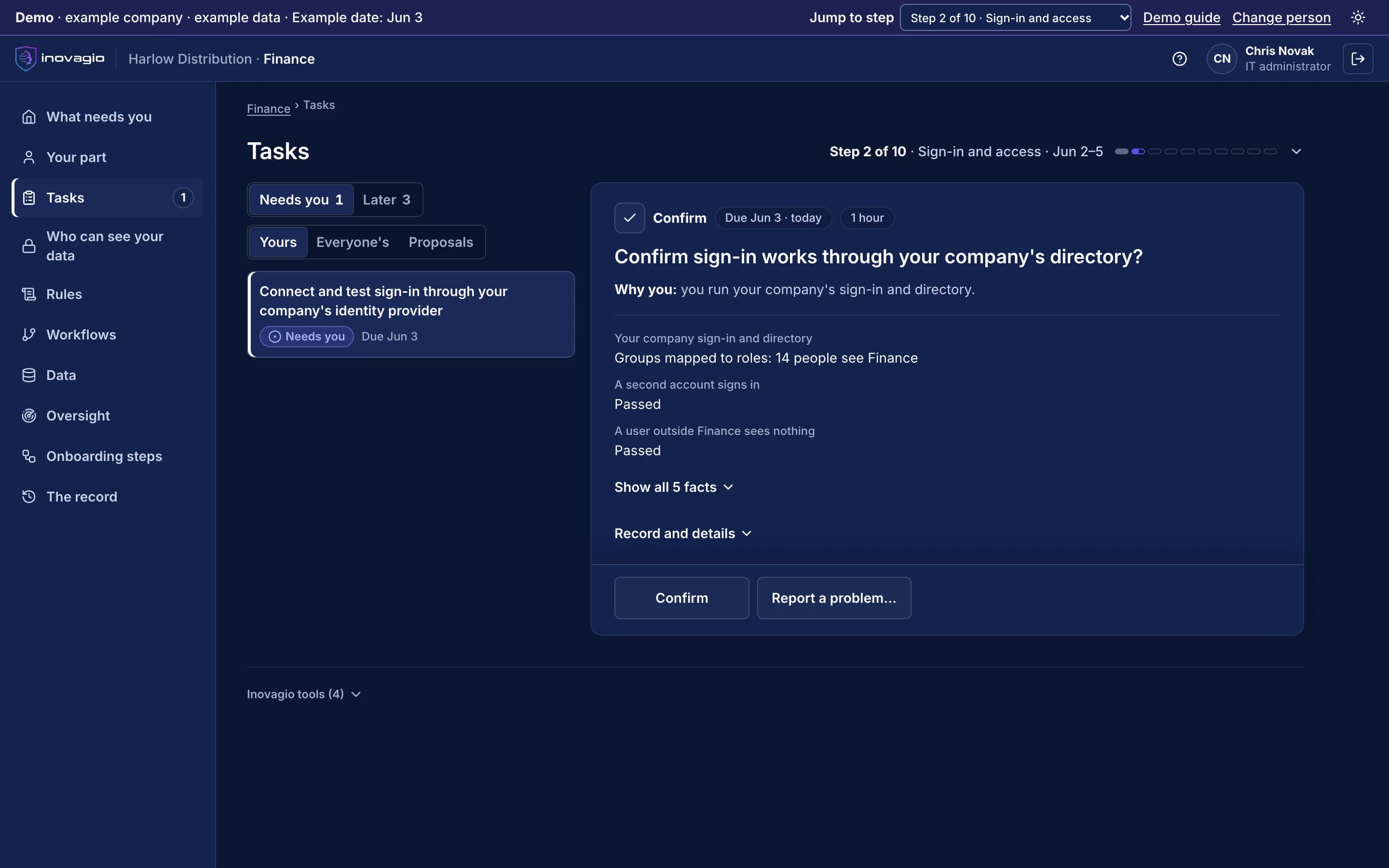
Auth › Sign-in: the sign-in tests run through the company’s own directory: a second account signs in, a user outside the department sees nothing, a forged account is refused, and a Virtual Employee starts with no access. Sample data from Inovagio’s example companies.
Everything Auth does, by area.
Protocols
- OIDC discovery and JWKS
- Authorization code with PKCE (S256 only)
- Client credentials with per-client grant control
- Refresh-token rotation with reuse detection
- Token exchange (RFC 8693)
- Device authorization grant (RFC 8628)
- Token introspection and revocation
- RP-initiated logout
Sign-in methods
- Passwords hashed with Argon2id
- TOTP with recovery codes and step-up
- Passkeys (WebAuthn registration and assertion)
- Magic links
- Social sign-in providers
- Enterprise OIDC federation
- SAML 2.0 federation with full assertion validation
Administration
- Tenant, user and application administration
- Role-based access with a fine-grained permission catalog
- No principal can administer a more privileged one
- OAuth consent screens
- Per-tenant branding of hosted sign-in pages
- SCIM 2.0 users, groups, filtering, PATCH and bulk
- Self-service signup and account recovery without user enumeration
Tokens and keys
- EdDSA (Ed25519), RS256 and ES256 signing, chosen per client
- Key rotation with overlap validation
- Tiered key custody: local, OS keystore, KMS or HSM
- Complete ID-token claims (at_hash, auth_time, azp)
- Discovery lists only what the server supports
What Auth replaces
Auth does the work of these, inside one platform with one identity, one policy and one record:
- Separate identity provider for internal apps
- Per-application user stores
- Shared admin passwords and static API secrets
- Manual account provisioning and offboarding
The controls Auth brings
Every Inovagio product keeps the same five commitments, because regulated work needs all five at once.
Security
Sign-in through your identity provider, with tokens signed and short-lived.
Governance
Roles and permissions for people, services and agents in one model.
On the record
Every sign-in, grant and change is recorded.
Monitoring
Sign-in activity and failures appear in Panoptes.
Cost per task
One identity service for every product, with no per-user charge.
Auth in your industry
Every industry runs the same ten steps, so Auth does the same job in each, on that industry’s own work.
- Financial servicesBanks, credit unions, lenders and insurersWorked example: Alder Ridge Community Bank · Example company
- Healthcare providersHealth systems, hospitals and physician groupsWorked example: Meridale Health · Example company
- Health plansMedicare Advantage, Medicaid and commercial plansWorked example: Ashgrove Health Plan · Example company
- LegalLaw firms and in-house legal teamsWorked example: Calloway Finch · Example company
- GovernmentState, county and city agenciesWorked example: City of Larkhaven · Example company
- DefenseDefense contractors and their suppliersWorked example: Keelstone Aerospace · Example company
- Finance operationsFinance teams in any industry
For developers: Auth at a glance
- Standards
- OpenID Connect, OAuth 2.0 with PKCE (RFC 7636), token exchange (RFC 8693), device grant (RFC 8628), SAML 2.0, SCIM 2.0 (RFC 7643/7644), WebAuthn
- Grants left out
- Implicit and resource-owner password, as OAuth 2.1 recommends
- Signing algorithms
- EdDSA (Ed25519), RS256, ES256
- Password hashing
- Argon2id
- Conformance
- Built to the OpenID Foundation Basic OP and Config OP profiles
- Identity store
- MNEMOS, event-sourced
- Platforms
- macOS, Linux and Windows servers
Auth in the platform.
Where Auth fits
One platformAgent HarnessAgent harness
Inovagio CLIInovagio DesktopWeb ChatInovagio SDK
OpsisExperience layer
FolioMorphe
Virtual EmployeesVirtual Employee layer
NexusErgon
SynesisKnowledge layer
PerceptionMNEMOS
OriginModel layer
Inference ServerForge
Phylax (this layer)Trust layer
Auth (this product)Inovagio SecretsGuard
OperationsOperations
PanoptesArchon
Platform servicesPlatform services
ServerAPI ManagementConnect
Further reading
Guides and posts on Auth
 Guide · GovernanceABA Formal Opinion 512: an AI checklist for law firmsABA Formal Opinion 512 applies the duties lawyers already have to generative AI. This guide turns competence, confidentiality, client communication, supervision and fees into questions a firm can answer, and lists what to ask of any AI tool before client work goes near it. · 5 min read
 Guide · GovernanceAI agents and CUI: keeping controlled information controlledThe federal rules for controlled unclassified information say who may see it, where it is kept and when it may be shared. An AI agent that reads a drawing or drafts a supplier letter has to follow them too. This guide covers what the rules ask and how to set up an agent that follows them. · 5 min read
 Article · GovernanceCan you turn your AI agents off? What examiners now askUS bank regulators have started asking how banks would shut their AI agents down, while the new model risk guidance leaves agents out of scope. Here's what examiners are asking, which deadlines arrive in Colorado and the EU, and what a working kill switch looks like. · updated November 18, 2026 · 11 min read
 Guide · GovernanceCSBS AI Supervisory Framework: a checklist for banksState examiners now have a framework for reviewing AI, with its own section on AI that takes actions on its own. The questions they are directed to ask, turned into a checklist, and the control in Inovagio that answers each one. · updated November 18, 2026 · 9 min read
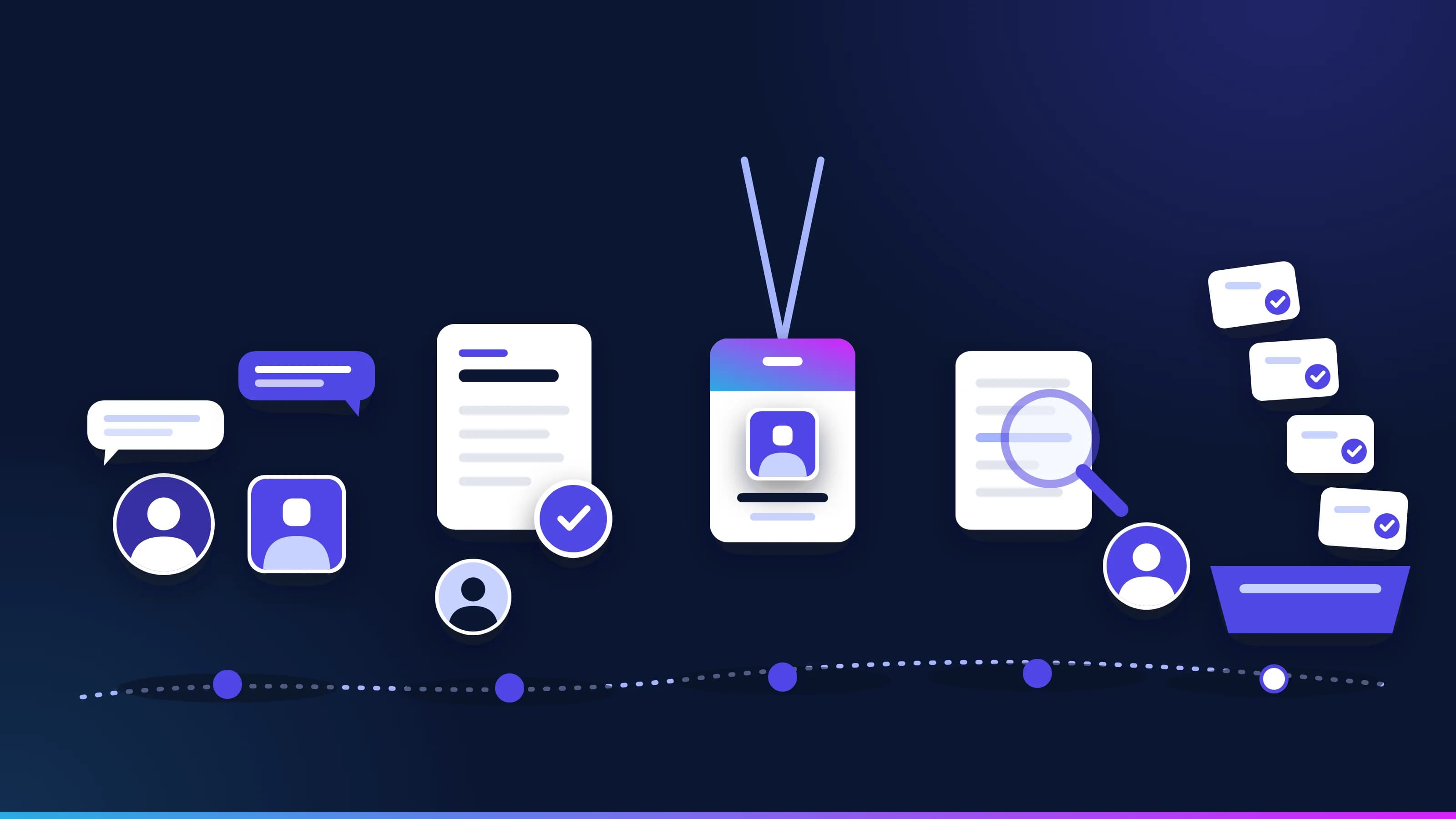 Article · OnboardingHow to onboard an AI employee, the way you hire a personA department hires a Virtual Employee using the same steps it uses for a person (interview, approval, account, a test and shadow mode, then the work). This is how to onboard AI employees so they earn the routine queue on evidence. · updated November 18, 2026 · 8 min read
 Article · GovernanceIs it safe to give AI a login?Work that crosses systems needs a login, and a login is what a security team guards hardest. These are the five controls that make a Virtual Employee safe to credential, how the kill switch works, and the one number a security team should watch. · updated November 18, 2026 · 8 min read
See Auth on one of your workflows.
Every project starts with one workflow your people know well, measured against what it costs you today.