

Series · The knowledge layer, explained
What is a context layer, and why do AI agents need one?
A context layer tells an AI agent what your words mean, which rules apply, which records it may open and what was decided before. Gartner now calls it a core part of data infrastructure, and Forrester the next step after semantic layers and knowledge graphs. Here is what goes in one, in plain words.
Inovagio team · Published · Updated · 11 min read
On this page
Ask an AI agent in a county records office how many public records requests are open, and it will write a query in seconds. Whether it counted the ones paused for clarification is anyone's guess. A context layer is what removes the guess: it's the part of your systems that tells an agent what your words mean, which rules apply, which records it may open and what your people decided before, so it answers the way an experienced colleague would.
Without one, the agent has your tables and its training. Those are rarely enough. A column called status with the value C could mean closed. It could just as easily mean clarification requested, and the model has no way to know which one your records team means.
In 2026 the analyst firms started calling this core infrastructure. The published research on accuracy backs them up. If you build these systems, the guide to context engineering for AI agents goes deeper into how each step's context is put together.
Why analysts started saying "context layer"
#The phrase moved into analyst research in 2026, through four statements over six months.
In May 2026, Gartner told data and analytics leaders that missing semantics (the business meaning behind the data) makes AI agents inaccurate and wastes money. Gartner predicts that by 2027, organizations that prioritize semantics in AI-ready data will increase agentic AI accuracy by up to 80% and reduce costs by up to 60%. Its advice was to make a context layer a core part of the data infrastructure, because "traditional schema-based data models alone no longer suffice for agentic AI" (Gartner, May 11, 2026). The same release says regulators will ask for more transparency about what data means. The May release names no product category. It describes a job to be done.
Forrester got more specific. Its analysts describe the context layer as the next step after semantic layers and knowledge graphs, combining the governed business meaning of the first with the ontology modeling of the second. It holds two kinds of thing: what a company knows (data, metadata, business concepts, policies and processes) and runtime context, meaning what happens as the work runs (events, decisions, actions and outcomes) (Forrester, August 20, 2026). Forrester says a report surveying context layer platforms is due at the end of 2026, with a vendor evaluation after it.
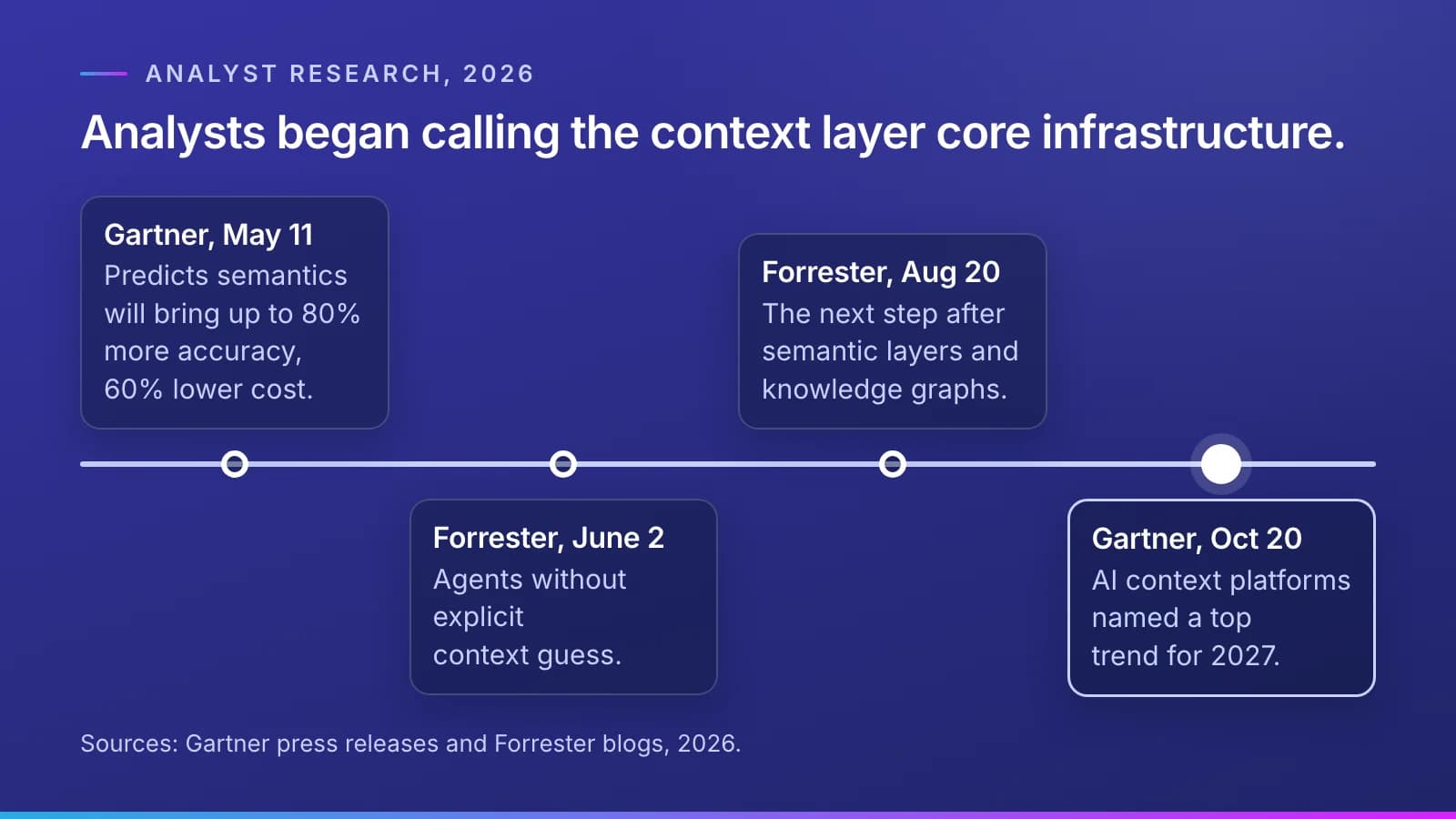
Then in October, Gartner put "AI context platforms" on its list of top strategic technology trends for 2027. The press release lists what goes wrong without a dedicated context layer: "overprivileged agents, compliance failures, low trust and excessive token consumption" (Gartner, October 20, 2026). Tokens are the units of text a model reads and is billed for, so the last item is a cost warning.
Two of those four risks are about permissions and money, not accuracy. That matters if you run a regulated business, and it's the part most vendor demos skip.
What a context layer holds
#Think about a strong new hire in their first month. They get a glossary of the department's terms, the procedures binder, access to the case files they need (and only those), a badge that opens some doors, and a senior colleague who remembers how last year's odd cases were settled. A context layer gives an AI agent the same five things, written down so software can use them.
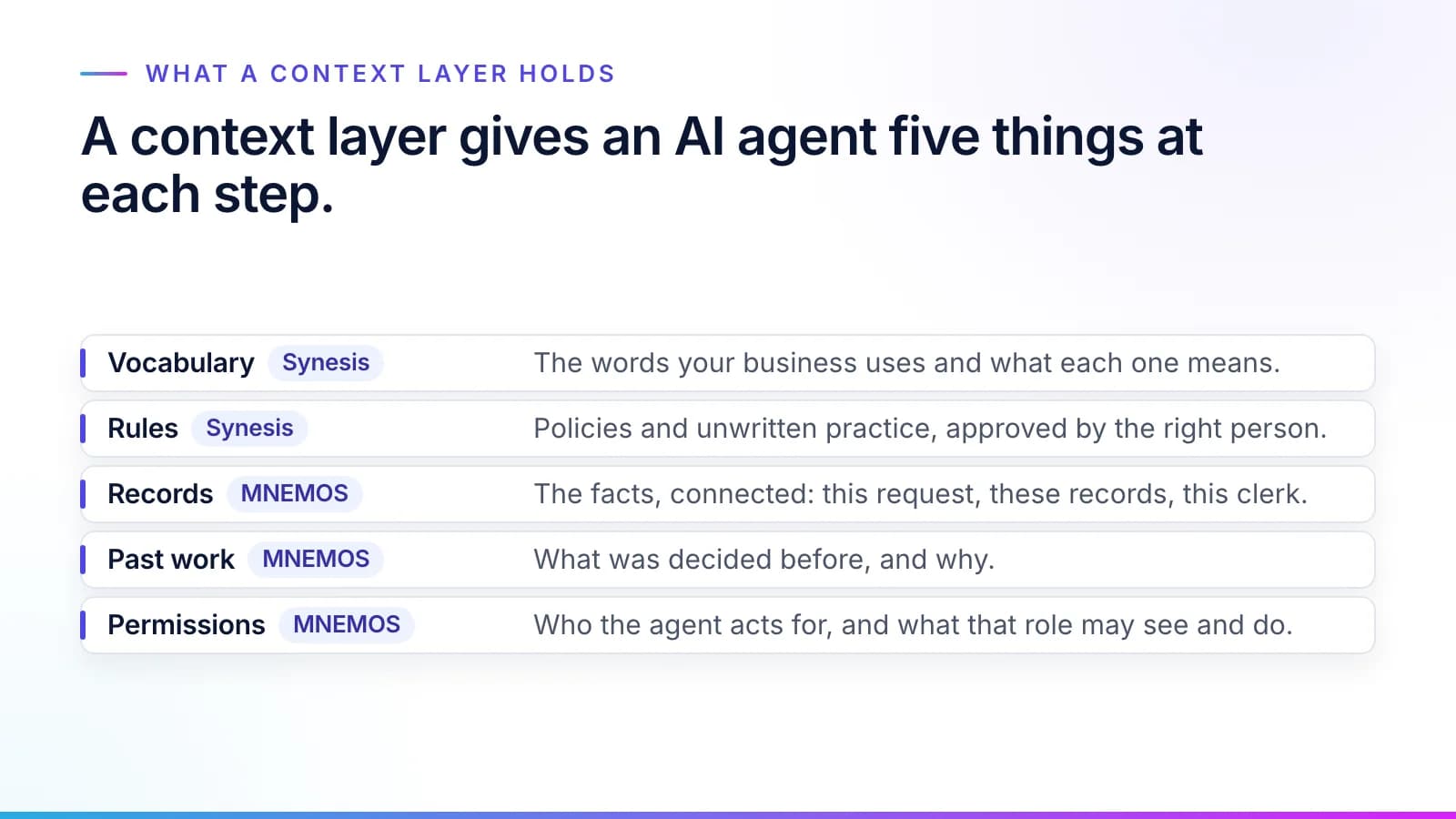
- Vocabulary. The words your business uses and what each one means. "Open request" gets one definition, and "client", "customer" and "account holder" are recorded as the same thing, or as different things if that's the truth.
- Rules. The policies and the unwritten practice, written as rules the right person has approved: when a payment waits for a second look, which variance the controller lets through at month end. These are business rules rather than AI guardrails, and an agent needs both kinds of check.
- Records. The facts themselves, connected: this request, for these records, held by this department, handled by this clerk.
- Past work. What was decided before and why. Forrester calls this runtime context; your team calls it "we tried that in March and the regulator didn't like it".
- Permissions. Who the agent is acting for, and what that person or role is allowed to see and do.
The agent shouldn't read all of it at once. A model has a limited working space, and filling it with everything makes answers worse, a problem engineers call context rot. A good context layer hands over the few items that apply to the step at hand.
What goes wrong without one
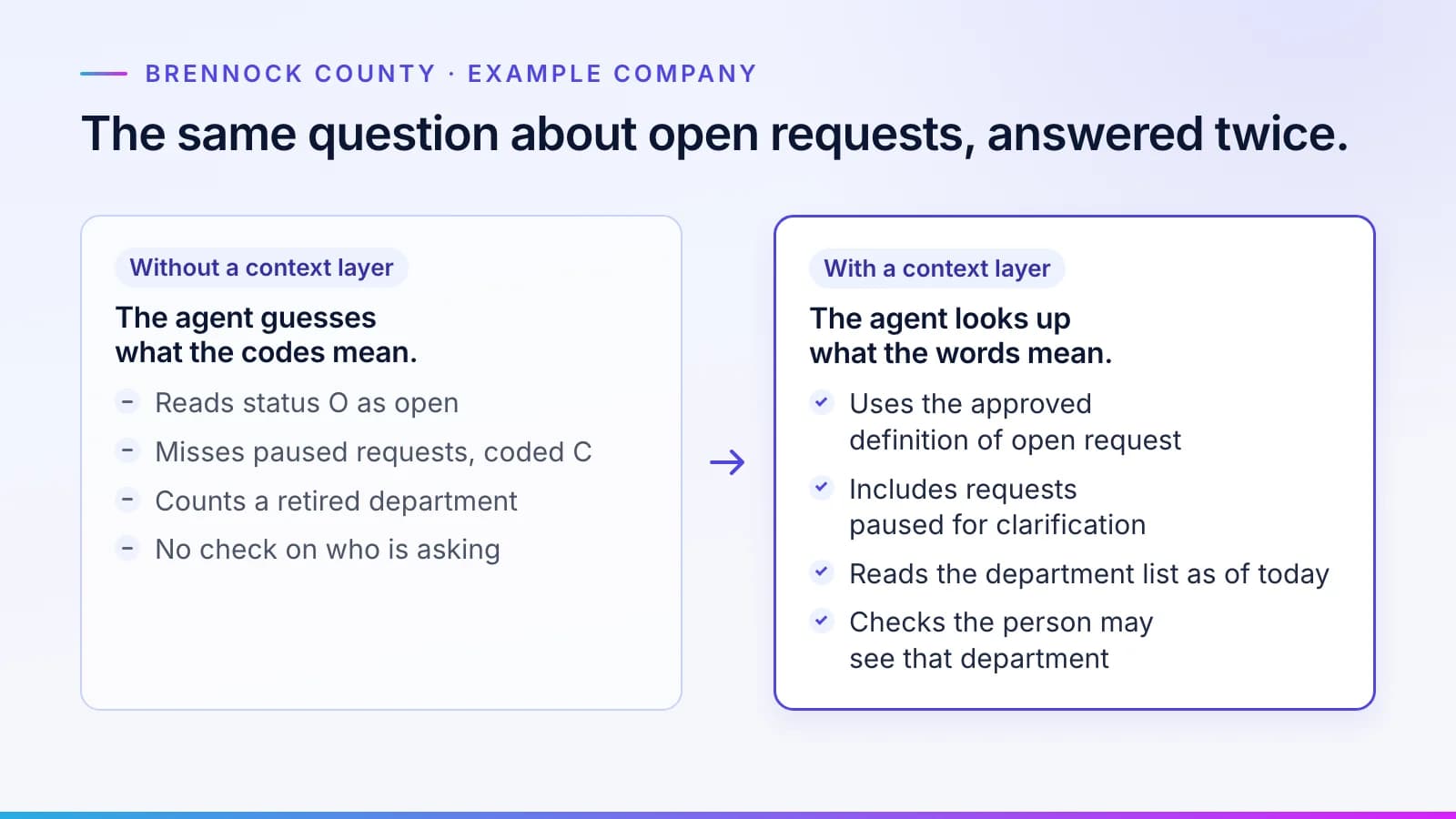
#Here is a small case. The records office at Brennock County asks an agent how many public records requests are open for the public works department. The county's case system has a requests table with a department column and that one-letter status field. (Brennock County · Example company)
The agent without a context layer guesses that status = 'O' means open. It misses the requests paused while the office waits for a requester to narrow them (coded C), and it counts a department code the county retired last year when two divisions merged. The number looks plausible, so nobody checks it.
The agent with a context layer looks up "open request" in the approved vocabulary. It finds that the term includes requests paused for clarification and excludes requests whose records are released and only waiting to be collected. It reads the department list as of today, and it checks that the person asking may see that department's requests at all, since some of them concern police records. The answer comes back with its definition attached.
This isn't a made-up failure. In a June 2026 post on semantics, Forrester's analysts say of agents without explicit meaning, "Without explicit context, they guess", and list wrong joins and misread metrics as the result (Forrester, June 2, 2026). A join is how a query links two tables; a wrong one quietly doubles or drops rows.
What the research says it does to accuracy
#The strongest evidence started with insurance data, of all places.
Juan Sequeda and Dean Allemang, working with Bryon Jacob, built a benchmark on an insurance database and tested a leading model of 2023 against it. The model answered 16% of business questions correctly from the raw tables and 54% from a knowledge graph of the same data (Sequeda, Allemang and Jacob, arXiv, November 13, 2023). The knowledge graph held the same records, connected according to an agreed model of the business. A knowledge graph, in everyday terms, is the difference between a pile of index cards and a map of how they connect.
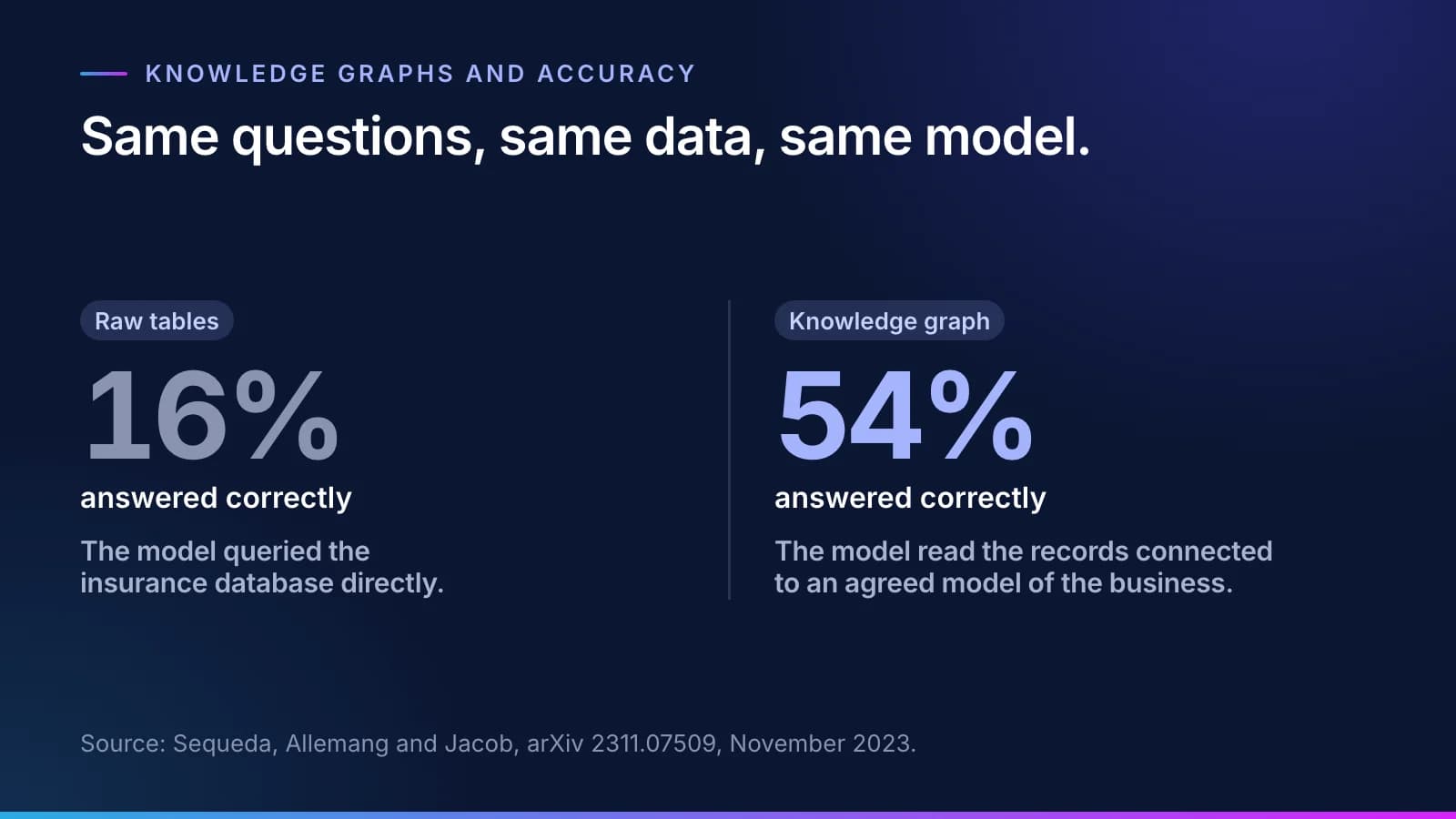
A follow-up added a check: before running a query, the system tested it against the ontology, the written model of which things can relate to which, and sent a failing query back to the model with the reason to repair it. The share of answers that were either right or an honest "I don't know" rose from 54% to 72%, with "I don't know" making up 8 points of it, so the error rate fell to 20% (Allemang and Sequeda, arXiv, May 20, 2024). For a regulated business that second figure matters as much as the first. A refusal goes to a person. A wrong number goes into a report.
The effect hasn't faded as models improved. In April 2026, two researchers tested three frontier models on 100 retail analytics questions. A four-kilobyte document describing the data's measures, naming conventions and how to tell similar terms apart added 17 to 23 points of accuracy to every model. With or without it, the three models scored within a few points of one another, too close to separate statistically (Rumiantsau and Fokeev, arXiv, April 28, 2026). The document moved accuracy far more than the choice of model did.
Two cautions. These are question-answering tests over databases, not full workflows. And the 2026 paper is a preprint, not yet peer reviewed. Still, the direction has held across three years of models.
Context layer vs semantic layer vs knowledge graph
#Most companies own pieces of a context layer already. The pieces just don't talk to each other, and the agent can't see most of them.
| You may have | What it does | What it leaves out |
|---|---|---|
| A business glossary or data catalog | Lists terms and where data lives | Rules, permissions, past decisions |
| A semantic layer | Gives each measure, like revenue or days to close, one approved formula over the tables | Concepts outside reporting, and rules for actions |
| A document search tool | Finds passages that resemble a question | Whether a passage is current, approved or allowed |
| A policy manual | States the rules in prose | Anything a machine can apply or check |
A semantic layer is the closest relative, and Forrester calls it the right place to start. The guide to semantic layers for AI agents covers how one works. An ontology goes further, describing the things the business deals with and the rules between them, not only its measures. A knowledge graph connects your actual records under that ontology. The context layer is everything an agent draws on at each step, including what those leave out: permissions and past decisions. Our plain-English piece on taxonomy vs ontology vs knowledge graph explains each rung of that ladder with one example carried through.
How Inovagio builds one
#We split the job across two products that share one record of approvals.
Synesis, the knowledge layer, builds the meaning. Our agents interview the people who do the work and read the records. Then they draft terms and rules as candidates, each with a confidence score, and each one passes its stage's checks and approvals before any Virtual Employee uses it. Knowledge moves through five gated stages: vocabulary, taxonomy, thesaurus, ontology, knowledge graph.
You choose who approves each stage and each kind of rule: often a department head for their own area's terms, and a governance body or compliance for the ontology and for rules that touch regulated decisions, which can require more than one approver.
Measures like days to close are kept as governed metrics bound to the tables that hold the data. The pillar guide on ontology for AI agents walks through the five stages and the standards behind them.
MNEMOS, the data engine, holds the records and the agents' memory, and it enforces who may see what. It keeps five layers of agent memory (raw, working, episodic, semantic, and memory shared by the Virtual Employees on one queue), runs hybrid keyword and vector retrieval and graph queries, and trims every result to the documents the signed-in person may see.
Every record is bound to its tenant in code. Memory isn't the rulebook, though. What a Virtual Employee learns from its own work can be proposed as knowledge, but only the right person can approve it.
When to walk the graph and when plain search is enough is the subject of our guide to how AI agents use your knowledge graph.
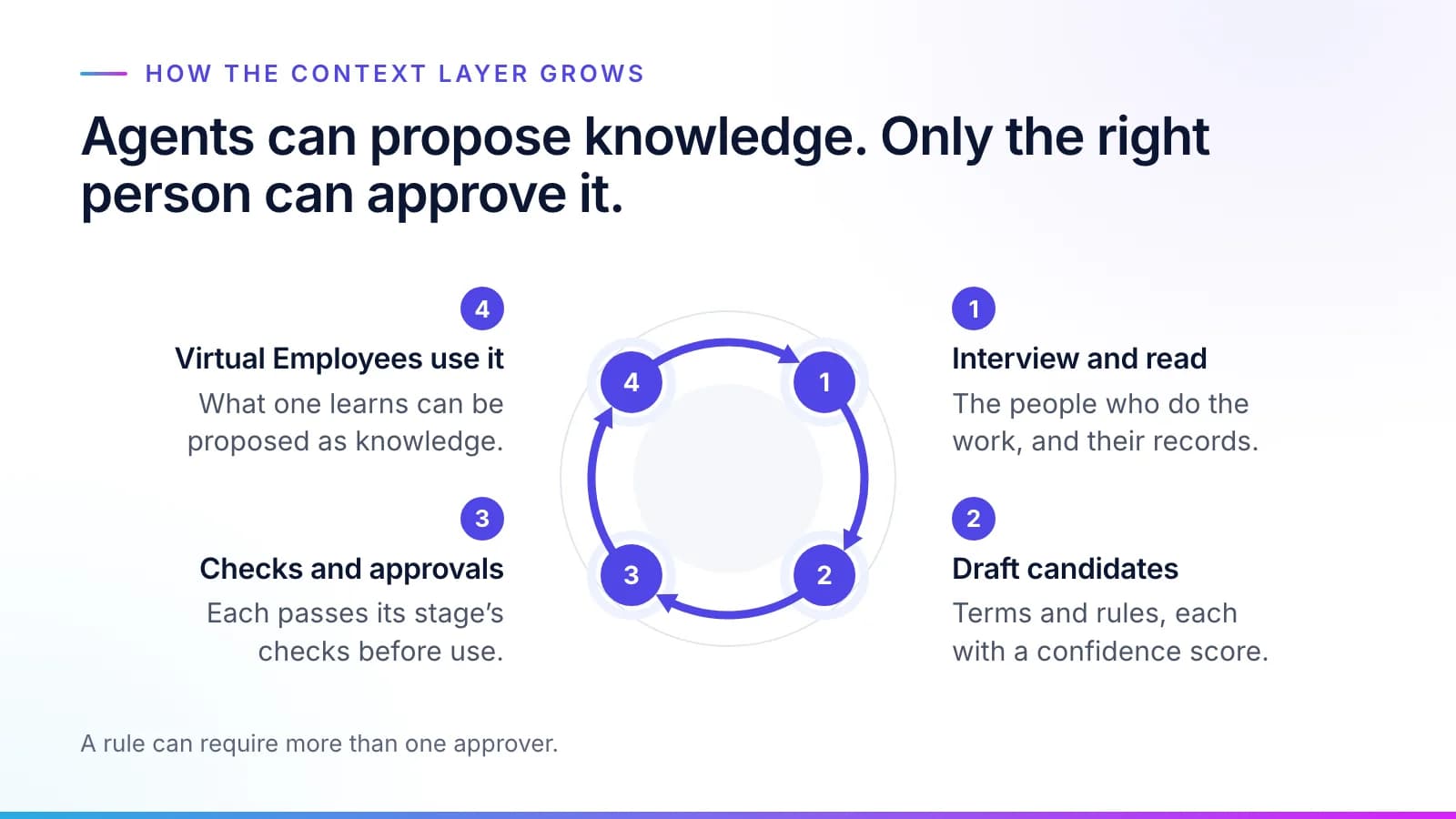
At each step, a Virtual Employee gets the approved definitions, the rules that apply, the records it may read and the relevant past decisions, and little else. Agents look up approved facts instead of re-reading long documents, and the AI each task uses is measured for every knowledge version before it publishes. The vocabulary, ontology and rules export free in open standards (SKOS, OWL and SHACL), so the context layer stays yours whoever runs the models. The architecture page shows where both products sit.
Where to start
#Don't start with a company-wide ontology. Forrester's own assessment is that most organizations aren't yet ready to build a knowledge graph, and they're right.
Start with one queue and write down its vocabulary: the few dozen terms the team argues about. Then write down the rules people apply to them, each approved by the person you make responsible for it. That covers the first two of the five things, and it's close to what the four-kilobyte document in the 2026 study held. The other three come from systems you already run. Our guide to picking your first queue covers how to choose one, and why the knowledge build stalls covers what slows it down when people try to do it with workshops. The records count as much as the words: data hygiene for AI covers keeping them clean enough for an agent to act on.
If you want to see the whole picture in one place, our knowledge layer questions and answers collects the questions buyers and architects ask most.
Further reading
#- Gartner, Gartner Says Lack of Semantics Causes Inaccurate AI Agents and Wasted Spending, press release, May 11, 2026.
- Gartner, Gartner Identifies the Top Strategic Technology Trends for 2027, press release, October 20, 2026.
- Forrester, Build Meaning Before Machines: Why Semantics, Ontologies, And Knowledge Graphs Matter For Agentic AI, June 2, 2026.
- Forrester, The Next Evolution Of AI Will Rely On Context Layers, August 20, 2026.
- Sequeda, Allemang and Jacob, A Benchmark to Understand the Role of Knowledge Graphs on Large Language Model's Accuracy for Question Answering on Enterprise SQL Databases, arXiv, November 13, 2023.
- Allemang and Sequeda, Increasing the LLM Accuracy for Question Answering: Ontologies to the Rescue, arXiv, May 20, 2024.
- Rumiantsau and Fokeev, Semantic Layers for Reliable LLM-Powered Data Analytics, arXiv preprint, April 28, 2026.
Questions
What people ask.
What is a context layer in AI?
A context layer is the part of a company's systems that gives an AI agent the business meaning it needs at each step: the vocabulary, the approved rules, the connected records, past decisions and the permissions that apply. It lets the agent answer the way an experienced employee would instead of guessing from table and column names.
Is a context layer the same as a semantic layer?
No. A semantic layer gives each business measure one approved formula over the data, which helps with numbers and reports. A context layer includes that and adds the rules, the relationships between things, past decisions and permissions. Forrester describes the context layer as the next step after semantic layers and knowledge graphs.
Do we need a knowledge graph before we can use AI agents?
Usually not on day one. Most of the measured gains come from writing down the vocabulary and the rules for one area of work and having the right people approve them. A knowledge graph becomes worth building when agents have to follow connections across many records, such as a contract to its supplier to that supplier's parent company.
What does Gartner say about the context layer?
In May 2026 Gartner recommended making a context layer a core part of data and analytics infrastructure. Gartner predicts that by 2027, organizations that prioritize semantics in AI-ready data will increase agentic AI accuracy by up to 80% and reduce costs by up to 60%. In October 2026 it named AI context platforms one of its top strategic technology trends for 2027.
How does a context layer keep agents from seeing data they shouldn't?
Permissions are one of the things it holds. Every request carries the identity of the person or role the agent is acting for, and results are trimmed to the records that identity may see before the agent reads them. Records are also bound to their tenant, so one customer's data never reaches another's agent.
How long does it take to build a context layer?
It depends on the scope, which is why it's best started with one queue. The vocabulary and rules for a single team's work are a far smaller job than a company-wide model, and the people who approve them are a handful your organization names. A test on your own past cases shows how much accuracy it adds before anything grows wider.
The products, industries and examples it covers.
- Knowledge layerSynesisTurns your policies, procedures, records and your people’s know-how into a rulebook your experts approve, which you own and can take anywhere.
- Data engineMNEMOSRecords, documents, vectors, graph and agent memory in one engine, with a ledger behind every write.
- IndustryGovernmentPermit applications checked against your code and checklist before the review deadline, and records requests prepared with proposed redactions for staff to approve.
- OverviewHow it worksTen checked steps from your first decision to the day it handles real cases.
- OverviewArchitectureHow the platform fits together, from your data to finished work.
Read next.
 Guide · Context engineeringContext engineering for enterprise AI agentsContext engineering decides what an AI agent sees at each step of a task. The research on why long contexts fail, the techniques that keep context small, how agent memory fits in, and the controls that stop context from becoming an attack path. · updated November 18, 2026 · 18 min read
 Guide · OntologyOntology for AI agents: how to build one in five stagesHow to build an ontology AI agents can use, in five gated stages from a controlled vocabulary to a knowledge graph. The W3C standards for each stage, competency questions, Turtle and SPARQL for a worked example, entity resolution, versioning and "as of" queries. · updated November 18, 2026 · 21 min read
 Guide · Semantic layerSemantic layer for AI agents: governed metrics for accurate answersA semantic layer defines each business metric once, with its joins and its owner, so an AI agent asks for "credit note rate" instead of writing its own SQL. What the 2023 to 2026 benchmarks show, a worked metric definition, the open Ossie standard and where MCP fits. · updated November 20, 2026 · 14 min read
See it on your work
See how one of your tasks runs, start to finish.
A 30-minute walkthrough of one of your workflows, the approval step and the audit record, with the people who build the platform.