

OriginModels
Choose your model, and where it runs.
Open models on your hardware or a frontier model, behind one API. Switch models without rewriting a workflow.
We’ll spend 30 minutes with you on one of your workflows, and you don’t need to share any data.
- Synesis
- Virtual Employees
- Agent Harness
- Opsis
- Origin
- Phylax
- Operations
- Platform services
Routing rules
The smallest model that meets each task’s quality bar · every fallback declared here and recorded on the task
| Task type | First choice | Keep on our servers |
|---|---|---|
| New matter intake | Small · 8B | |
| Conflicts search | Small · 8B | |
| Contract review | Mid-size · 30B | |
| Engagement letters | Firm model · tuned | |
| Public research | Mid-size · 30B |
Why a task moves up a tier
Confidence under 0.8
Document over 40 pages
Privileged material
Stays on firm servers
Share by tier, this week
- Small · 8B64%
- Mid-size · 30B29%
- Firm model7%
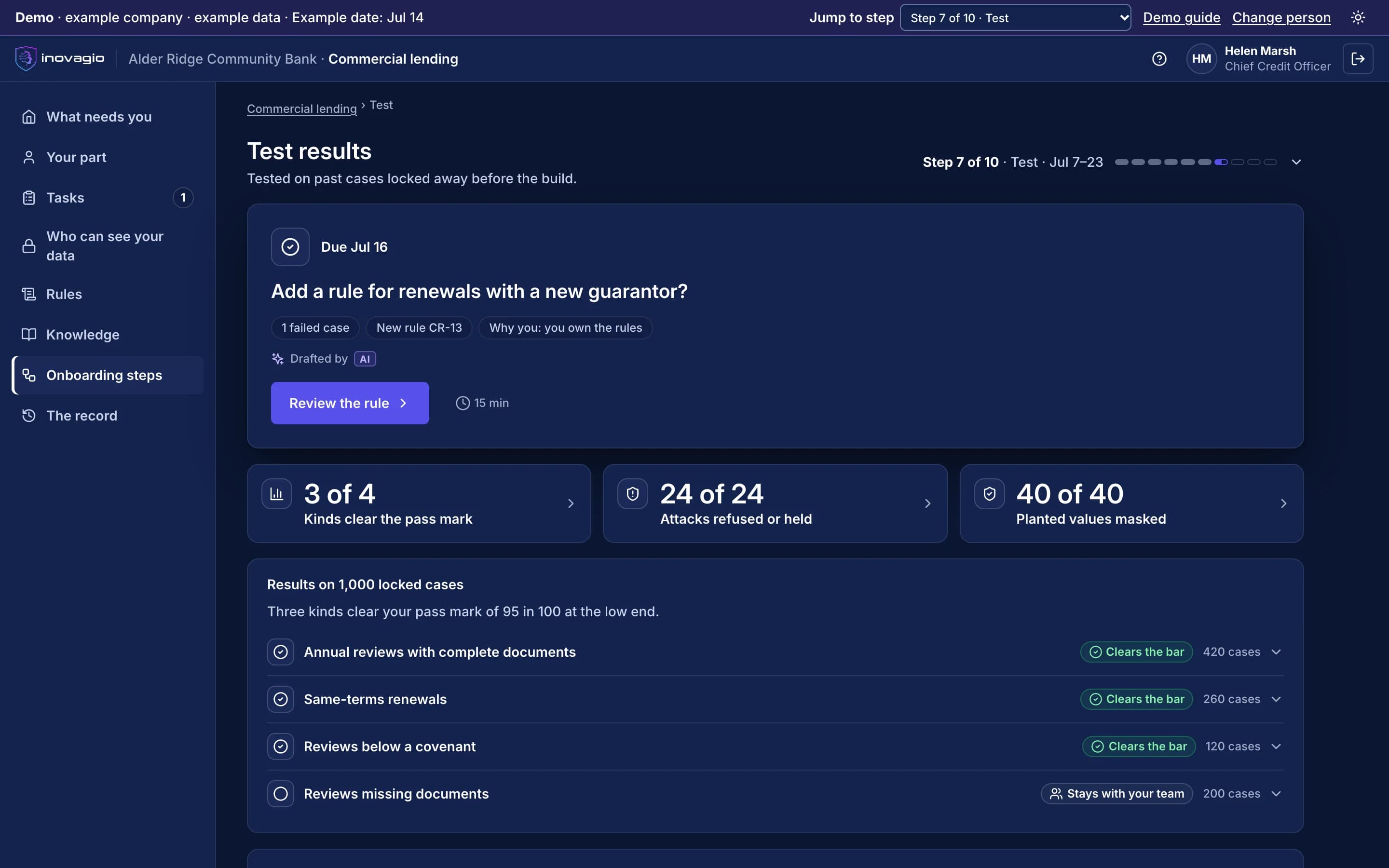
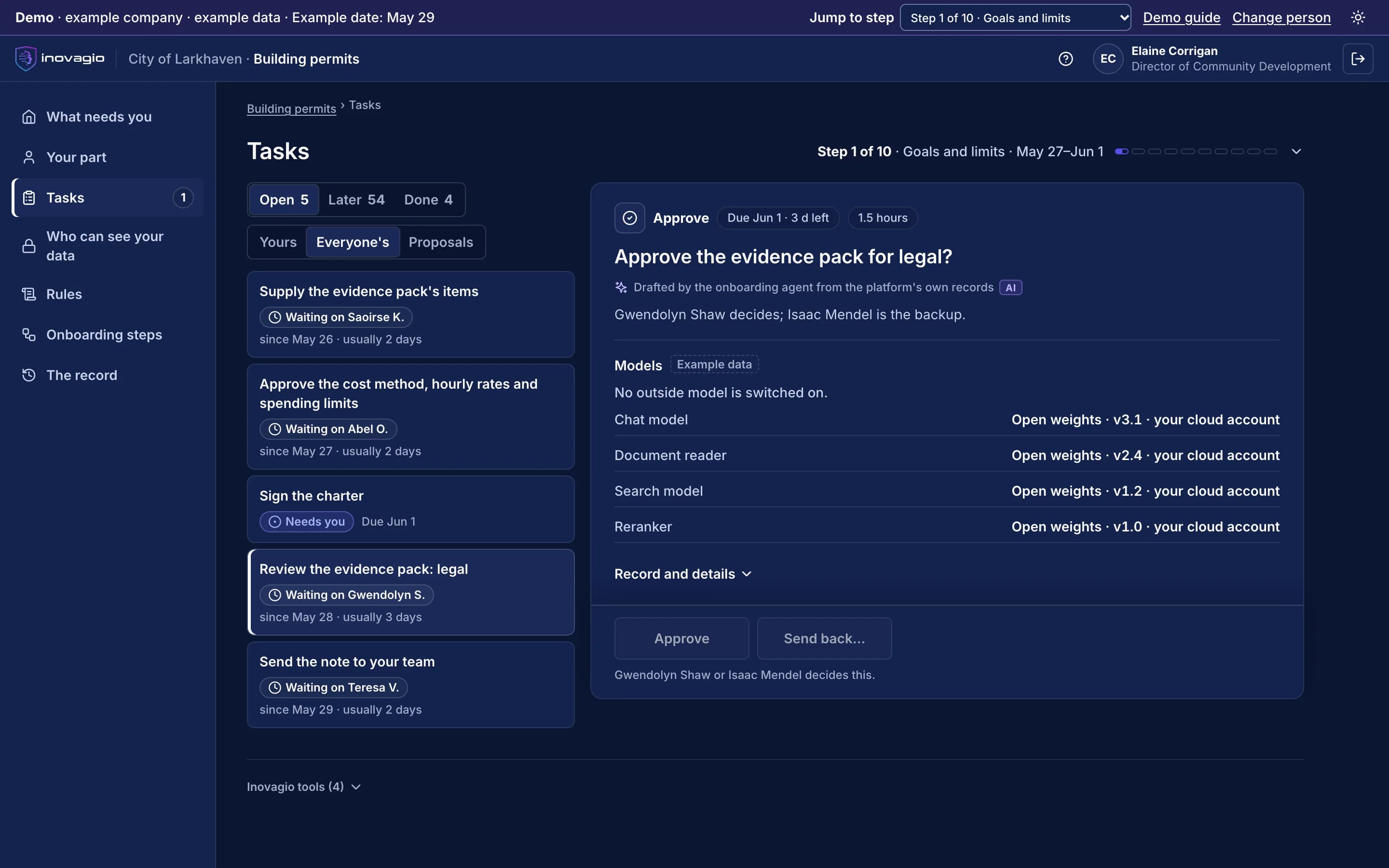
Origin › Models: the models listed in an evidence pack for legal review, for chat, reading documents, search and reranking, each with open weights, its version and where it runs, with no outside model switched on. Sample data from Inovagio’s example companies.
Where Origin works
Lists the models you may use and scores them per task (Origin). These are the onboarding steps it works in, from your first decision to live work.
What Origin does
Origin is Inovagio’s model layer: our own inference engine runs open models on your hardware, or routes to a frontier model, behind one API.
Our own inference engine
Built from the ground up, from model format and compression to GPU code, so your models run on hardware you control.
Open or frontier
Run leading open-weight model families on your own hardware, or a frontier model, through the same API.
Small task models
Train compact models on your own approved results for the tasks you run most, scored on your own cases before any task switches.
Cost on every call
Every request carries its cost, so you see what each task spent on models.
The products that make up Origin.
Origin
- Inference ServerModel servingRun open models, small to large, on hardware you control.
- ForgeModel trainingTrain task-specific models on your data, with the evidence built in.
What you get with Origin
Where models run
On your hardware, in your cloud, or hosted for you.
Changing models
Switch behind one API; the new model is re-scored on your approved results before it goes live.
Serving open models
Built into the platform.
Model cost
Cost per task, recorded on every call.
What Origin replaces
Origin does the work of these, inside one platform with one identity, one policy and one record:
- Separate inference servers for chat, embeddings and reranking
- Hosted model APIs for workloads that must stay private
- Model routing and gateway layers
- Standalone embedding and reranking services
- Tokenizer libraries and services
The controls Origin brings
Every Inovagio product keeps the same five commitments, because regulated work needs all five at once.
Security
Prompts and records stay on hardware you control; each request is bound to its tenant.
Governance
Which model may serve which task is set by policy.
On the record
Every call is recorded with its model, tokens and cost.
Monitoring
Latency, throughput and errors per model in Panoptes.
Cost per task
Small models you own take the routine work; frontier models only when you choose.
Origin in your industry
Every industry runs the same ten steps, so Origin does the same job in each, on that industry’s own work.
- Financial servicesBanks, credit unions, lenders and insurersWorked example: Alder Ridge Community Bank · Example company
- Healthcare providersHealth systems, hospitals and physician groupsWorked example: Meridale Health · Example company
- Health plansMedicare Advantage, Medicaid and commercial plansWorked example: Ashgrove Health Plan · Example company
- LegalLaw firms and in-house legal teamsWorked example: Calloway Finch · Example company
- GovernmentState, county and city agenciesWorked example: City of Larkhaven · Example company
- DefenseDefense contractors and their suppliersWorked example: Keelstone Aerospace · Example company
- Finance operationsFinance teams in any industry
For developers: Origin at a glance
- Interfaces
- Native Inovagio API over REST with server-sent-event streaming, and gRPC
- Platforms
- macOS (Apple silicon), Linux and Windows servers
- Deployment
- One inovagio app on a laptop or workstation, a private server, or multi-GPU cloud nodes
Origin in the platform.
Where Origin fits
One platformAgent HarnessAgent harness
Inovagio CLIInovagio DesktopWeb ChatInovagio SDK
OpsisExperience layer
FolioMorphe
Virtual EmployeesVirtual Employee layer
NexusErgon
SynesisKnowledge layer
PerceptionMNEMOS
Origin (this layer)Model layer
Inference ServerForge
PhylaxTrust layer
AuthInovagio SecretsGuard
OperationsOperations
PanoptesArchon
Platform servicesPlatform services
ServerAPI ManagementConnect
Questions
Origin questions
Can we run everything without sending data to a model vendor?
Yes. Origin runs open models on your own hardware, so prompts and records stay in your environment unless your policy routes a task to a frontier model you chose.
Do we lose quality with open models?
On well-defined tasks, small open models trained on your approved results often match large ones, and you see the score on your own cases before anything switches. Chosen tasks can still go to a frontier model through the same API.
Guides and posts on Origin
 Article · OwnershipForward-deployed engineers: what you should ownMore AI vendors now send forward-deployed engineers to build inside your company, and Gartner predicts most of those systems will be abandoned. Here's what leaves with the engineers, what to write into the contract, and what you should own on the day they go. · updated November 20, 2026 · 9 min read
 Guide · KnowledgeKnowledge layer: questions and answersStraight answers to the questions buyers and architects ask about the knowledge layer for AI agents, from ontologies, knowledge graphs and semantic layers to context engineering, GraphRAG, semantic caching, small models and who owns it all. · updated November 18, 2026 · 12 min read
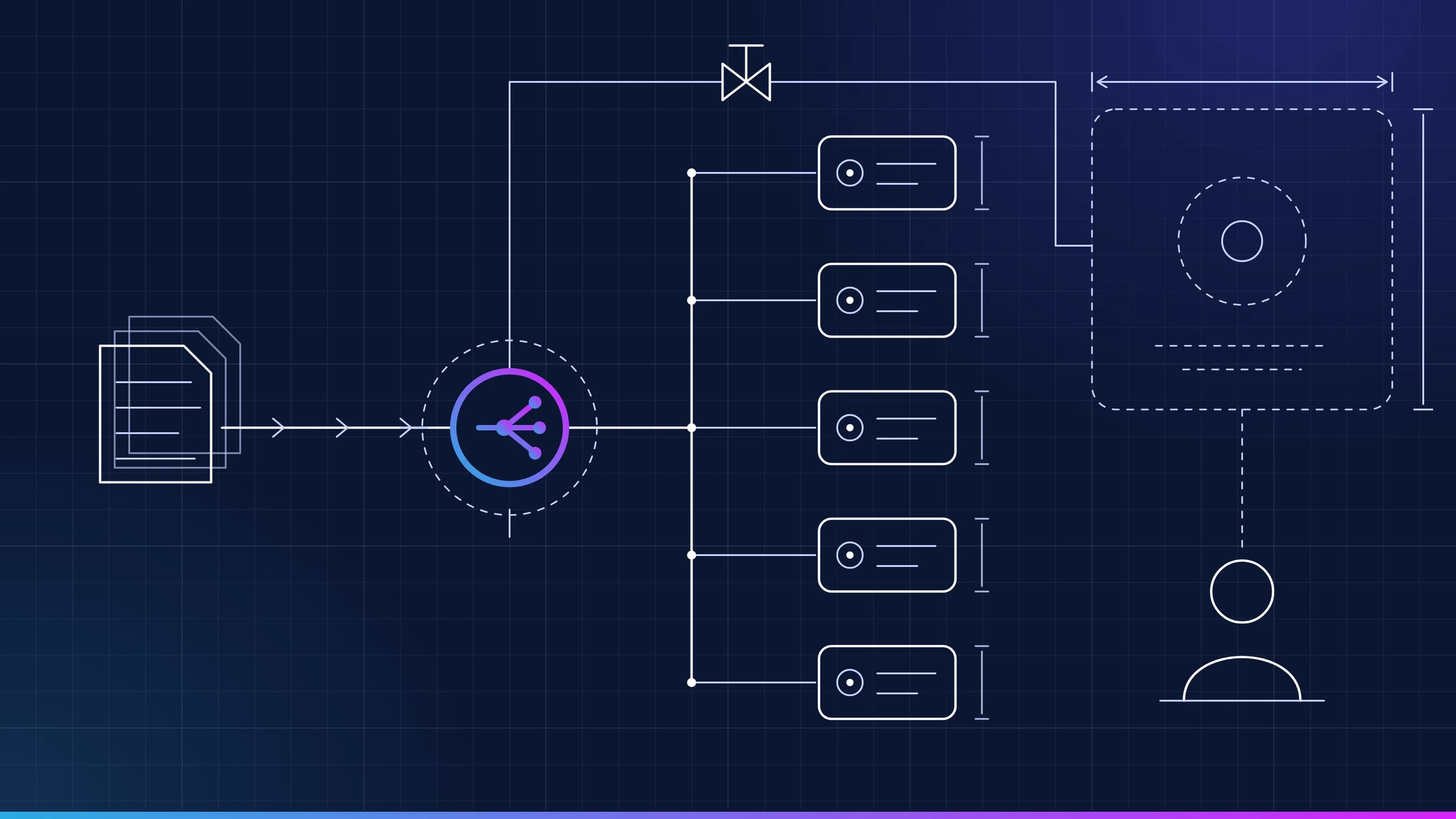 Guide · Small language modelsSLMs for enterprise AI agents: routing, fine-tuning and limitsHow to move an enterprise agent's routine model calls to small language models without losing accuracy: the published conversion method, routing and escalation, LoRA fine-tuning, the gates a model passes before it serves, hardware sizing with worked numbers, and where small models still fail. · updated November 18, 2026 · 18 min read
 Article · Small language modelsSmall language models: why smaller AI does most business workMost steps an AI agent takes at work are narrow, like reading a field or sorting a document. A small language model can do them on your own server. Here's what the research says about how much work fits one, and where small models still fall short. · updated November 18, 2026 · 10 min read
 Article · ModelsThe model is a replaceable partThe best AI model this quarter won't be the best next quarter. When you can switch AI models without touching your rules, approvals or audit record, every better model shows up on the scoreboard in your cost per correct task. · updated November 20, 2026 · 7 min read
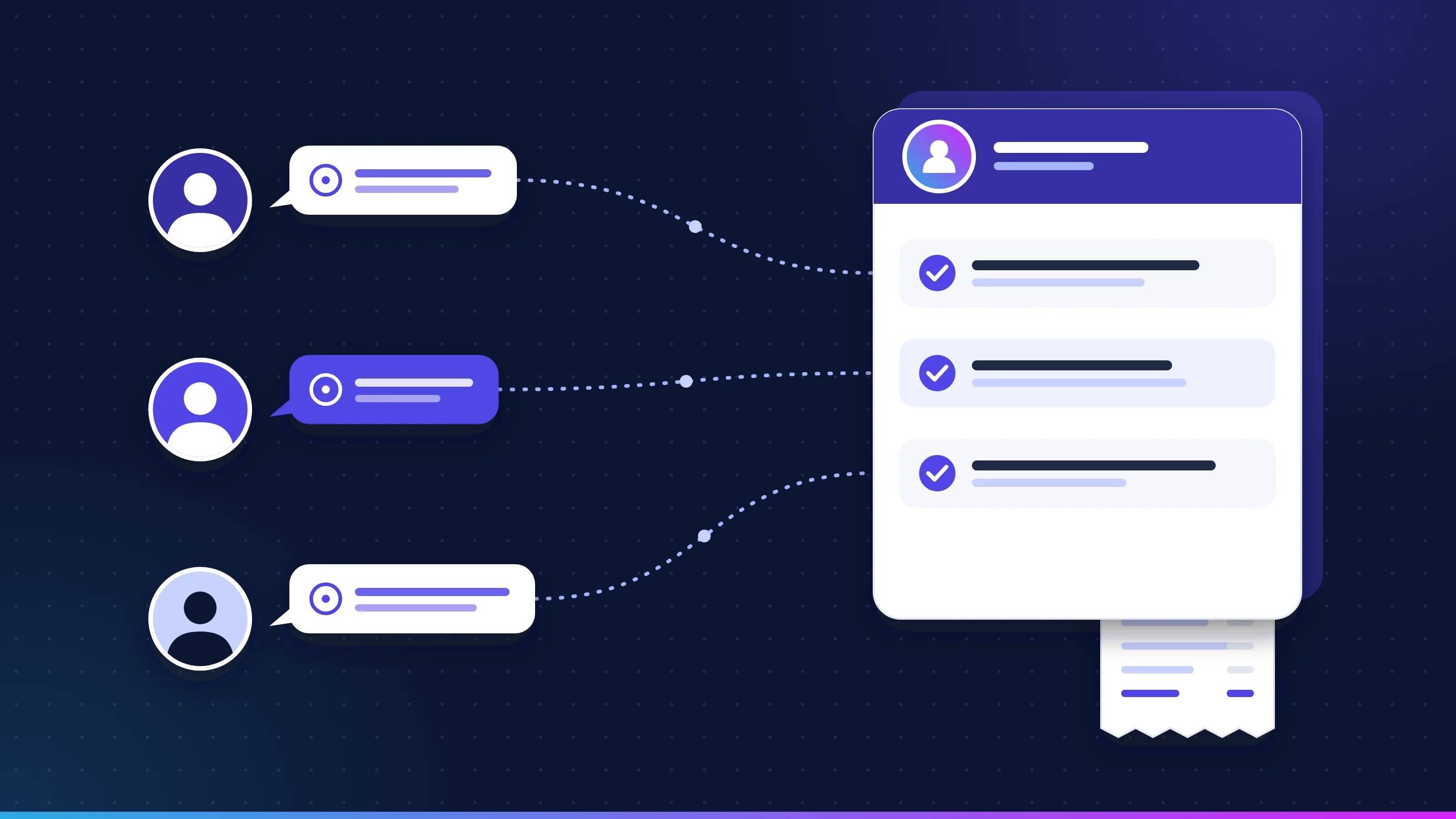 Guide · ApproachVirtual Employees: questions and answersStraight answers to what buyers ask about Virtual Employees, including what they are, how they learn your rules, what they never do, who owns what, where they run, how cost is measured, and how they differ from AI assistants. · updated November 18, 2026 · 12 min read
See Origin on one of your workflows.
Every project starts with one workflow your people know well, measured against what it costs you today.