MNEMOSData engine
One engine for every kind of data your agents need.
Tables, documents, vectors, search, graph and agent memory in one engine, reached by the drivers your teams already use.
We’ll spend 30 minutes with you on one of your workflows, and you don’t need to share any data.
Where MNEMOS works
Holds your records, documents, how they connect, the queues and every decision (MNEMOS). These are the onboarding steps it works in, from your first decision to live work, and after go-live.
- Step 0 · AccountOpen your accountRemoves: The open-ended vendor login.
- Step 4 · DataCheck, protect and prove the dataRemoves: The data surprise after go-live.
- Step 5 · LearnLearn from your peopleRemoves: Know-how that lives in a few people’s heads.
- After go-live · The recordOperate: watch, re-test, decideRemoves: Silent drift, and spend nobody can justify.
What MNEMOS does
MNEMOS is Inovagio’s data engine: SQL, documents, vectors, search, graph, queues and agent memory in one engine, with an audit ledger behind every write.
Every data model
Tables, documents, vectors, full-text search, graph, queues and agent memory share one engine and one transaction.
Speaks your protocols
Connect with the drivers your teams already use: MNEMOS speaks the Postgres, TDS, openCypher graph and Redis wire protocols, or use the native client.
A ledger behind every write
Writes are recorded in a hash-chained audit ledger, so every data change can be proven.
Isolated per tenant
Every record is bound to the signed-in identity’s tenant, in code; any attempt to read across it is refused and recorded.
MNEMOS at work
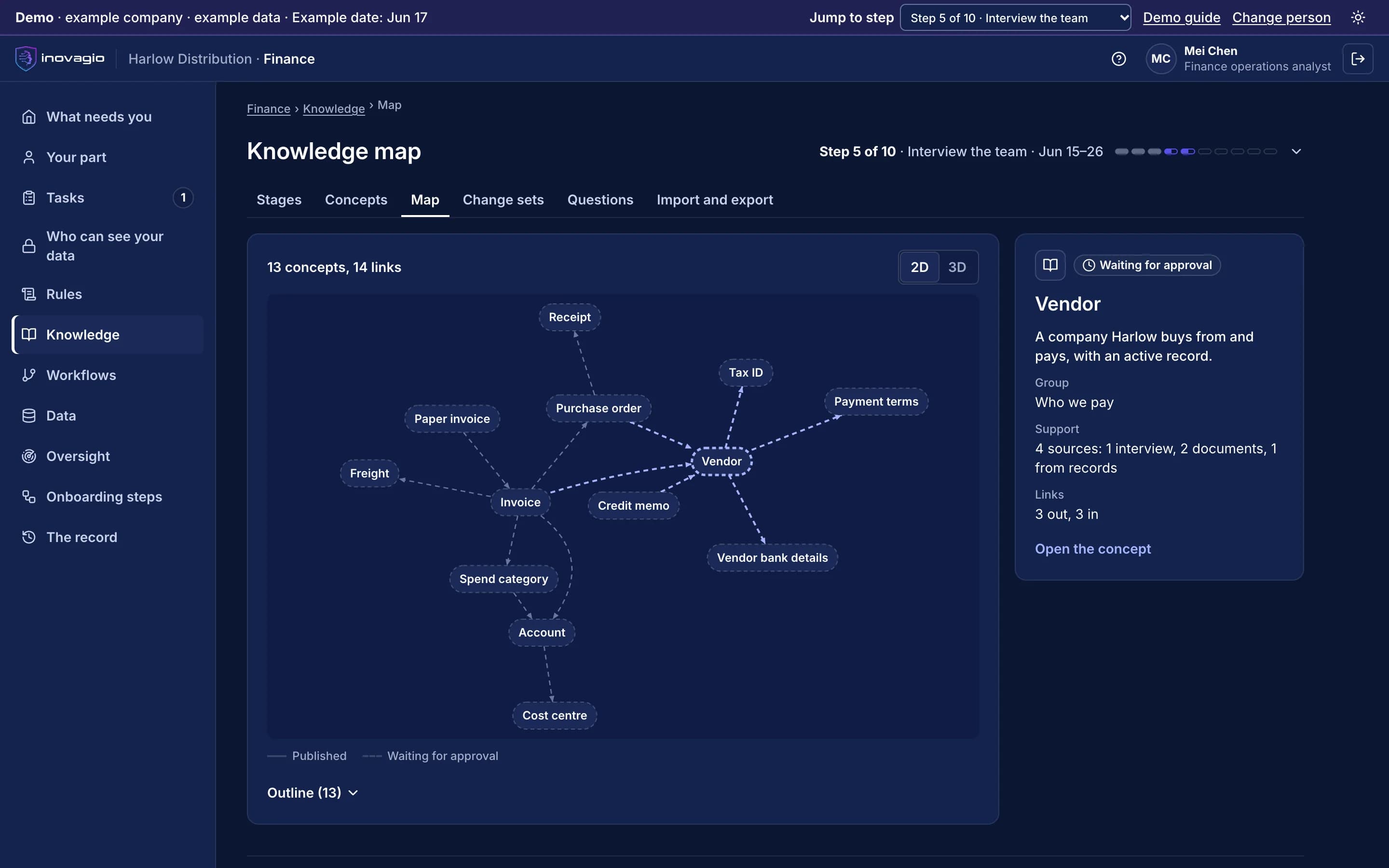
In the App at step 5: Learn from your people.
- 13 concepts and 14 links, from invoices and purchase orders to vendor bank details.
- Each concept shows what supports it: an interview, documents and records.
- Concepts and links wait for approval before they are published.
The model, and the records it describes.
A claims department’s semantic model (its ontology classes, taxonomy and vocabulary) kept in MNEMOS, and the knowledge graph of claim records it types. Switch between them, rotate, and select anything to follow its links, with the source each fact came from. Every name here is an example.
Inside MNEMOS
The views MNEMOS gives the people who run it, on sample data from Inovagio’s example companies.
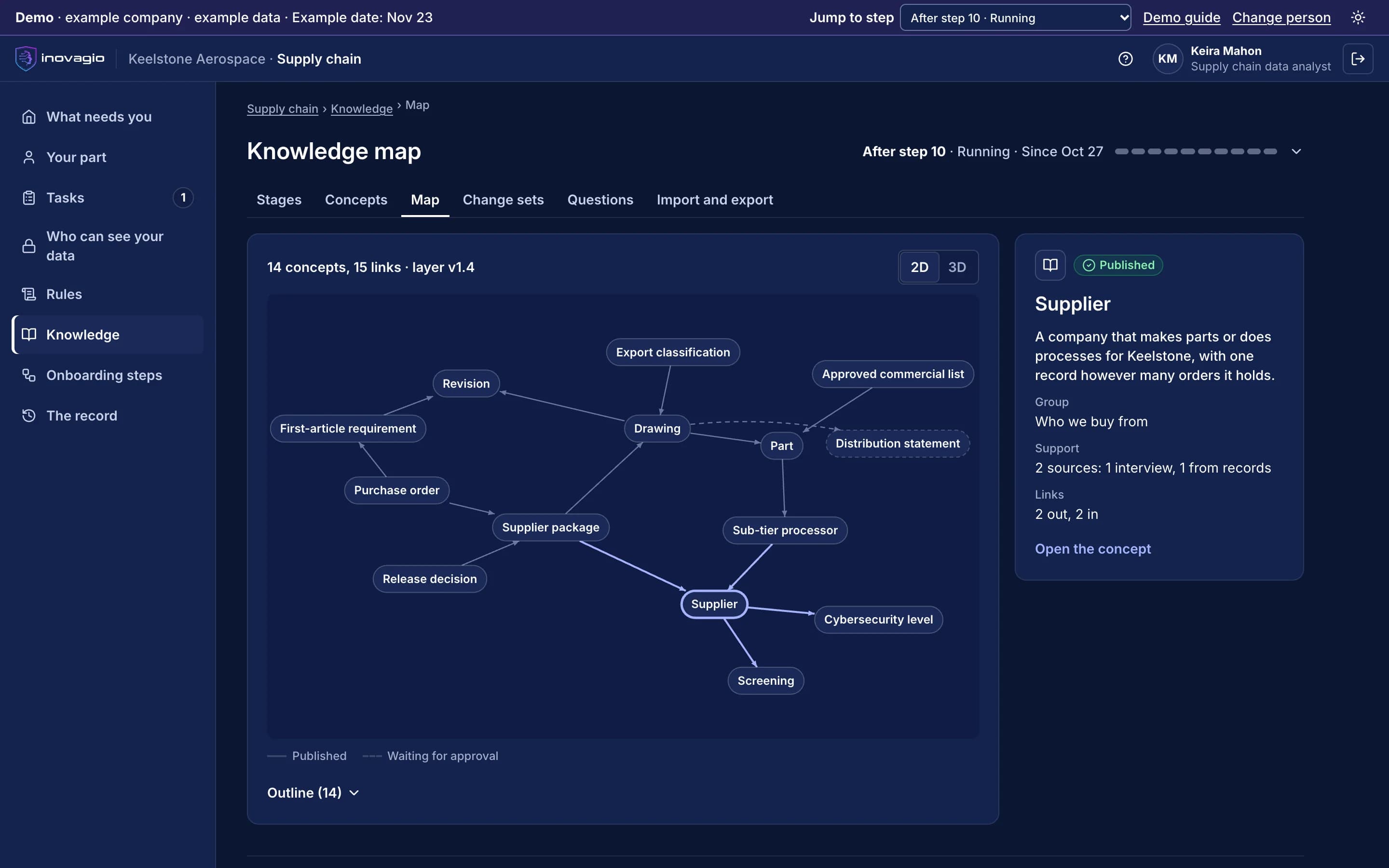
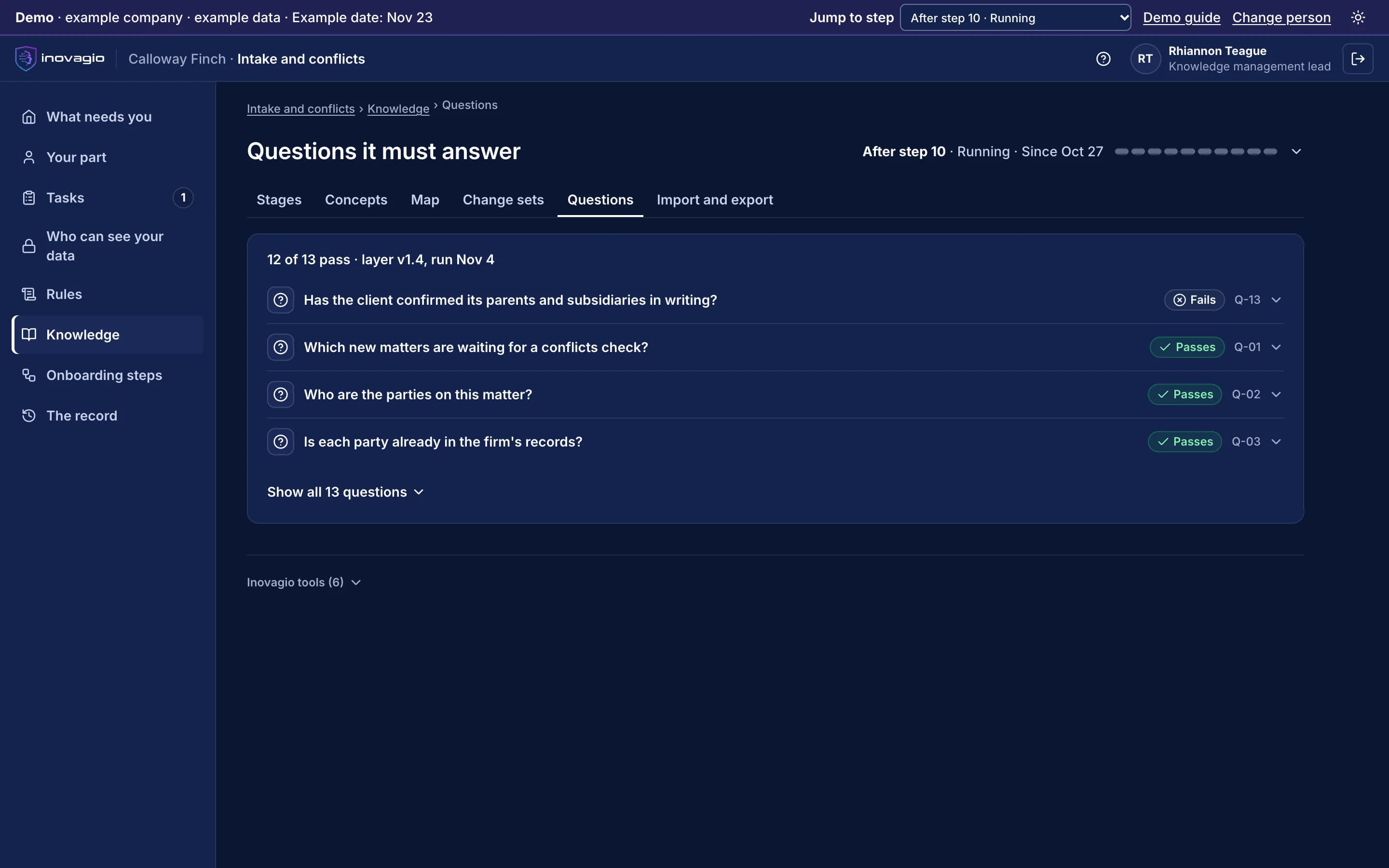
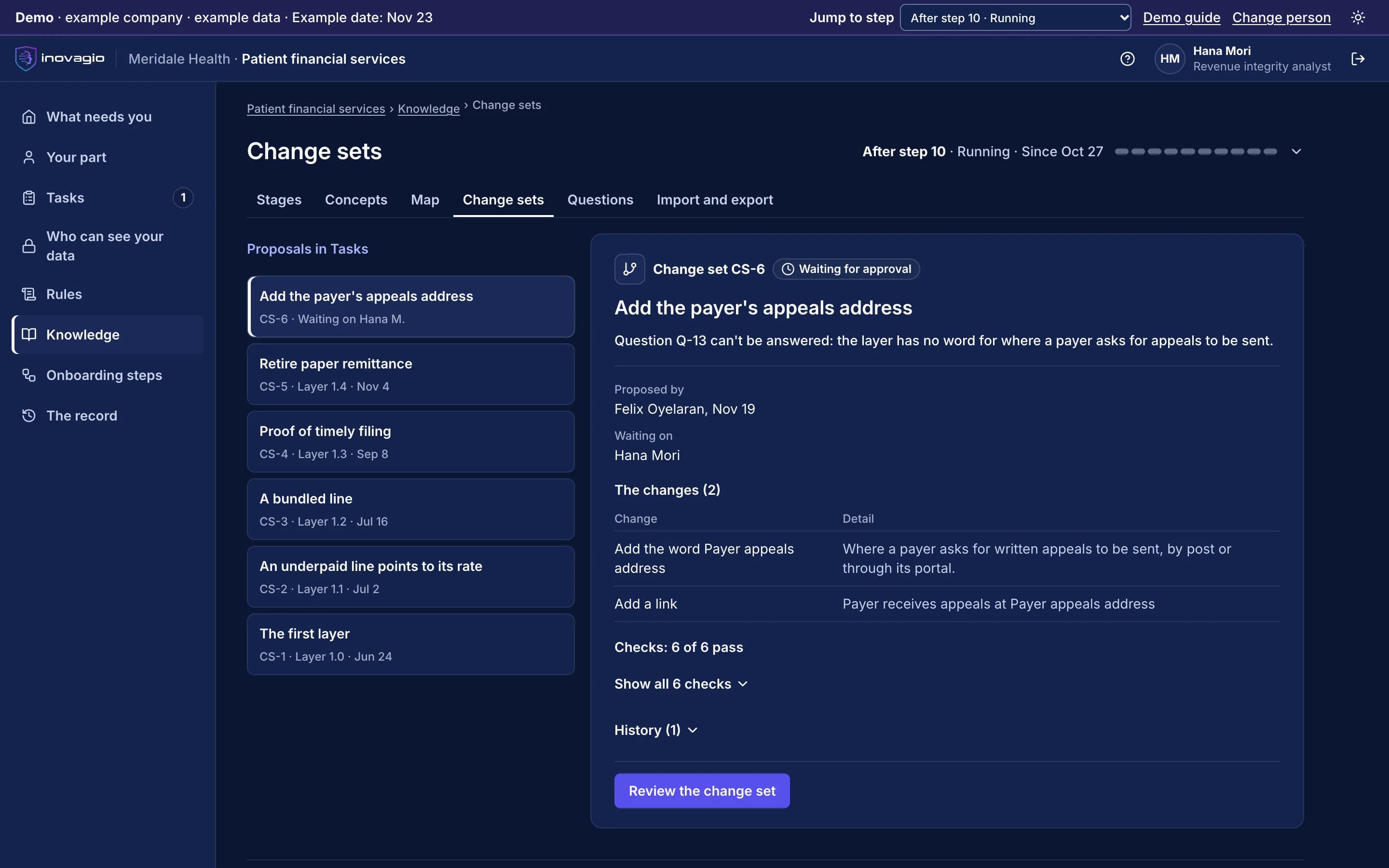
MNEMOS › Knowledge map: a manufacturer’s concepts, such as supplier, part, drawing and revision, each linked to what it relates to, with one concept’s definition and sources. Sample data from Inovagio’s example companies.
What you get with MNEMOS
Data for AI
Relational, vector, search, graph, cache and queue in one engine.
Keeping data consistent
One transaction spans every data model.
Proving what changed
A tamper-evident ledger records every write.
Your existing tools
They connect over the protocols they already speak, with a compatibility guide to check first.
Everything MNEMOS does, by area.
Data models
- SQL: DDL with keys and constraints, MERGE, RETURNING, COPY
- JSON document collections with path indexes
- Strings, hashes, lists, sets, sorted sets and streams with TTL
- Topics, durable queues, consumer groups, dead-letter, change data capture after commit
- Task API: idempotent enqueue, fenced leases, retries, delay, priority
- Property graph with ISO GQL / SQL/PGQ queries
- Time-series store for logs, metrics and traces
- Geospatial, bi-temporal tables and materialized views
Search and AI
- BM25 full-text search with analyzers, phrase, prefix and fuzzy queries
- HNSW and IVF-PQ vector indexes on columns and collections
- Hybrid keyword + vector retrieval with reciprocal rank fusion
- Semantic reranking by the Inovagio inference server
- Integrated vectorization, chunking and re-embedding on model change
- Document-level security trimming in every result
- Five-layer agent memory: raw, working, episodic, semantic, and shared by the Virtual Employees on one queue
- AI catalog for agents, tools, skills, prompts and evaluation suites
Trust and security
- Dual ledger: data log plus write-once audit log
- Epoch-batched Merkle signing with RFC 3161 timestamps
- Roles, GRANT, object privileges and row-level security
- Per-page authenticated encryption at rest with key rotation
- Crypto-shredding with an erasure certificate and legal hold
- TLS with authentication for every remote connection
- Per-tenant statement, memory and connection quotas
Operations
- All data in one versioned .mnemos file format
- Online backup, offline restore and point-in-time recovery
- Synchronous replicas, automatic failover with fencing, controlled switchover
- Online consistency checker for heap, indexes and catalog
- Import from and export to common database dump formats
- Metrics, logs and traces into Panoptes
- Shell client, admin CLI plugin and web console
What MNEMOS replaces
MNEMOS does the work of these, inside one platform with one identity, one policy and one record:
- Relational database
- Document database
- Key-value cache
- Message broker and event streams
- Task and job queue
- Workflow state store
- Search engine (keyword, vector and hybrid)
- Vector database
The controls MNEMOS brings
Every Inovagio product keeps the same five commitments, because regulated work needs all five at once.
Security
Every record is bound to the signed-in tenant in code, encrypted at rest and in transit.
Governance
Retention, legal hold and erasure apply across tables, documents, vectors and graphs alike.
On the record
A tamper-evident ledger records every write, so any change shows.
Monitoring
Queries, latency and storage are reported to Panoptes.
Cost per task
One engine in place of several databases, caches and brokers to license and run.
MNEMOS in your industry
Every industry runs the same ten steps, so MNEMOS does the same job in each, on that industry’s own work.
- Financial servicesBanks, credit unions, lenders and insurersWorked example: Alder Ridge Community Bank · Example company
- Healthcare providersHealth systems, hospitals and physician groupsWorked example: Meridale Health · Example company
- Health plansMedicare Advantage, Medicaid and commercial plansWorked example: Ashgrove Health Plan · Example company
- LegalLaw firms and in-house legal teamsWorked example: Calloway Finch · Example company
- GovernmentState, county and city agenciesWorked example: City of Larkhaven · Example company
- DefenseDefense contractors and their suppliersWorked example: Keelstone Aerospace · Example company
- Finance operationsFinance teams in any industry
For developers: MNEMOS at a glance
- Interfaces
- Native client and wire protocol (gRPC optional), REST, SQL, ISO GQL graph queries, key-value and messaging APIs
- Wire compatibility
- Four wire protocols (two relational, a graph protocol v5 and a key-value cache protocol), with their official drivers
- Isolation levels
- Read Committed, Repeatable Read, Serializable
- Platforms
- macOS, Linux and Windows
- Deployment
- Single server, primary with synchronous replicas, or inside the Inovagio platform
- Standards
- ISO GQL (39075), SQL/PGQ (9075-16), RFC 3161
- Packages
- Signed installers for macOS and Windows; Linux packages
MNEMOS in the platform.
Where MNEMOS fits
One platformAgent HarnessAgent harness
Inovagio CLIInovagio DesktopWeb ChatInovagio SDK
OpsisExperience layer
FolioMorphe
Virtual EmployeesVirtual Employee layer
NexusErgon
Synesis (this layer)Knowledge layer
PerceptionMNEMOS (this product)
OriginModel layer
Inference ServerForge
PhylaxTrust layer
AuthInovagio SecretsGuard
OperationsOperations
PanoptesArchon
Platform servicesPlatform services
ServerAPI ManagementConnect
Questions
MNEMOS questions
Do we have to rewrite our applications?
Usually not much. MNEMOS speaks the Postgres, TDS, openCypher graph and Redis wire protocols, so existing drivers connect. The compatibility guide lists which SQL features, system catalogs and extensions are covered, so you know before you move anything.
Can MNEMOS run on our own servers?
Yes. It runs on your hardware, in your cloud, or hosted for you.
Guides and posts on MNEMOS
 Guide · Data qualityAI-ready data checklist for regulated teamsTwenty-eight checks to run against the data an AI process will read, before it goes live and at set intervals after. Grouped by stage, from sources and owners to documents, mapping and run-time checks, each with why it matters to an examiner and how to test it. · updated November 18, 2026 · 8 min read
 Guide · Context engineeringContext engineering for enterprise AI agentsContext engineering decides what an AI agent sees at each step of a task. The research on why long contexts fail, the techniques that keep context small, how agent memory fits in, and the controls that stop context from becoming an attack path. · updated November 18, 2026 · 18 min read
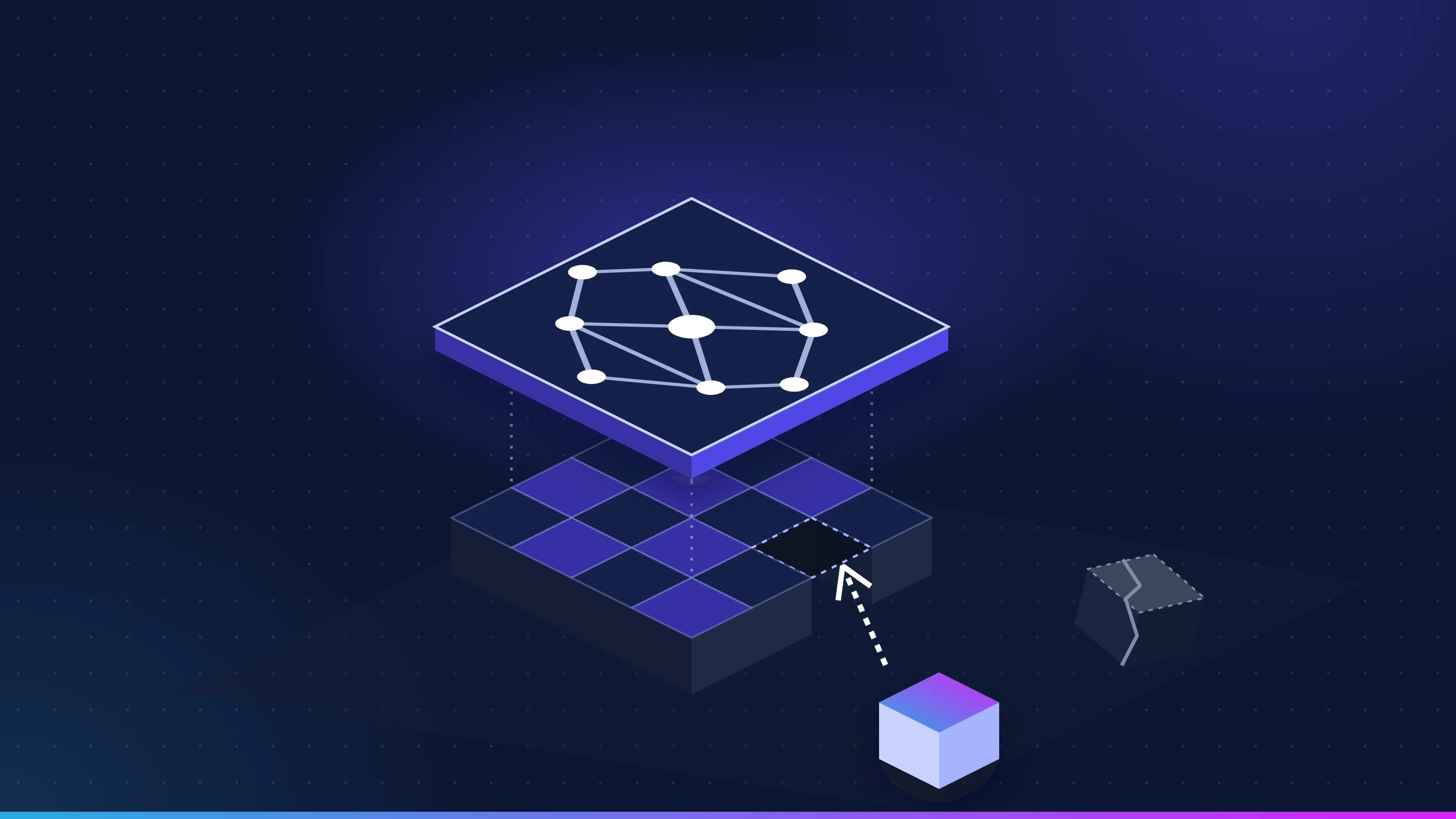 Article · Data qualityData hygiene for AI: your knowledge layer is only as clean as your dataAn AI agent acts on whatever record it is handed, so a duplicate customer or an old policy becomes a wrong action, not just a wrong number. What dirty data looks like to an agent, what regulators have already seen, and why a knowledge layer makes the problems visible and fixable. · updated November 18, 2026 · 8 min read
 Guide · Data qualityData quality checks for AI agents in automated processesThe checks a record must pass before an AI agent may act on it, and the monitoring that catches what slips through. Shapes, business rules, freshness limits, confidence and quarantine, drift, and how a bad record is traced and fixed at the source, with the audit record each step leaves. · updated November 18, 2026 · 13 min read
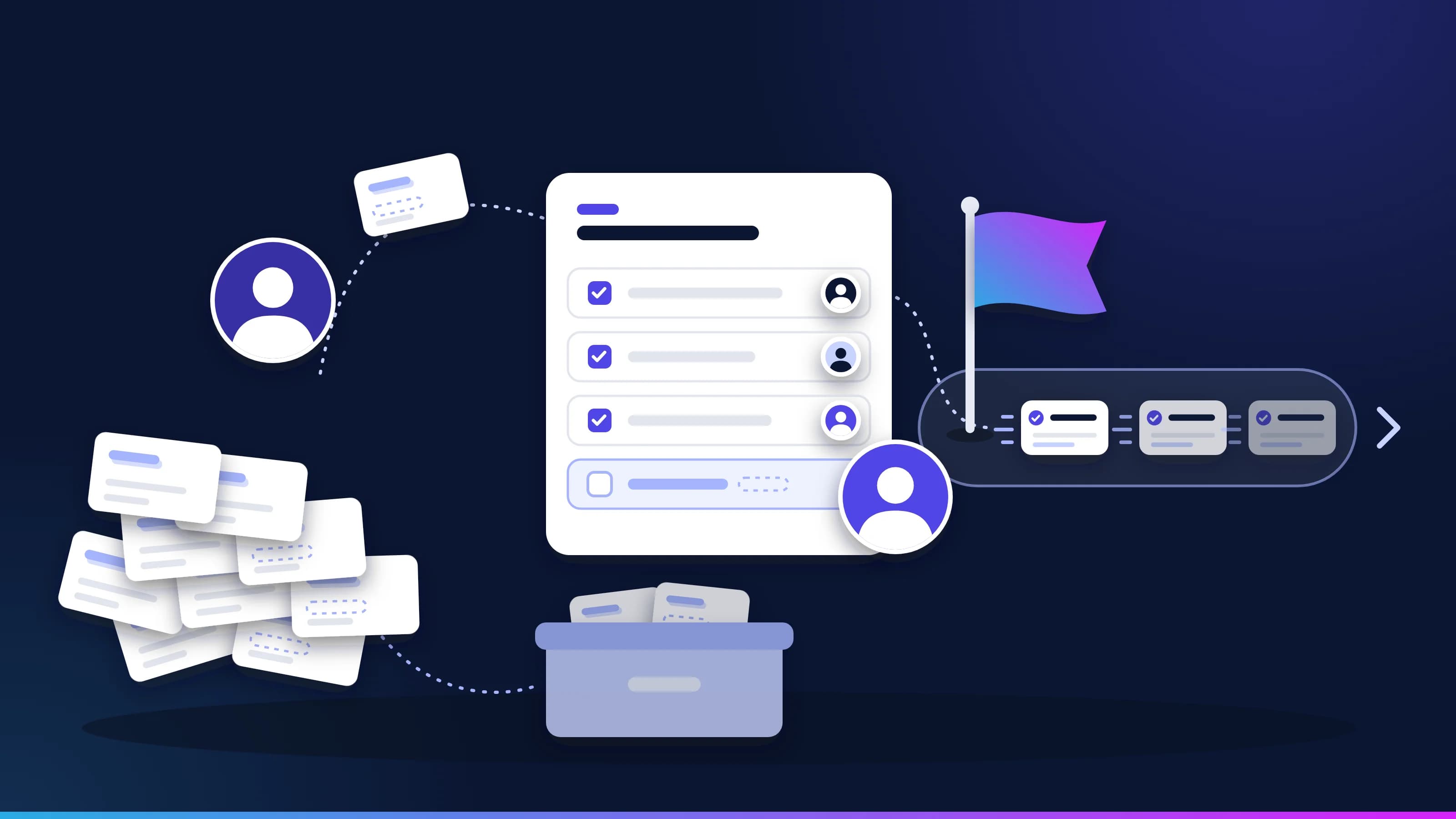 Article · Data qualityGet ahead of data cleanup before AI: a 90-day planData cleanup before AI goes wrong when it tries to fix everything. A 90-day plan that fixes only what the first AI queue reads, at the system it comes from, with a named owner for each source, plus the quick wins and what to leave alone. · updated November 18, 2026 · 7 min read
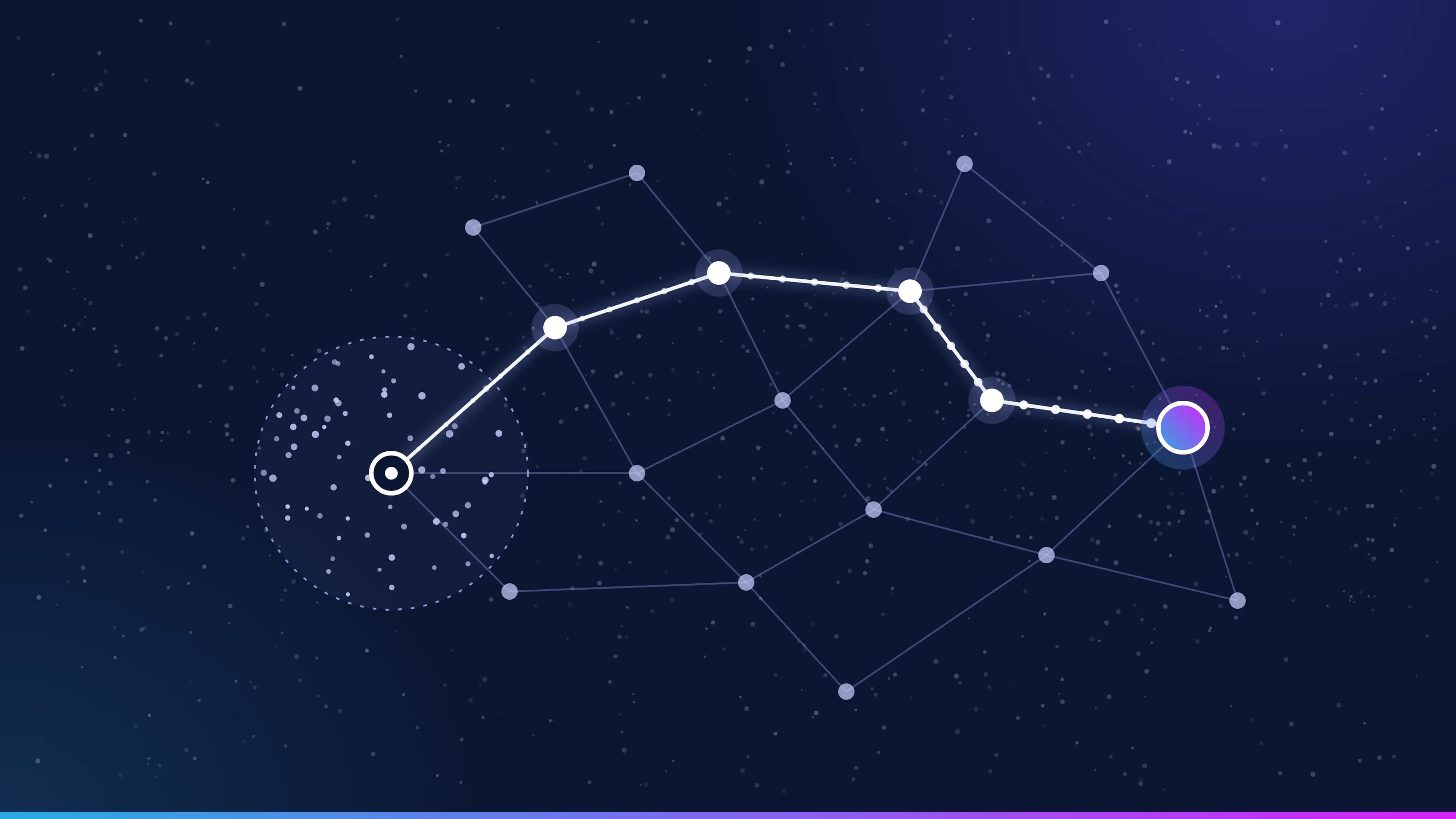 Guide · Knowledge graphHow AI agents use your knowledge graphAn AI agent uses your knowledge graph in five steps. Approved terms become concepts, the ontology types the graph, retrieval finds connected records and their evidence, your rules check the result, and failures go to a person. How each step works, and what the GraphRAG research shows. · 17 min read
See MNEMOS on one of your workflows.
Every project starts with one workflow your people know well, measured against what it costs you today.