
Series · The knowledge layer, explained
Forward-deployed engineers: what you should own
More AI vendors now send forward-deployed engineers to build inside your company, and Gartner predicts most of those systems will be abandoned. Here's what leaves with the engineers, what to write into the contract, and what you should own on the day they go.
Inovagio team · Published · Updated · 9 min read
On this page
Page 31 of the statement of work is where the real decision sits. A forward-deployed engineer (FDE) is a vendor's engineer placed inside your team to build and connect an AI system. This contract puts four of them in the commercial loan operations team at Tollerby Bank (Example company) for six months, "to configure the platform to your processes."
The demo was excellent, and the engineers will be good. What the contract doesn't say is what Tollerby will own on the day they leave. That gap matters more than the model or the price. It decides whether the system is still running two years later.
Why vendors send engineers
#Enterprise AI doesn't plug in. A lending or contracts process runs on local codes and exceptions that no product ships with, so somebody has to sit with the people who do the work and wire the system to it. By 2025, venture firms were telling AI startups to make that a strategy.
The role isn't new. It began with software vendors selling to government agencies and large enterprises, where no product fit the work as delivered, and AI vendors took it up when they hit the same problem. It differs from a solutions engineer, who helps you evaluate and set up a product and then moves to the next deal. An FDE stays inside your team for months and writes the code that fits the product to you.
The case for it was made plainly in a 2025 essay from Andreessen Horowitz titled "Trading Margin for Moat". It argues that AI application companies should accept lower margins early and put engineers inside customers, because deep integration captures the customer's data and makes the product the place where the work happens (Schmidt, Andreessen Horowitz, June 4, 2025). For a vendor, that's sound strategy.
Read it from the buyer's side, though. The vendor's moat is your switching cost. Every month the engineers spend learning when your loan team counts a renewal as late is a month of knowledge that lives in their heads and their code, inside the vendor's platform.
What Gartner predicts happens next
#Now there's a forecast for where that leads. Gartner predicts 70% of enterprises will abandon agentic AI built by vendor forward-deployed engineering by 2028. The release gives two reasons: soaring costs, and the customer being unable to evolve the system on its own (Gartner, September 29, 2026).
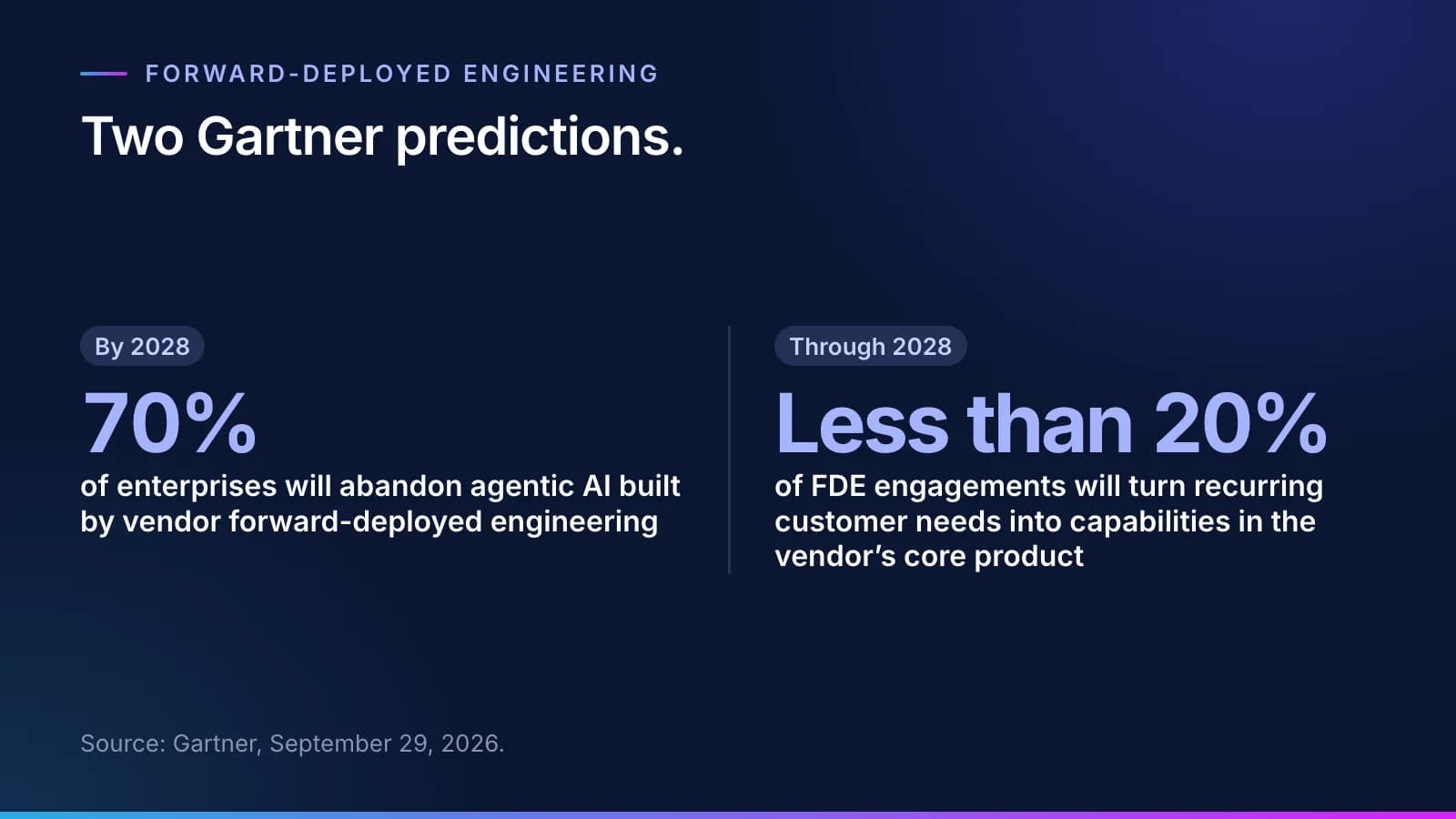
The same release adds a second prediction that buyers should read twice. Gartner predicts that through 2028, less than 20% of FDE engagements will turn recurring customer needs into capabilities in the vendor's core product. Most of what the engineers build stays custom, which means it stays expensive to change.
Gartner also names a risk it calls "FDE washing": consulting services marketed as forward-deployed engineering. Its analyst adds that some providers charge premium fees without the delivery depth or change management to justify them. If a proposal's engineers can't name the product capability their work will turn into, and who maintains it after they leave, you're probably buying consulting with a new label. Gartner's 70% is one of three failure-rate numbers worth reading closely, and why AI projects fail sets them side by side.
What leaves with the engineers
#The code is the easy part to hand over. It's in a repository, and someone can read it. The hard part is the reasons.
Take one rule at Tollerby. Loans coded R, for renewal in progress, count as outstanding in the finance team's maturity report but not in the loan officers' renewal queue, because the two teams settled that argument in 2019. An engineer learns this in week three, writes it into a prompt or a mapping table, and moves on. Nobody records who decided it or why. When the engineer leaves, the rule stays in the system and the reason goes with them.
Multiply that by a few hundred rules and you have the problem Gartner describes. The system still runs, but nobody inside can change it safely. Each new exception means calling the vendor back. The bill grows, and abandoning the system starts to look cheaper than maintaining it.
The same happens to the quieter assets: the test cases that show the system works, the prompts tuned by trial and error, the record of what the AI did on each task. If those live only in the vendor's platform, your own history is out of your reach.
Gartner's advice, in three phases
#Gartner's recommendations are worth following whoever you buy from, and the order matters. A decision you skip before signing is hard to make later, in the middle of the engagement, with a deadline looming.
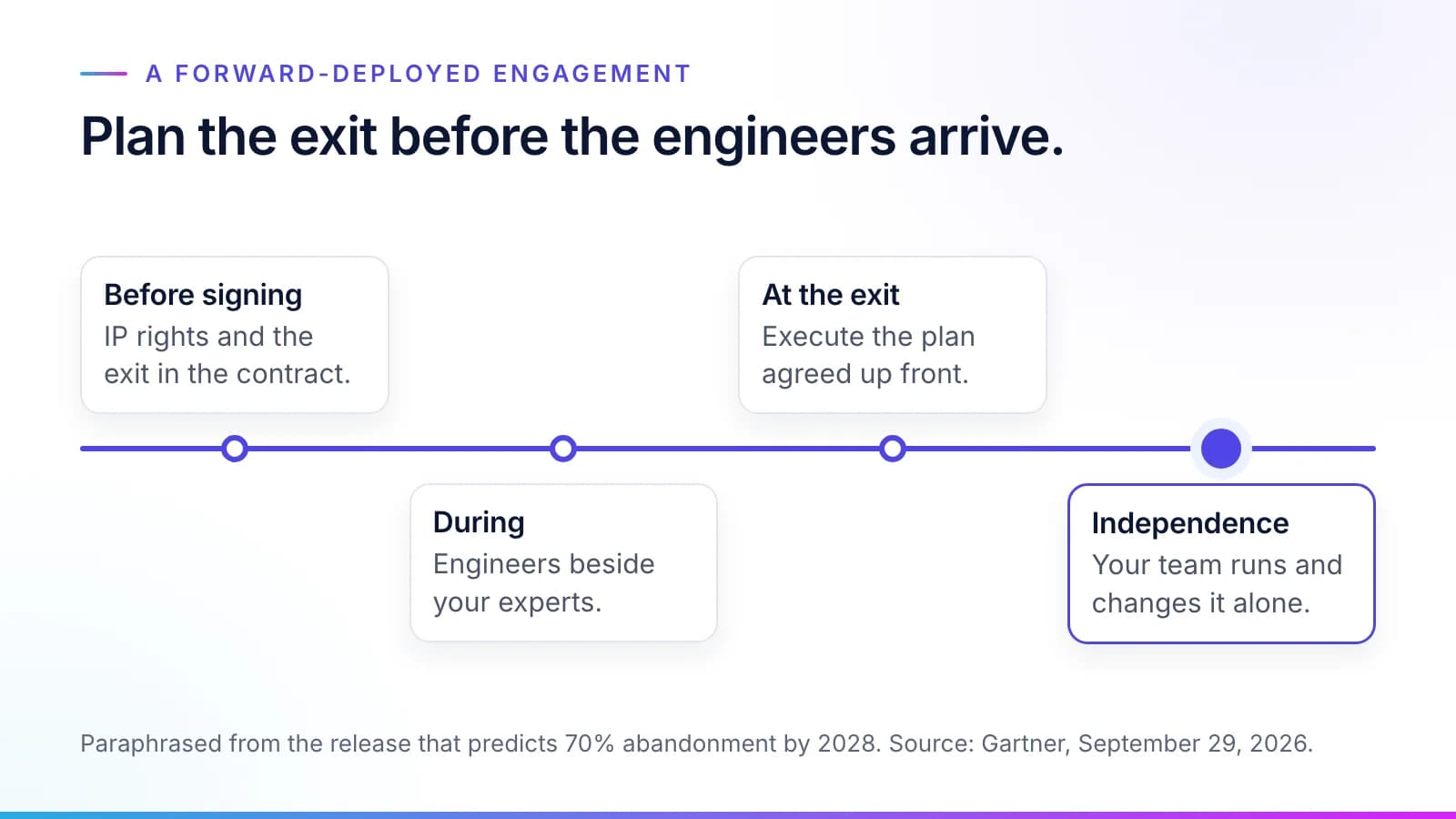
Before signing, use engineers only where the problem needs deep product expertise or close integration with your operations. Name an executive sponsor who is accountable for business outcomes, not only the implementation budget. Write deliverables, knowledge transfer, intellectual property (IP) rights and the exit into the contract before you sign.
During the engagement, put the engineers next to your own domain experts and users, so the knowledge is shared rather than held. Test the operating model as well as the technology: who decides what, where people stay in the loop and how the system will be governed.
At the exit, execute the plan you agreed at the start instead of extending the engagement because your team isn't ready. The test is simple and strict. Can your organization run and change the system on its own? Gartner measures success by that, rather than by whether the build was finished.
What you should own when they leave
#"IP rights and knowledge transfer" sounds abstract until you turn it into a list. When an AI system is handed over, you should hold five assets, each in a form you can use without the vendor.
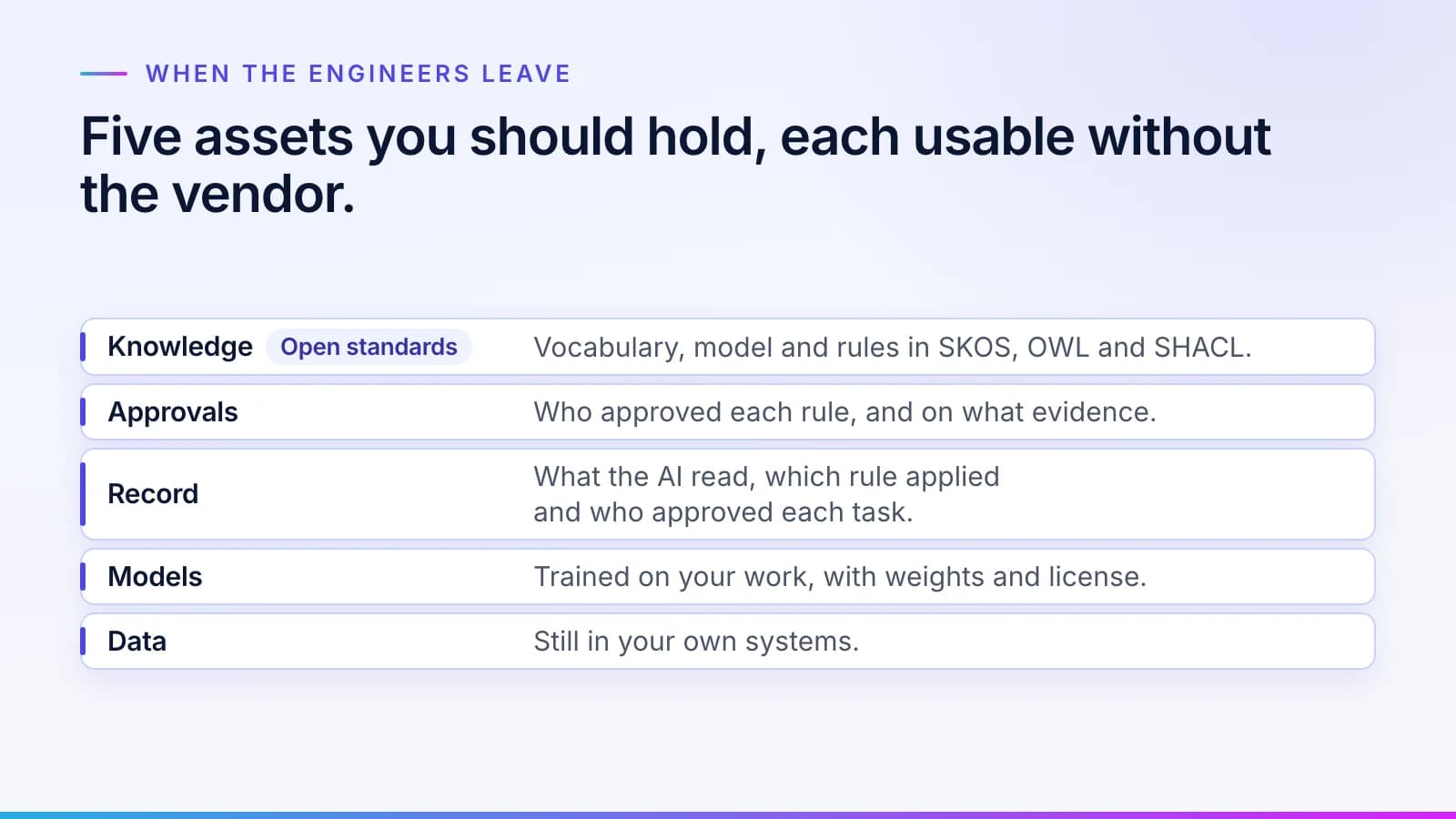
- The knowledge: your vocabulary and rules, exported in open standards that any standards-based tool can read. SKOS carries the vocabularies, OWL the model of how things relate, and SHACL the constraints the data must meet.
- The approvals: who approved each rule and on what evidence, so your team can change a rule and know whom to ask.
- The record: what the AI read, which rule applied and who approved each task, in a form an auditor can read after the vendor has gone.
- The models: any model trained on your work. Hold its weights and license, and the test results that cleared it for use.
- The data: still in your own systems, never copied into a platform you can't leave.
Ask for each one by name in the contract. A general clause on "knowledge transfer" leaves you exposed to the second risk Gartner names: a system your team can't evolve on its own.
For a bank, this is also an exam question. The federal banking agencies' guidance on third parties says that using one "does not diminish or remove" the bank's own responsibilities (Interagency Guidance on Third-Party Relationships: Risk Management, June 2023). When an examiner asks how a vendor-built system is governed, it's the bank that answers. It can only answer from what it holds.
How buyers keep the knowledge in their hands
#Whoever does the build, the knowledge has to end up with you. Buyers who manage this well ask for the business rules to be written down one at a time, each tied to the person or document it came from, and approved by someone on their own side. Then their own people can change a rule without calling the vendor back. Why the knowledge build stalls explains what slows this work down when people do it by hand.
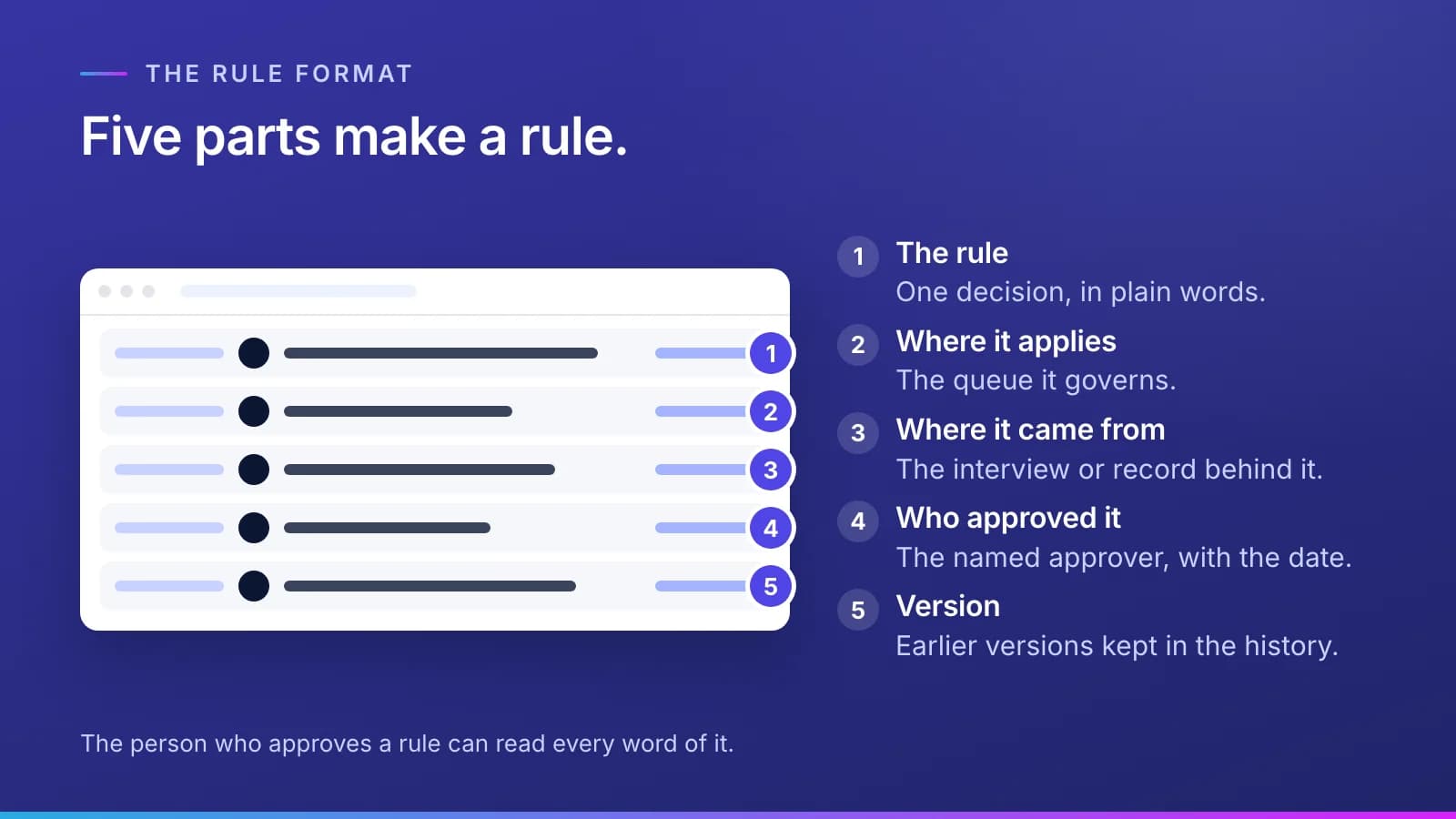
The same goes for the record and the models. The record of every task should be tamper-evident, and your auditors should be able to read it without the vendor. Any model trained on your approved results should be yours, under the base model's license. And when the business knowledge sits outside the model, the model is a replaceable part: you can swap it when a better one arrives, and you can run the small ones yourself, as our piece on small language models for business explains.
The longer argument for owning these layers is in why faster AI makes owning it more valuable.
Run the exit test before you sign
#Ask any vendor to demonstrate the exit. Don't accept a description.
- Export the rules for one process, and open the file in a tool the vendor doesn't make.
- Pick one finished task and show its full record without logging in to the vendor's platform.
- Change one rule with your own expert, and show who approved the change.
- List every model the system uses, with where it came from and its license, and show how it was tested.
- Name the people on your side who could run the system next month if the vendor's team left.
If the vendor can do the first four in an afternoon, you're buying something you'll own. If the fifth request gets a pause, that's the gap to close before signing. Write down who on your side learns each part of the system, and by when. Questions about the knowledge itself, from vocabularies to ontologies, are answered in our knowledge layer questions and answers.
Further reading
#- Gartner, Gartner Predicts 70% of Enterprises Will Abandon Agentic AI Built by Vendor Forward-Deployed Engineering by 2028, press release, September 29, 2026.
- Joe Schmidt, Andreessen Horowitz, Trading Margin for Moat: Why the Forward Deployed Engineer Is the Hottest Job in Startups, June 4, 2025.
- W3C, SKOS Simple Knowledge Organization System Reference, W3C Recommendation, August 18, 2009.
- W3C, OWL 2 Web Ontology Language Document Overview (Second Edition), W3C Recommendation, December 11, 2012.
- W3C, Shapes Constraint Language (SHACL), W3C Recommendation, July 20, 2017.
- Board of Governors of the Federal Reserve System, FDIC and OCC, Interagency Guidance on Third-Party Relationships: Risk Management, Federal Register, June 9, 2023.
Questions
What people ask.
What is a forward-deployed engineer?
A forward-deployed engineer is a vendor's engineer placed inside a customer's team to build, configure and connect the vendor's AI system to the customer's processes. The role often includes capturing the business knowledge the system runs on, which is why what happens to that knowledge when the engineer leaves matters so much.
Why does Gartner predict forward-deployed AI projects will be abandoned?
Gartner predicts 70% of enterprises will abandon agentic AI built by vendor forward-deployed engineering by 2028, because of soaring costs and because customers can't evolve the systems on their own. It also predicts that through 2028, less than 20% of these engagements will turn recurring customer needs into capabilities in the vendor's core product.
What is FDE washing?
FDE washing is Gartner's term for consulting services marketed as forward-deployed engineering. Gartner warns that some providers charge premium fees for it without the delivery depth to justify them. Ask what product capability the engineers' work will turn into, and who will maintain it after they leave.
What should we own at the end of an AI implementation?
Five things: the knowledge in open standards, the approvals behind each rule, the record of every task, any models trained on your work with their weights and licenses, and your data in your own systems. Write each one into the contract by name rather than relying on a general promise of knowledge transfer.
How can we test a vendor's exit plan before we sign?
Ask them to show it. Export the rules for one process and open them in another tool, show the full record of a finished task without their platform, change a rule with your own expert, list every model with its license, and name who on your side could run the system next month.
The products, industries and examples it covers.
- Knowledge layerSynesisTurns your policies, procedures, records and your people’s know-how into a rulebook your experts approve, which you own and can take anywhere.
- Model trainingForgeTrain task-specific models on your data, with the evidence built in.
- Governance and auditPhylaxSign-in, policy, secrets and one audit trail from the screen to the disk, so you can show any examiner what happened.
- ModelsOriginRun open models on your own hardware, or a frontier model, through one API, never locked to one vendor.
- IndustryLending and account operationsBorrowers’ statements and tax returns spread, covenants tested and annual review memos drafted against your credit policy. Your credit team decides.
Read next.
 Article · ApproachFaster AI makes owning it more valuableIf AI models keep improving this fast, why own any of it? Because a better model still doesn't know your business, and every layer you own gains value with each new model. · updated November 20, 2026 · 3 min read
 Article · ModelsThe model is a replaceable partThe best AI model this quarter won't be the best next quarter. When you can switch AI models without touching your rules, approvals or audit record, every better model shows up on the scoreboard in your cost per correct task. · updated November 20, 2026 · 7 min read
 Article · Small language modelsSmall language models: why smaller AI does most business workMost steps an AI agent takes at work are narrow, like reading a field or sorting a document. A small language model can do them on your own server. Here's what the research says about how much work fits one, and where small models still fall short. · updated November 18, 2026 · 10 min read
See it on your work
See how one of your tasks runs, start to finish.
A 30-minute walkthrough of one of your workflows, the approval step and the audit record, with the people who build the platform.