
Inovagio SDKDeveloper kits
Build your own apps, cards and agents on the Inovagio core.
The same core, rules and audit trail the Inovagio products use, from your own code.
We’ll spend 30 minutes with you on one of your workflows, and you don’t need to share any data.
Where Inovagio SDK works
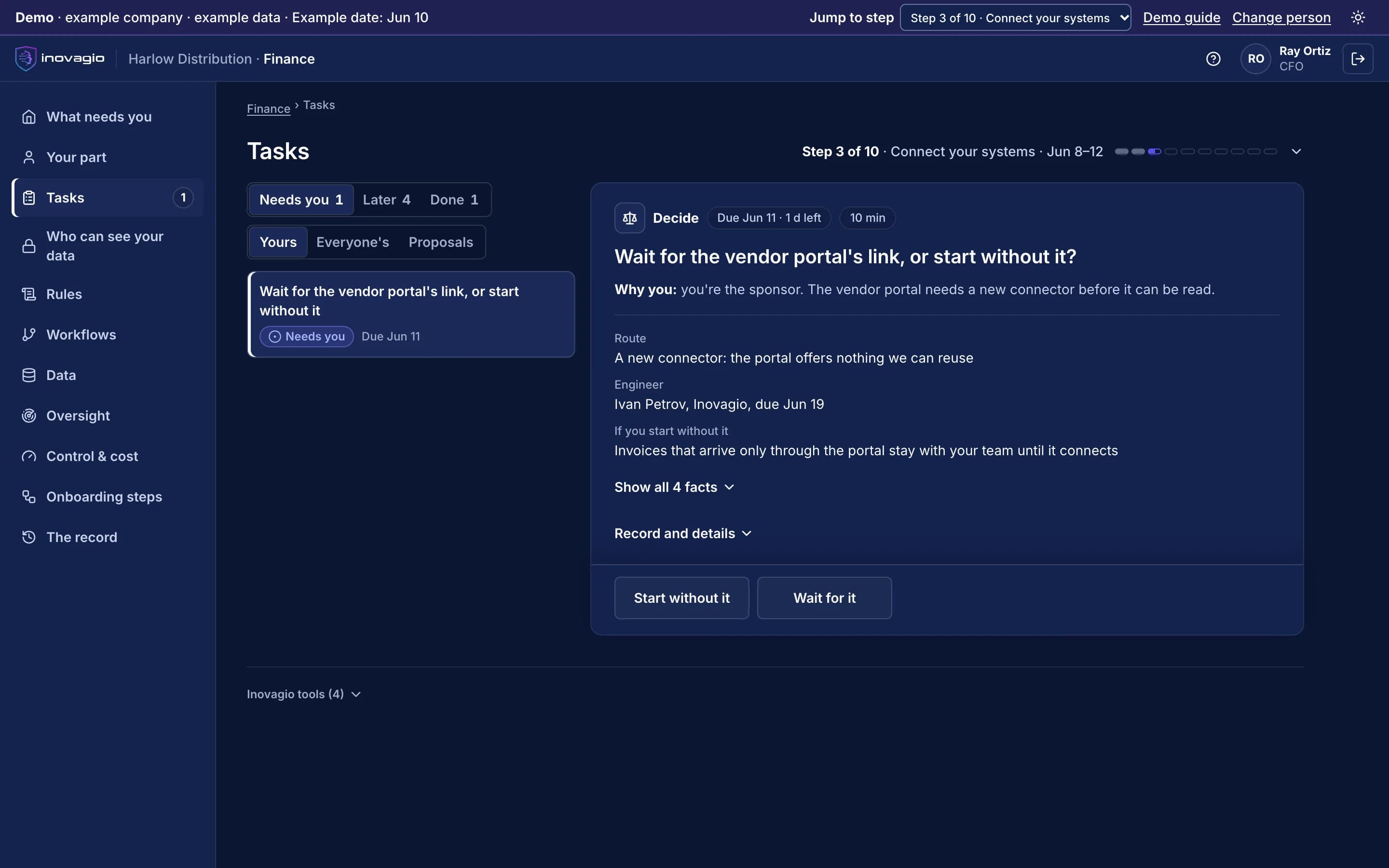
Builds a new connector when no route exists (Inovagio SDK). These are the onboarding steps it works in, from your first decision to live work.
What Inovagio SDK does
Inovagio SDK is Inovagio’s developer kit: a stable C ABI over the platform’s agents, workflows, memory, inference and governance, plus the card framework and first-party WASM UI kit for building your own cards, apps and hosts.
One stable C ABI
Agents, chat sessions, orchestration, memory, knowledge, inference, connectors, governance and sign-in sit behind one versioned C ABI with a published manifest.
Native bindings
Swift, Kotlin and Python bindings sit on the same ABI, so every language gets the same behavior.
Build your own cards
Public C++ headers and a C ABI for card templates, data sources, actions and hosts.
Validate, preview, serve
Template tooling validates a card against the catalog and renders a preview, and a loopback development server runs cards on live or recorded data.
Conformance kits
Test libraries your data sources and hosts must pass, the same suites the built-in ones pass.
A web UI kit with no runtime dependencies
The first-party C++ UI engine compiles to WASM with zero third-party runtime dependencies and accessibility built in.
Governed by default
Calls through the SDK pass the same authorization, audit and tenant binding as the platform’s own clients.
Inovagio SDK at work
In the App at step 3: Map the work and connect, read-only.
- The vendor portal offers nothing to reuse, so it needs a new connector.
- A named engineer builds it, with a due date.
- Until it connects, invoices from the portal stay with your team.
Inside Inovagio SDK
The views Inovagio SDK gives the people who run it, on sample data from Inovagio’s example companies.
- Synesis
- Virtual Employees
- Agent Harness
- Opsis
- Origin
- Phylax
- Operations
- Platform services
renewal_card.py
Card app · Python bindings over the SDK’s C ABI
from inovagio.cards import define_card, field, actionfrom inovagio.platform import knowledge# A card for each commercial renewal due this month.renewal_card = define_card( id="loan-renewal", title="Loan renewal", source=knowledge.query("lending.renewals_due"), fields=[ field("loan", "Loan"), field("terms", "Terms"), field("documents", "Documents on file"), field("rule", "Rule applied", cite=True), ], actions=[ action("recommend", needs="Credit analyst"), action("approve", needs="Loan officer"), action("send_back", reason="required"), ],)
Project
- renewal-cards/
- renewal_card.py
- renewal_wall.py
- test_card.py
- inovagio.toml
Checks
- Template
- Valid
- Catalog id
- loan-renewal
- Conformance kit
- 42 of 42 pass
- Permissions
- Read lending · approve
- Audit
- Same trail as the platform
- Synesis
- Virtual Employees
- Agent Harness
- Opsis
- Origin
- Phylax
- Operations
- Platform services
Card · loan-renewal
The development server renders the card on recorded data
renewal_card = define_card( id="loan-renewal", title="Loan renewal", source=knowledge.query("lending.renewals_due"), fields=[ field("loan", "Loan"), field("terms", "Terms"), field("documents", "Documents on file"), field("rule", "Rule applied", cite=True), ], actions=[ action("recommend", needs="Credit analyst"), action("approve", needs="Loan officer"), action("send_back", reason="required"), ],)
Loan renewal
Loan LN-4410 · Borrower B-2287
- Loan
- Commercial line · renewal
- Terms
- Unchanged from the prior approval
- Documents on file
- Last year’s return ✓ · This year’s statements ✓
- Rule applied
- Renewal documents rule v2 · same terms
Source: Credit policy §3.2 · loan committee, renewal documents rule v2
Approve needs a loan officer; the credit analyst recommends.
Rendered
- Rendered
- Web · desktop · phone
- Accessibility
- Tree complete
- Bundle
- WASM UI kit, no runtime dependencies
- Synesis
- Virtual Employees
- Agent Harness
- Opsis
- Origin
- Phylax
- Operations
- Platform services
define_card(**spec)
Defines a card template the catalog can validate, render and serve
- define_card
- field
- action
- knowledge.query
- agents.run
- workflows.start
- governance.check
Parameters
| Name | Type |
|---|---|
| id | str |
| source | Query |
| fields | list[Field] |
| actions | list[Action] |
Returns a Card, checked against the catalog when published.
Example
Runcard = define_card( id="renewal-mini", source=knowledge.query("lending.renewals_due"), fields=[field("loan", "Loan")],)card.render(limit=3)
Result
- Valid
- Yes
- Records
- 3 cards rendered
- Time
- 41 ms
Inovagio SDK › Code: Python, through the SDK bindings, building a card app on the platform. Sample data from Inovagio’s example companies.
Everything Inovagio SDK does, by area.
Platform SDK
- Agents and chat sessions
- Workflows and orchestration
- Memory and knowledge
- Inference and model daemon streams
- Connectors and MCP
- Governance, guard and sign-in
- Platform supervisor control
Card SDK
- Public C++ headers
- C ABI for native shells
- Template validation and preview
- Loopback development server
- Conformance kits for sources and hosts
- Examples: data source, card, app, native shell
WASM UI kit
- Web, desktop and phone backends
- Layout, input and compositor
- Design tokens
- Accessibility tree
- Strict content security policy delivery
- Semantic versioning and changelog
What Inovagio SDK replaces
Inovagio SDK does the work of these, inside one platform with one identity, one policy and one record:
- Model-provider client libraries
- Agent framework libraries
- Front-end UI framework for internal apps
- Glue code between AI services
The controls Inovagio SDK brings
Every Inovagio product keeps the same five commitments, because regulated work needs all five at once.
Security
Your app gets the same permission checks and sandbox as Inovagio’s own faces.
Governance
Policy is enforced by the runtime, not left to each app.
On the record
Calls from your app write to the same audit trail.
Monitoring
Your app’s agents report to Panoptes like any other.
Cost per task
Reuse the platform’s agents and models instead of building your own stack.
Inovagio SDK in your industry
Every industry runs the same ten steps, so Inovagio SDK does the same job in each, on that industry’s own work.
- Financial servicesBanks, credit unions, lenders and insurersWorked example: Alder Ridge Community Bank · Example company
- Healthcare providersHealth systems, hospitals and physician groupsWorked example: Meridale Health · Example company
- Health plansMedicare Advantage, Medicaid and commercial plansWorked example: Ashgrove Health Plan · Example company
- LegalLaw firms and in-house legal teamsWorked example: Calloway Finch · Example company
- GovernmentState, county and city agenciesWorked example: City of Larkhaven · Example company
- DefenseDefense contractors and their suppliersWorked example: Keelstone Aerospace · Example company
- Finance operationsFinance teams in any industry
For developers: Inovagio SDK at a glance
- Interface
- C ABI with a published ABI manifest; C++ headers
- Bindings
- Swift, Kotlin and Python bindings on the same ABI
- Compatibility contracts
- Card catalog id, C ABI, wire version
- Platforms
- macOS, Linux, Windows; web through WASM
Inovagio SDK in the platform.
Where Inovagio SDK fits
One platformAgent Harness (this layer)Agent harness
Inovagio CLIInovagio DesktopWeb ChatInovagio SDK (this product)
OpsisExperience layer
FolioMorphe
Virtual EmployeesVirtual Employee layer
NexusErgon
SynesisKnowledge layer
PerceptionMNEMOS
OriginModel layer
Inference ServerForge
PhylaxTrust layer
AuthInovagio SecretsGuard
OperationsOperations
PanoptesArchon
Platform servicesPlatform services
ServerAPI ManagementConnect
See Inovagio SDK on one of your workflows.
Every project starts with one workflow your people know well, measured against what it costs you today.