

Series · The knowledge layer, explained
Data hygiene for AI: your knowledge layer is only as clean as your data
An AI agent acts on whatever record it is handed, so a duplicate customer or an old policy becomes a wrong action, not just a wrong number. What dirty data looks like to an agent, what regulators have already seen, and why a knowledge layer makes the problems visible and fixable.
Inovagio team · Published · Updated · 8 min read
On this page
Data hygiene for AI is the routine work of keeping the records an AI agent reads accurate and current, with no duplicates and a named owner, and fixing problems where they start. Good operations teams have always done some of it. What's changed is the cost of a dirty record. A person reading a report might catch a wrong number. An agent acting on the same record sends the letter.
That's why the phrase "your knowledge layer is only as clean as your data" isn't a slogan. A knowledge layer is the shared reference your AI agents work from: your business's words and rules, connected to the records they describe and approved by the people you make responsible. Think of it as the binder a good manager hands a new hire on day one, if someone kept that binder current and checked it every night. If the binder is wrong, the new hire is confidently wrong, and so is the agent.
What dirty data looks like when the reader is an agent
#Take Pellmoor Savings Bank (Example company), a community bank that has an AI agent preparing its commercial loan renewal files. Its credit team still decides every loan. Nothing exotic goes wrong. Three ordinary data problems do.
Start with a father and son who share a name and an address, and who are both guarantors. A matching tool merged them years ago. When the agent prepares the son's renewal, it finds the father's personal guaranty and his debts in the son's file, and flags a covenant breach that doesn't exist. An analyst loses a morning chasing it.
Then there's the credit policy. The bank approved version 7 in March, but version 6 is still in a shared folder, in a file with a friendlier name. The agent finds version 6 first and tests every covenant against last year's ratios. Nothing looks wrong, which is the problem.
The last is a vendor problem. An appraisal firm is listed twice in the vendor file, once under its legal name and once under its trading name. Only one of those entries is on the approved-appraiser list, and the agent happens to check the appraisal against the other. Its report says an unapproved firm valued the collateral.
None of these is an AI failure. The model read what it was given and reasoned correctly from it. Each is a data hygiene failure that a person had been quietly working around for years, and the agent can't work around what nobody wrote down.
Each one also costs money twice: once for the task, and again for the person who unwinds it. That's why we judge AI work by cost per correct task, not cost per task.
The evidence that data is the blocker
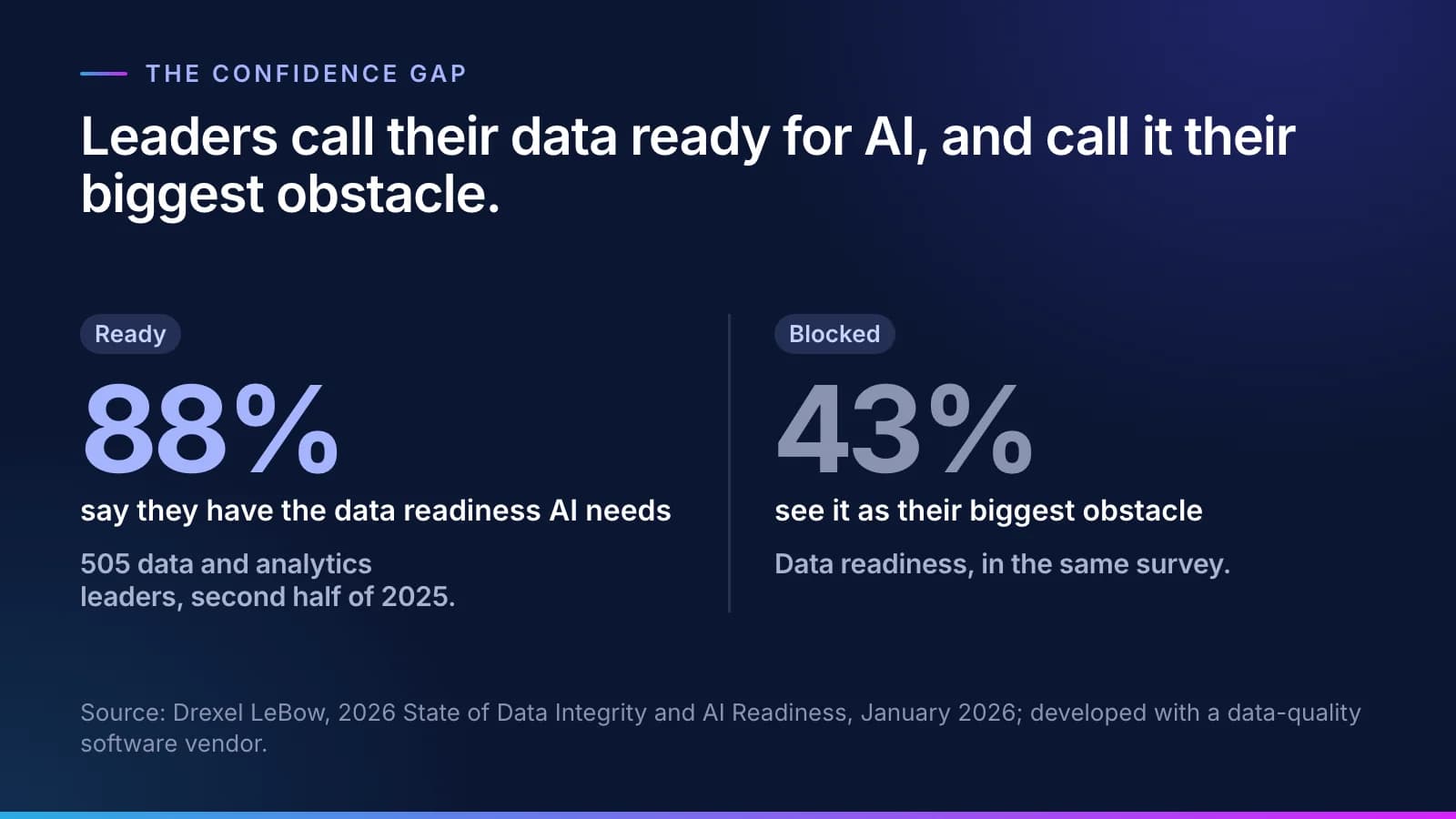
#The most telling number in this year's research is a contradiction. The Center for Applied AI and Business Analytics at Drexel University's LeBow College of Business surveyed 505 data and analytics leaders at major global enterprises in the second half of 2025, in a study developed with a data-quality software vendor. 88% said they had the data readiness they need for AI, yet 43% named data readiness as their biggest obstacle (Drexel LeBow, 2026 State of Data Integrity and AI Readiness, January 2026).
Analysts reached the same place earlier. In February 2025, Gartner predicted that through 2026, organizations would abandon 60% of AI projects unsupported by AI-ready data (Gartner, February 26, 2025). In April 2026 it reported, from a survey of data, analytics and AI leaders, that organizations with successful AI initiatives invest up to four times more in foundations such as data quality and governance, measured as a share of revenue. The same release put the agent version plainly: "Agents cannot function autonomously without high-quality context and absolute trust" (Gartner, April 16, 2026).
Read the two together and the explanation is plain. Most leaders believe their data is fine because their people have been compensating for it for years. The agent doesn't compensate.
What regulators have already seen
#Bank regulators were dealing with bad data in automated processes long before anyone put an agent on top of one, and their published orders are the clearest record we have of what it costs.
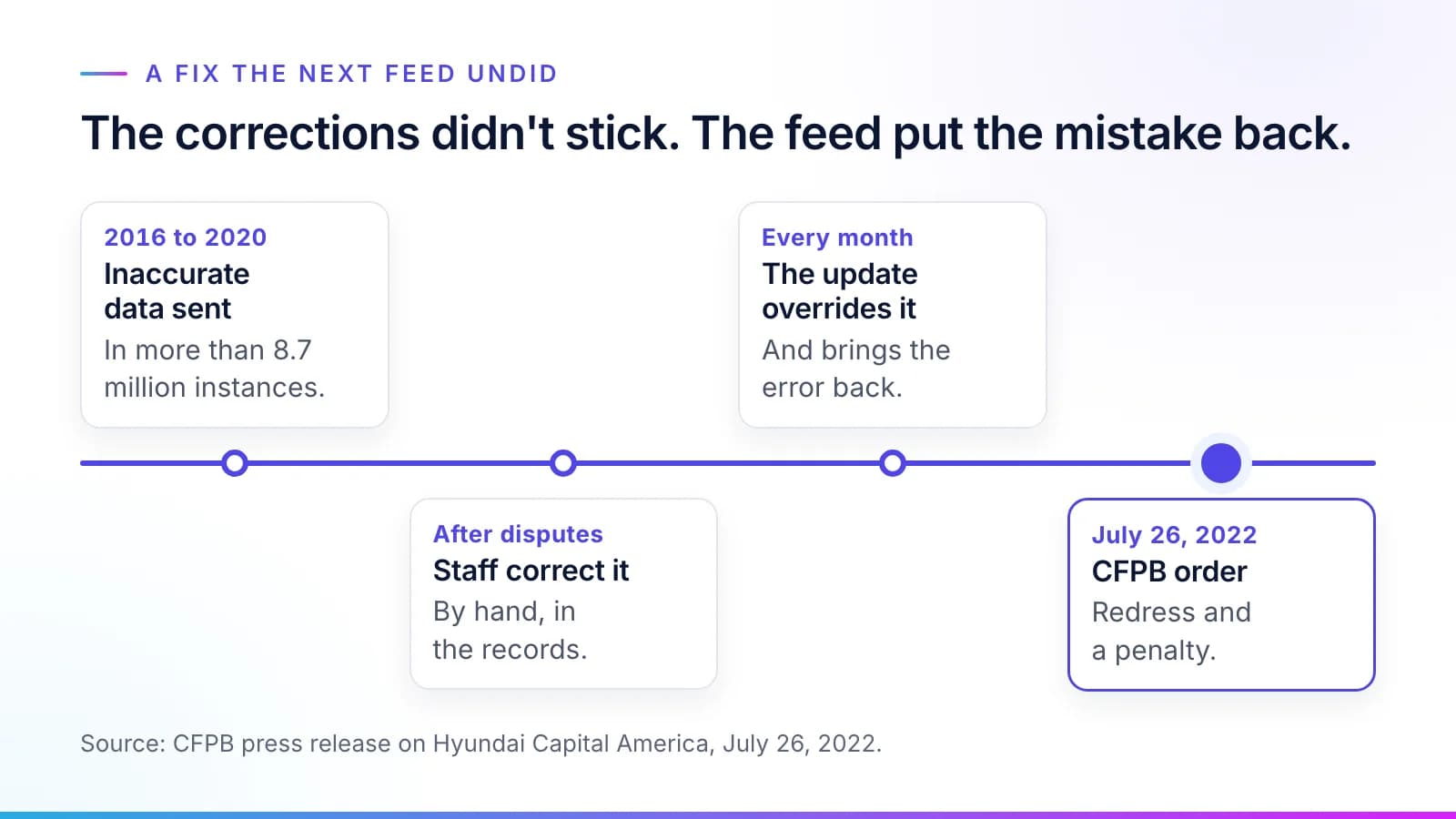
In 2022 the Consumer Financial Protection Bureau ordered Hyundai Capital America to pay redress and a penalty after finding that, between 2016 and 2020, it furnished inaccurate information to credit reporting companies in more than 8.7 million instances on more than 2.2 million consumer accounts. The detail that matters here: its furnishing system often overrode corrections staff made after consumer disputes, sending monthly updates that "reintroduced the data error after it had been disputed and corrected" (CFPB, July 26, 2022). The corrections didn't stick. The next feed put the mistake back.
In 2024 the UK's Financial Conduct Authority fined Metro Bank over its automated transaction monitoring. An error in how data was fed into the system meant some transactions were never monitored, and between June 2016 and December 2020 the bank lacked the systems and controls to adequately monitor over 60 million transactions for money laundering risk. Staff raised concerns in 2017 and 2018, and a check that every relevant transaction actually reached the system only arrived at the end of 2020 (FCA, November 12, 2024).
The Office of the Comptroller of the Currency assessed a civil money penalty against Citibank in 2020 for deficiencies that included data governance (OCC, October 7, 2020). Four years later the Federal Reserve said Citigroup "has made insufficient progress remediating its problems with data quality management" (Federal Reserve, July 10, 2024).
Put an agent on top of any of those feeds and it would have acted on every bad record, at machine speed, with a confident explanation.
Why a knowledge layer makes bad data visible
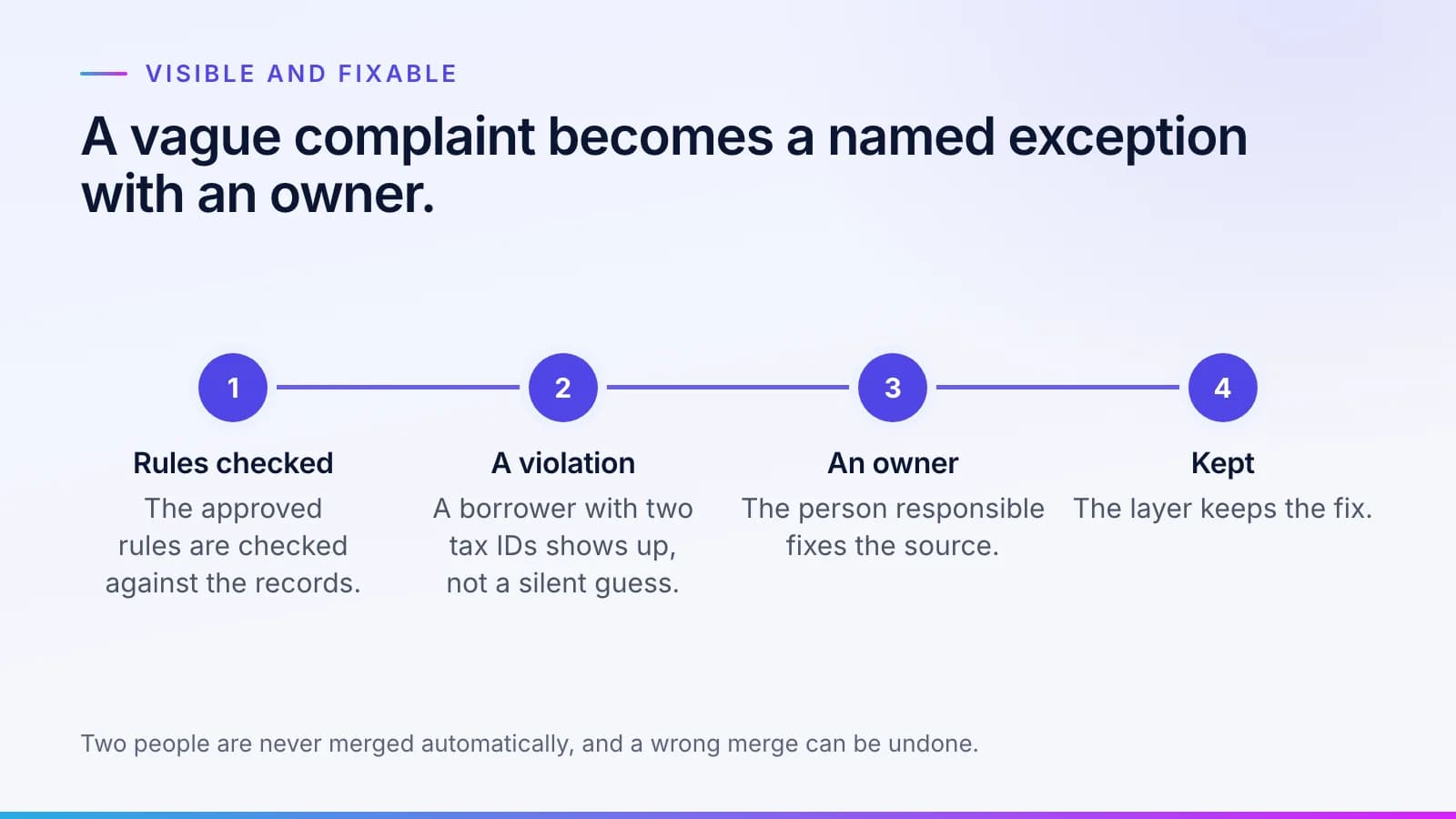
#A knowledge layer doesn't clean your data on its own. What it does is make each problem specific enough to fix. Once your words and rules are connected to your records, a vague complaint ("the vendor list is a mess") becomes a list of named exceptions with an owner.
Here's how that plays out at Pellmoor. In Synesis, our knowledge layer, the approved rules are checked against the records. A borrower with two tax IDs breaks a rule and shows up as a violation, not as a silent guess. The credit policy carries a version and the date it took effect, so a Virtual Employee that comes across version 6 after March sees it marked as replaced. Matching records are linked with the evidence for each link, and a wrong merge can be undone. Two people are never merged automatically: a father and son with different dates of birth can't be, and Pellmoor requires two approvers for any merge of two people. Perception, which reads documents into the layer, keeps a confidence score on the text it extracts, so a faxed tax return that read badly is flagged instead of trusted. The approved knowledge and the records sit in MNEMOS, with a history of every change.
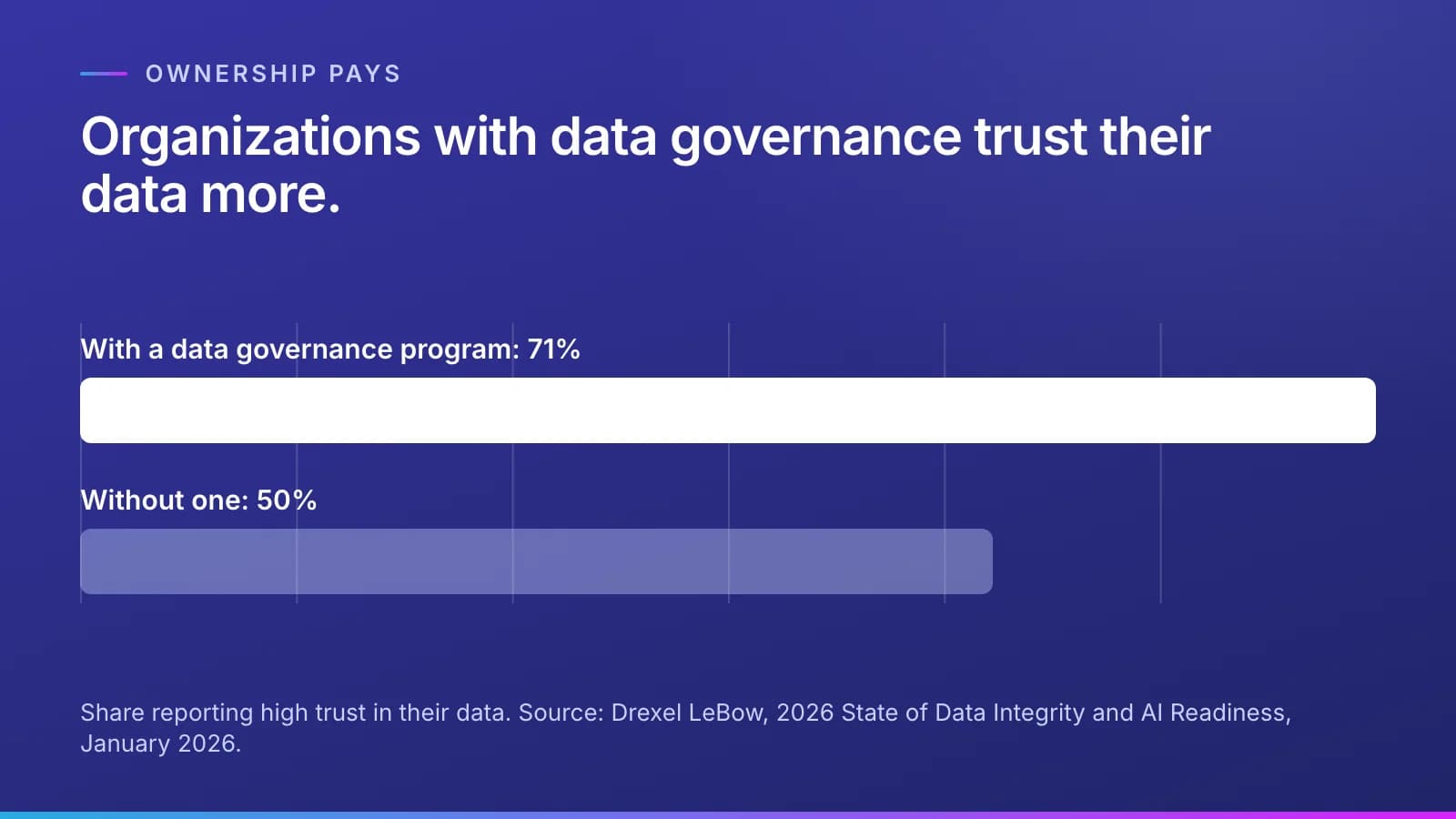
The other half is ownership. Every concept in the layer has an approver, whoever the organization makes responsible, so when a rule breaks there is a person whose job it is to fix the source. Governance and trust go together: in the same LeBow study, 71% of organizations with data governance programs reported high trust in their data, against 50% without.
Where to start with data hygiene for AI
#Don't start by cleaning everything. Start with the one queue you want AI to work first and the handful of sources it reads, and fix those at the system they come from, so the next feed doesn't undo the fix. Give each source an owner. Check documents for old versions and duplicates before an agent ever sees them, and test each source against the AI-ready data checklist.
Our guide to preparing data for a knowledge layer walks through that method step by step, and the 90-day data cleanup plan puts it on a calendar. If the terms are new, the ladder from vocabulary to knowledge graph explains the layers in plain words, and what a context layer is shows how agents use them at each step.
Further reading
#- 2026 State of Data Integrity and AI Readiness, Drexel LeBow Center for Applied AI and Business Analytics, January 2026: lebow.drexel.edu
- Lack of AI-Ready Data Puts AI Projects at Risk, Gartner, February 26, 2025: gartner.com
- Organizations with Successful AI Initiatives Invest Up to Four Times More in Data and Analytics Foundations, Gartner, April 16, 2026: gartner.com
- CFPB order against Hyundai Capital America for credit reporting failures, CFPB, July 26, 2022: consumerfinance.gov
- FCA press release on Metro Bank's financial crime failings, FCA, November 12, 2024: fca.org.uk
- OCC action against Citibank, OCC, October 7, 2020: occ.gov
- Federal Reserve action against Citigroup, July 10, 2024: federalreserve.gov
Questions
What people ask.
What is data hygiene for AI?
Data hygiene for AI is the routine work of keeping the records an AI system reads accurate and current, with no duplicates and a named owner, and fixing problems at the system they come from. It matters more for AI agents than for reports because an agent acts on the record it is given.
Why does bad data matter more for AI agents than for people?
A person reading a record often knows from experience that a figure looks wrong or a document is out of date, and works around it. An agent has no such memory unless it is written down. It acts on the record as given, quickly and with a confident explanation.
Does a knowledge layer clean my data?
Not by itself. A knowledge layer connects your words, rules and records, which makes problems show up as specific rule violations with an owner, such as a borrower with two tax IDs or a policy that has been replaced. People still fix the source, and the layer keeps the fix.
What are the most common data problems for AI?
Three come up again and again: duplicate or wrongly merged records for the same customer or vendor, documents that exist in several versions with the old one still findable, and fields that are missing or filled inconsistently across systems. Each one turns into a wrong action when an agent relies on it.
Should we clean all our data before starting with AI?
No. Start with the one queue you want AI to work first, clean the few sources it reads, and fix them where they come from. Cleaning everything first is slow and often stalls the project before any agent runs.
The products, industries and examples it covers.
- Knowledge layerSynesisTurns your policies, procedures, records and your people’s know-how into a rulebook your experts approve, which you own and can take anywhere.
- Data ingestionPerceptionTurn documents, scans, email and system data into cited knowledge.
- Data engineMNEMOSRecords, documents, vectors, graph and agent memory in one engine, with a ledger behind every write.
- IndustryFinancial servicesCredit, account and claims files checked against your policy, and answers to exam requests drafted from records on file. Your compliance officer approves every response.
- OverviewHow it worksTen checked steps from your first decision to the day it handles real cases.
- OverviewTrust and governanceEvery action checked, every step recorded.
Read next.
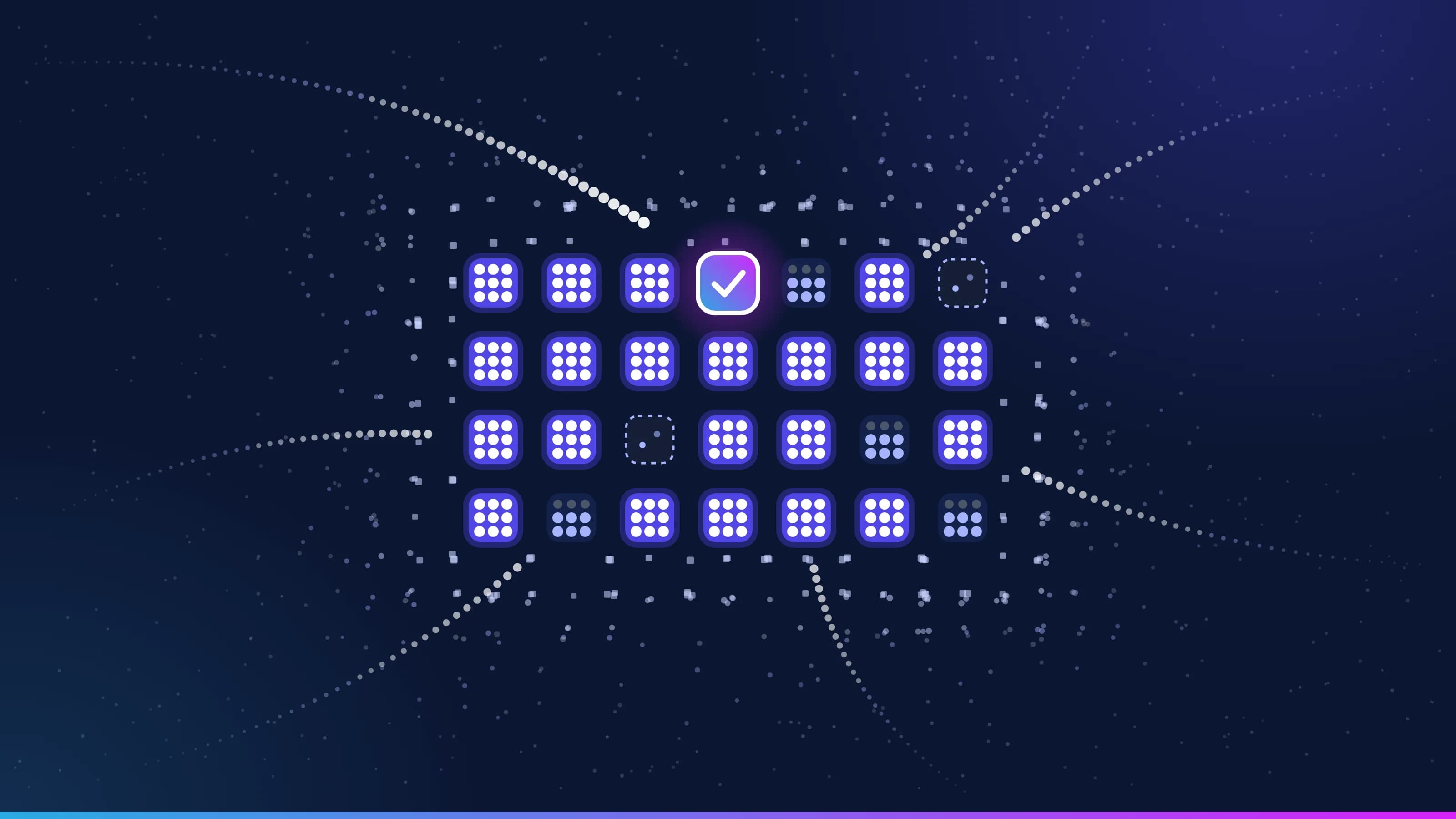 Guide · Data qualityAI-ready data checklist for regulated teamsTwenty-eight checks to run against the data an AI process will read, before it goes live and at set intervals after. Grouped by stage, from sources and owners to documents, mapping and run-time checks, each with why it matters to an examiner and how to test it. · updated November 18, 2026 · 8 min read
 Guide · Data qualityPreparing data for a knowledge layer: a step-by-step guideHow to get data ready for a knowledge layer and the AI agents that read it, in the order that works. Scope by the first queue, profile against named quality dimensions, name owners, resolve entities reversibly, clean documents, record lineage, map to the ontology and put a contract on every source. · updated November 18, 2026 · 17 min read
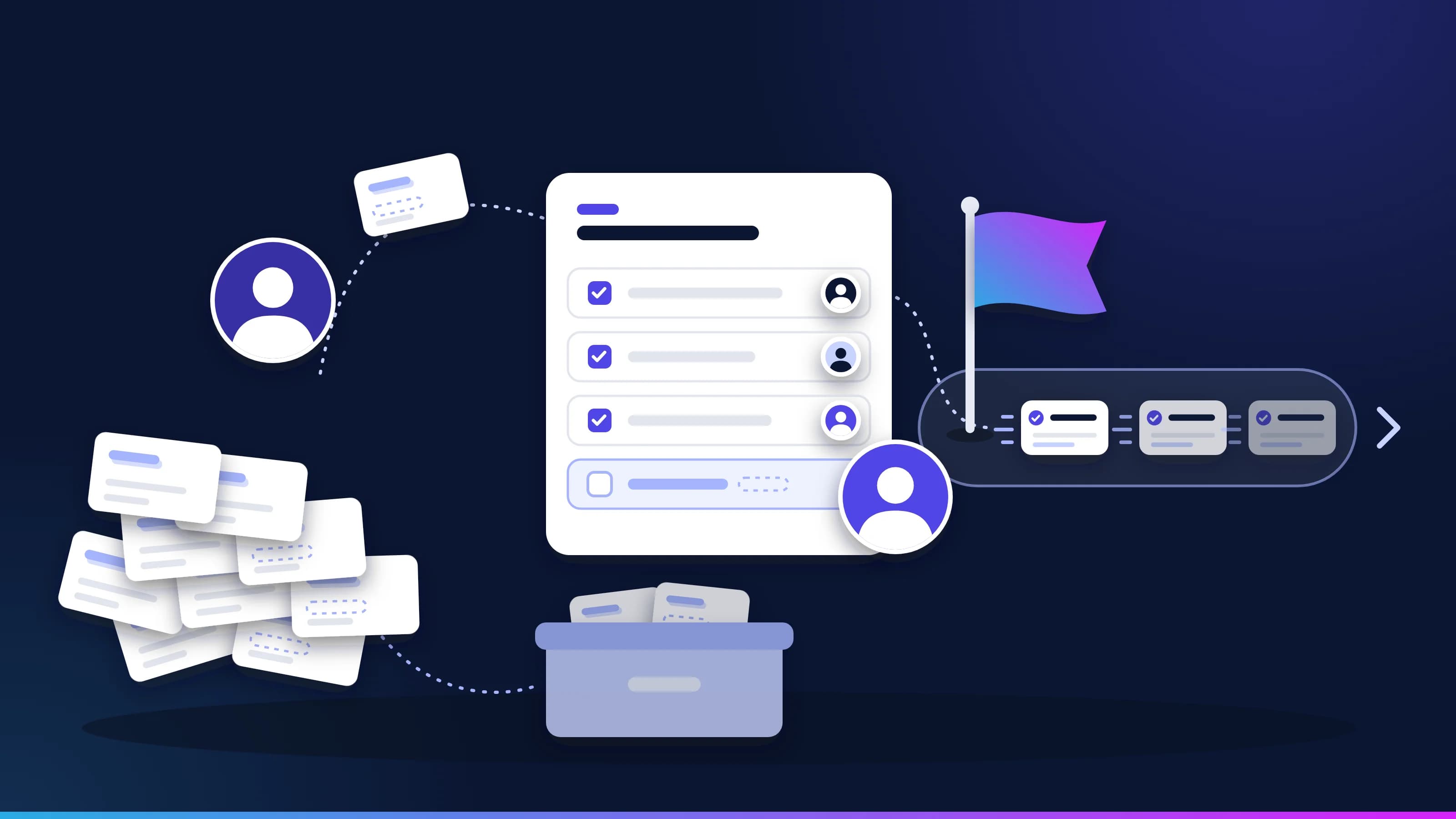 Article · Data qualityGet ahead of data cleanup before AI: a 90-day planData cleanup before AI goes wrong when it tries to fix everything. A 90-day plan that fixes only what the first AI queue reads, at the system it comes from, with a named owner for each source, plus the quick wins and what to leave alone. · updated November 18, 2026 · 7 min read
See it on your work
See how one of your tasks runs, start to finish.
A 30-minute walkthrough of one of your workflows, the approval step and the audit record, with the people who build the platform.