

Series · The knowledge layer, explained
Taxonomy, ontology, knowledge graph: what each one does for AI
A taxonomy sorts your words, an ontology writes down the rules between the things they name, and a knowledge graph connects your real records under those rules. What each stage fixes for an AI agent, who approves it, and where to start.
Inovagio team · Published · 13 min read
On this page
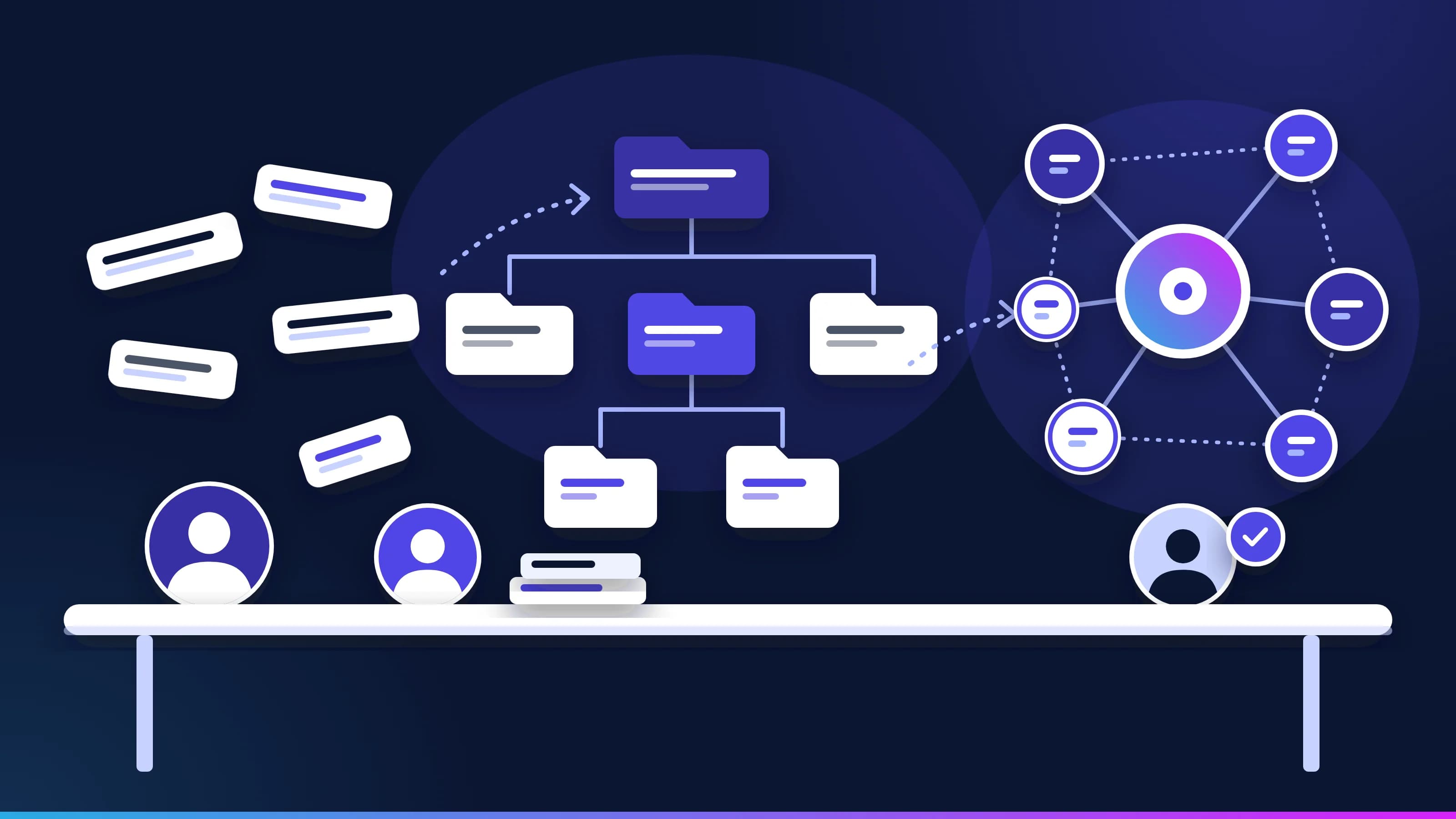
Ask an AI agent at most commercial lenders how many loans are in covenant breach, and you'll get a confident number. It's often wrong. A taxonomy sorts your business's words into a family tree. An ontology writes down the rules for how the things those words name relate. A knowledge graph is your real records, joined by the relationships the ontology defines. Each fixes a different kind of AI mistake.
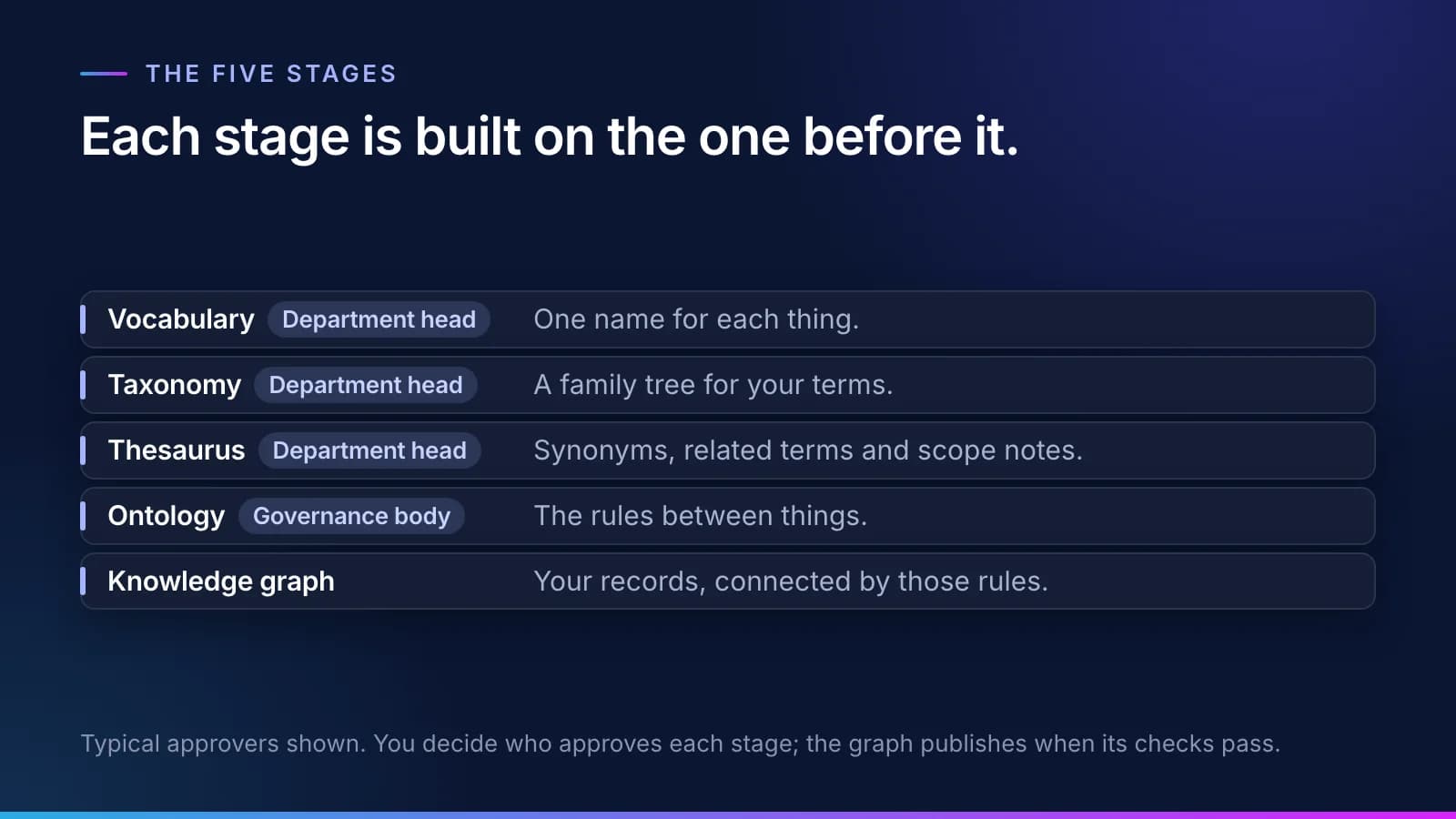
They also come in an order, because you can't write good rules about things you haven't named, and you can't connect records by relationships you haven't defined. That order is the useful part. Below, we climb it one rung at a time with a single loan operations team.
Why AI agents trip over your words
#Take Ferrowood Bank, a regional commercial lender (Example company). Its relationship managers record the same event as "covenant breach", "covenant exception" or "CB". Older files often say only "DSCR shortfall", meaning the borrower's debt service coverage ratio fell below the agreed minimum, which is one kind of covenant breach. The loan system has two date fields that people use interchangeably: the day a test was run and the end of the period it covers. And the word "covenant" means one thing to loan operations and something else to the bank's real estate lawyers, for whom a covenant is a restriction recorded against a property's title.
A person who has worked there for a year knows all of this. An AI agent doesn't. It's software that takes a task and works through the steps on its own, and the language model inside it (the same kind of AI behind chat assistants) knows English, not Ferrowood. Asked for loans in covenant breach, it counts the rows labeled "covenant breach" and misses the rest. Nothing errors. The number comes back low, and it looks right.
Analysts have started saying so in plain terms. Forrester's June 2026 note Build Meaning Before Machines puts it this way: agents without explicit meaning guess, and the guesses show up as wrong joins, misread metrics and actions based on faulty assumptions (Forrester, June 2, 2026). Gartner predicts that by 2027, organizations that prioritize semantics in AI-ready data will increase agentic AI accuracy by up to 80% and reduce costs by up to 60% (Gartner, May 11, 2026). That's a forecast, not a measurement, and Gartner doesn't give the baseline. The direction is the point.
Taxonomy vs ontology vs knowledge graph, one rung at a time
#The words on each rung are old. ANSI/NISO Z39.19, the US standard for controlled vocabularies, describes four types in order of increasing structure: lists, synonym rings, taxonomies and thesauri (NISO, reaffirmed 2010). Our first rung covers the first two. The international standard for thesauri is ISO 25964-1 (ISO, 2011). W3C standards cover all five. SKOS handles the first three; OWL and SHACL handle the ontology; RDF carries the knowledge graph. What's new is that software agents now read all five.
A vocabulary gives each thing one name
#A controlled vocabulary is an agreed list of terms, with one preferred term for each thing and the other names pointed at it. Think of the style guide a newspaper keeps so that every reporter writes the same company name the same way.
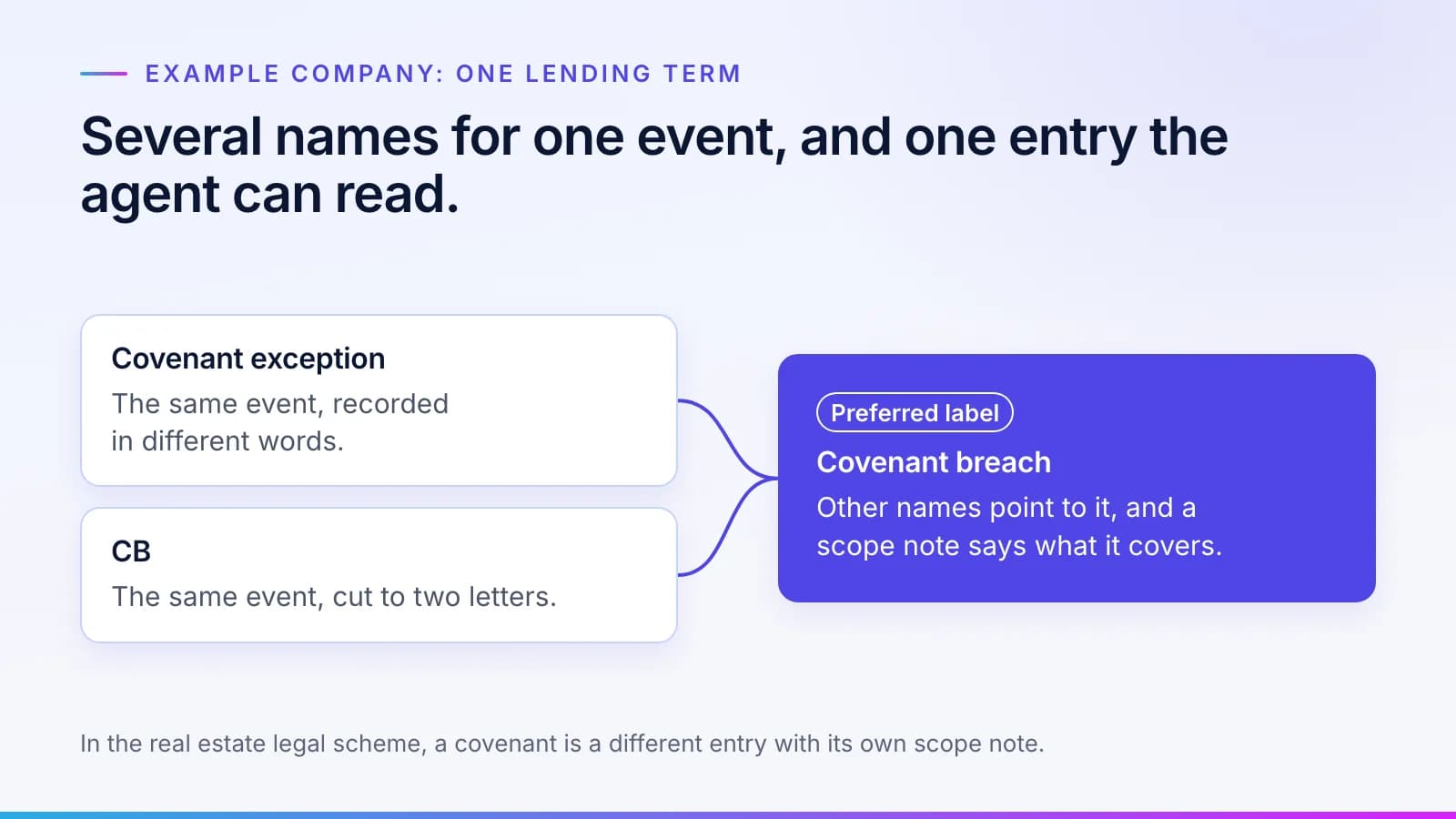
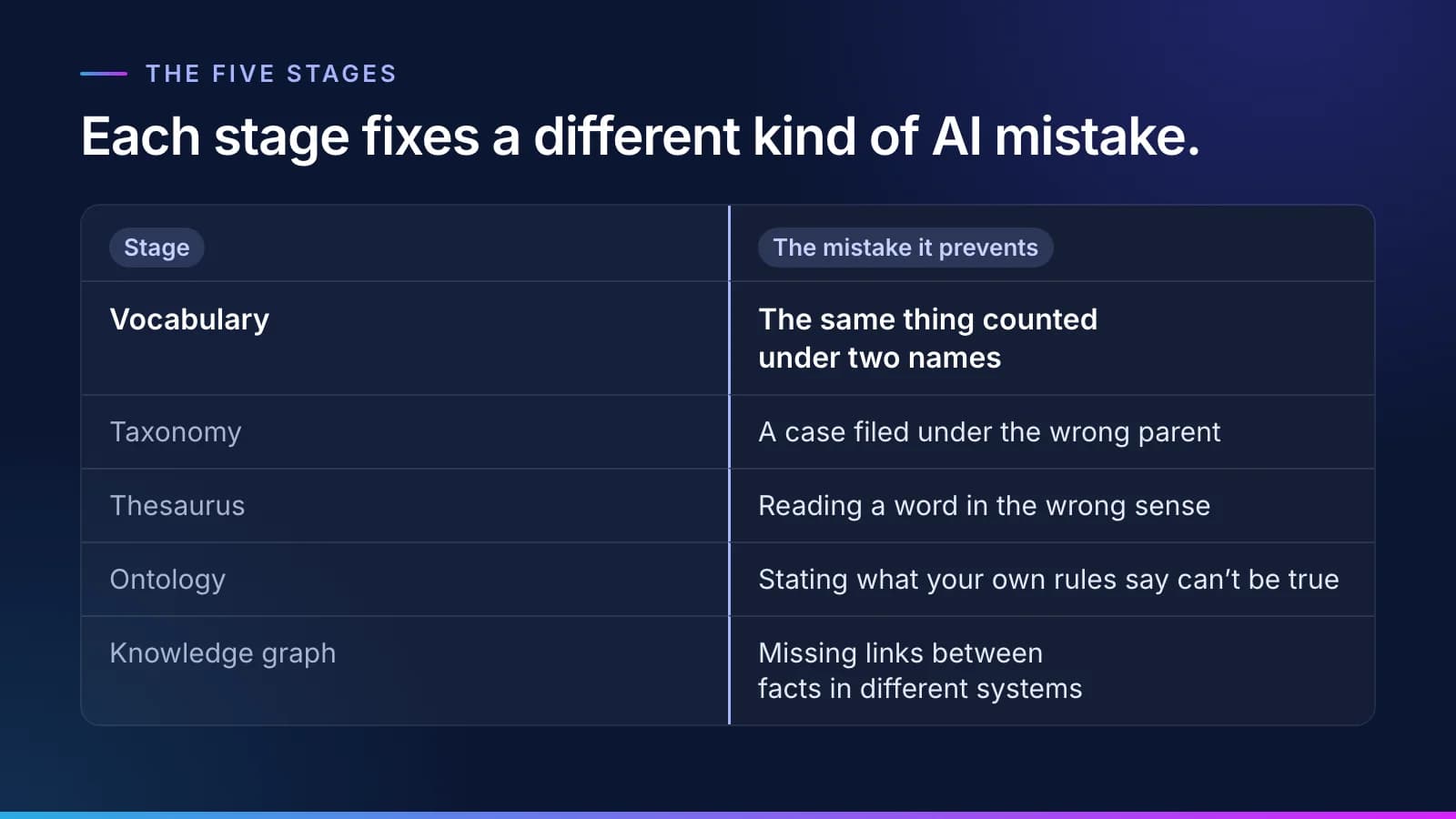
At Ferrowood, the loan operations team picks "covenant breach" as the preferred term and records "covenant exception" and "CB" as other names that point back to it. In the standard's own shorthand, "CB USE covenant breach". That alone fixes most of the low count. The DSCR files wait for the next rung. The mistake it prevents: two agents, or one agent on two days, counting the same thing under different names.
A taxonomy gives your terms a family tree
#A taxonomy arranges the vocabulary into parents and children. A financial covenant breach is a kind of covenant breach; a DSCR shortfall is a kind of financial covenant breach. It's the folder structure everyone wishes the shared drive had.
The tree lets an agent roll numbers up and drill down without being told every child by name, so the DSCR shortfalls now count as covenant breaches. It also routes work: Ferrowood sends financial covenant breaches to one desk and late financial statements, a reporting covenant breach, to another, because its loan agreements give the two different cure periods. The mistake it prevents: a case filed under the wrong parent, so it lands in the wrong queue or the wrong total.
A thesaurus adds related terms and scope notes
#A thesaurus keeps the preferred terms and the tree and adds the third kind of link the standards define: "related" links between concepts where neither is a kind of the other. "Covenant breach" is related to "waiver" and "cure period", because someone looking up one usually needs the others. A related link never joins a concept to any of its ancestors or descendants in the tree, a rule SKOS itself states, because that would blur the hierarchy. Scope notes, a line or two saying what a term covers and what it doesn't, belong at every rung, but a thesaurus can't work without them.
The W3C's format for the first three rungs is the Simple Knowledge Organization System (SKOS), a Recommendation since 2009. It gives each concept a preferred label and alternative labels, links it to broader and narrower concepts and to related ones, and carries its scope note (W3C SKOS Reference, August 18, 2009).
This is also where Ferrowood's two meanings of "covenant" meet. Words spelled the same with different meanings are homographs, and Z39.19 and ISO 25964 handle them the same way: each meaning gets its own entry, told apart by a qualifier in parentheses and a scope note. Here that's "covenant (loan agreement)", a condition the borrower agrees to in the loan documents, and "covenant (real property)", a restriction recorded against a title. Each sits in its own department's scheme and neither is mapped to the other, so an agent can't mistake one for the other.
The agent reading a title report now knows which one it's looking at. The mistake it prevents: reading a word in the wrong sense, which is the error that sounds most fluent and is hardest to spot.
Many teams stop here, and for search and routing that's often enough.
An ontology writes the rules between things
#A thesaurus says two concepts are related, but not how. An ontology names each relationship and states the rules it obeys, precisely enough for software to reason with them. Its classes are the things the business deals with. A loan agreement has borrowers and covenants, and each covenant test produces a result. The vocabulary stays a vocabulary. A test result that fails is tagged with the SKOS concept "covenant breach", so loan operations can keep refining its terms without an ontology release each time. The rules sit on the classes. A covenant test is run under exactly one loan agreement. A loan agreement covers one or more borrowers. A test's period end must fall inside the term of the loan. A relationship manager may not approve a waiver on a loan they originated.
Two W3C standards write these down so software can use them, and they do different jobs. OWL 2, the Web Ontology Language, describes classes of things and the properties that link them, so software can infer facts nobody wrote down (W3C OWL 2 Overview, Second Edition, December 11, 2012). We reason with its RL and EL profiles, which are built to stay fast on large record sets and large hierarchies. SHACL, the Shapes Constraint Language, checks each record against the rules and reports the ones that break them (W3C SHACL, July 20, 2017). OWL infers; SHACL validates. A spreadsheet of terms can't tell you that a covenant test for a period before the loan began is impossible. An ontology with its shapes can, and an agent that checks its work against one can stop and say so.
That last part matters more than it sounds. In a 2024 follow-up study, Dean Allemang and Juan Sequeda had software check each AI-written query against the ontology and send any that broke the rules back for repair. The share of answers that were either right or an honest "I don't know" rose from 54% to 72%, with "I don't know" making up 8 points of it, so the error rate fell to 20% (Allemang and Sequeda, arXiv, May 20, 2024). For a regulated lender, an honest "I don't know" is worth a great deal. The mistake it prevents: stating something your own rules say can't be true.
A knowledge graph connects your records
#A knowledge graph is the ontology filled in with real things: this loan, this borrower, this building, this appraisal, joined by the relationships the ontology allows. If the ontology is the rulebook, the knowledge graph is the scorebook with every real game recorded.
Now an agent can answer questions that cross systems. Which loans in covenant breach are secured by a building whose last appraisal is more than three years old, and belong to a borrower group with another loan maturing this quarter? Each hop follows a relationship the ontology allows, and each fact records where it came from, so every step of the answer can be traced. The mistake it prevents: missing the connection between facts that sit in different systems.
What the evidence says
#The clearest test happens to use insurance data, though its lesson isn't about insurance. In 2023 Juan Sequeda, Dean Allemang and Bryon Jacob asked a leading language model 43 business questions about an insurer's data: 13 tables taken from the OMG standard data model for property and casualty insurance, which runs to 199 tables in full. The model either wrote SQL (the language databases are queried in) against the tables, or queried a knowledge graph built over them. The result: a model answered 16% of business questions correctly from the raw tables and 54% from a knowledge graph of the same data (Sequeda, Allemang and Jacob, arXiv, November 13, 2023).
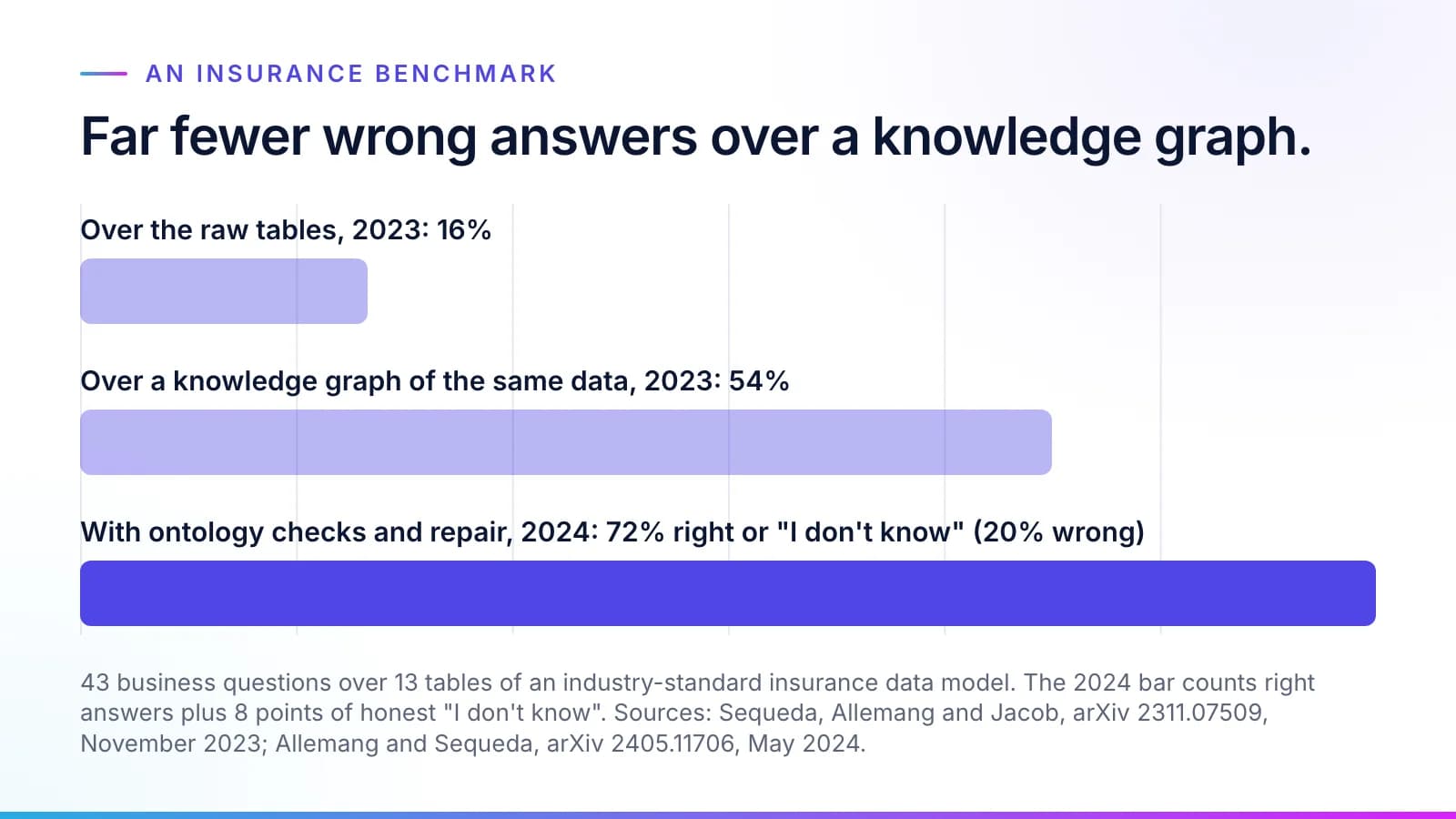
The split by difficulty is the striking part. On questions that needed more than four tables, the model got 0% right from the raw tables and 35.7% to 38.5% right over the knowledge graph. Those are the questions an operations leader actually asks.
Two cautions. It's one benchmark, run with one model of its day; today's models would score differently on both sides, so read the gap, not the absolute numbers. And the knowledge graph was built carefully by people who know the domain. A graph that a model extracts from your documents on its own is cheaper and noisier, which is a different trade (our guide to how AI agents use your knowledge graph covers it).
Who approves each stage
#Words are cheap to write and expensive to get wrong, so every stage needs an owner. In the way we run it, each department keeps its own vocabulary, taxonomy and thesaurus, and the right person there approves them, often the department head, because loan operations knows what a covenant breach covers and the real estate lawyers know what a title covenant is. A department's concept reaches the company-wide ontology only when someone decides the organization needs it, and it arrives as a mapping to the enterprise concept, so two departments' meanings never merge by accident. Because the ontology's rules cross departments, many organizations have a governance body or compliance approve it. A rule can require more than one approver, and an agent never approves anything. The knowledge graph has no single approver: a version is published only when every fact says where it came from, every record passes the ontology's shapes and the version has been evaluated on the live inference server.
Synesis, the knowledge layer in Inovagio, runs each change as a change set that moves from proposed to in review to approved to published, with a stage, status, confidence and version on every concept. Anything an agent extracts arrives as a candidate with a confidence score, and only a score that has been checked against a random audit of human reviews can let a simple term skip the queue. By default, Virtual Employees read only knowledge that has passed its gates. The terms come from interviews with the people who do the work (we explain why we start by listening), and how a rule is approved shows the same discipline applied to a single business rule. The approved graph is stored in MNEMOS, where Virtual Employees read it at the moment they need it. And because every stage is written in the W3C standards above, the rulebook exports free and goes wherever you take it, whichever vendor or model you use next.
Where to start
#Most teams don't need a knowledge graph on day one. Start with the vocabulary for one queue. It's the cheapest stage and it fixes the most common error: the same thing counted under two names.
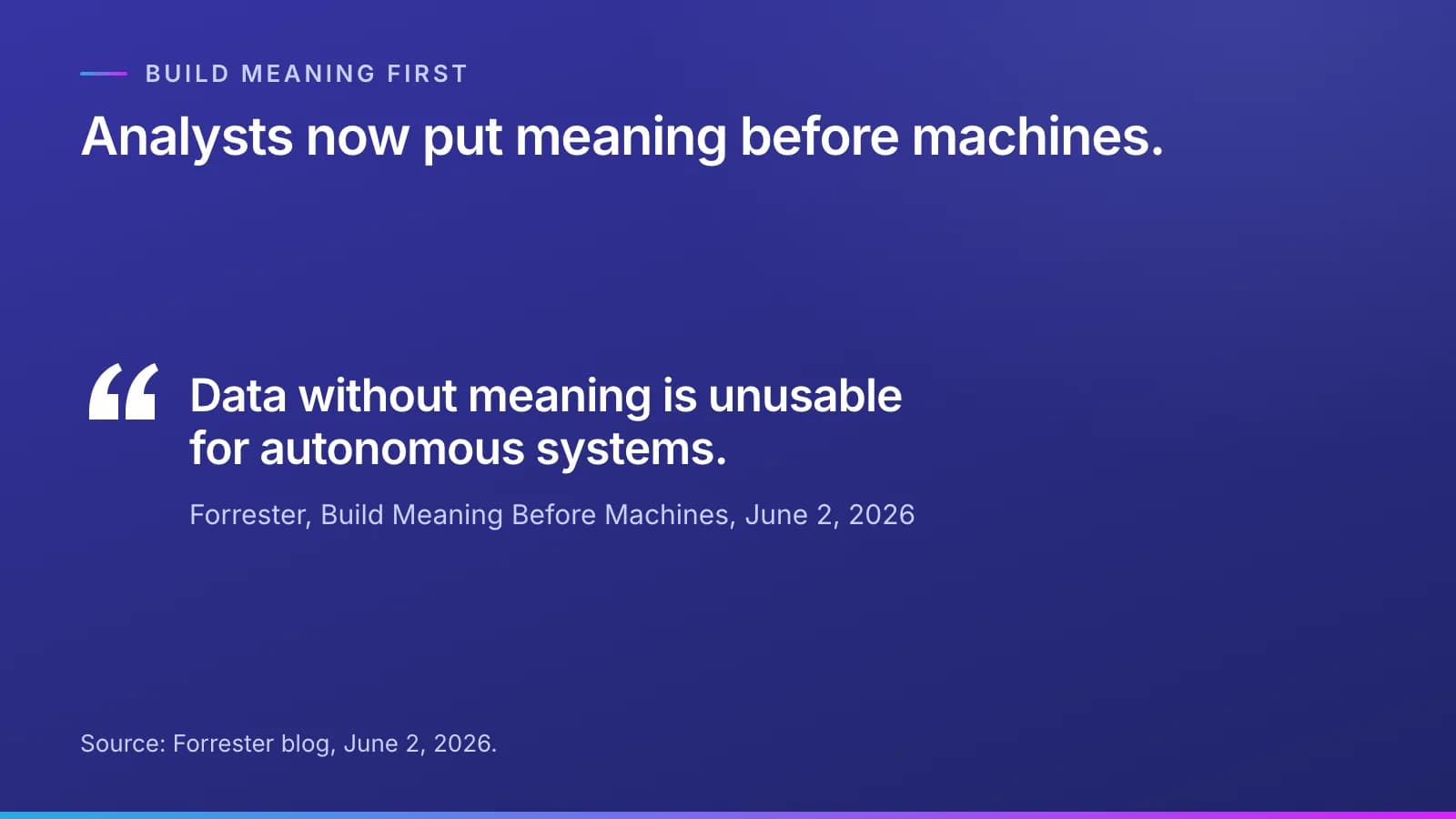
Forrester's advice runs the same way: it calls the semantic layer the right starting point and says most organizations aren't yet ready to build a knowledge graph. We'd add one thing. Climb when a real question forces you to, and write that question down first. "Which loans in breach are secured by a building with a stale appraisal?" is the kind of question that justifies an ontology. "What does CB stand for?" only needs a vocabulary.
The questions you want answered decide how far up the ladder you go. Ontologists call them competency questions, a practice that goes back to Michael Grüninger and Mark Fox's ontology design work in 1995, and they're the subject of our technical companion to this piece, ontology for AI agents, which shows the standards and the queries for architects. If your questions are mostly about numbers, start with the semantic layer instead. For how these stages fit into the wider picture of what an agent reads before it acts, see what a context layer is, and for short answers to the questions buyers ask most, the knowledge layer questions and answers.
Further reading
#- Build Meaning Before Machines: Why Semantics, Ontologies, And Knowledge Graphs Matter For Agentic AI, Forrester, June 2, 2026: forrester.com
- Gartner Says Lack of Semantics Causes Inaccurate AI Agents and Wasted Spending, Gartner, May 11, 2026: gartner.com
- A Benchmark to Understand the Role of Knowledge Graphs on Large Language Model's Accuracy for Question Answering on Enterprise SQL Databases, Sequeda, Allemang and Jacob, November 13, 2023: arxiv.org
- Increasing the LLM Accuracy for Question Answering: Ontologies to the Rescue, Allemang and Sequeda, May 20, 2024: arxiv.org
- SKOS Simple Knowledge Organization System Reference, W3C, August 18, 2009: w3.org
- OWL 2 Web Ontology Language Document Overview (Second Edition), W3C, December 11, 2012: w3.org
- Shapes Constraint Language (SHACL), W3C, July 20, 2017: w3.org
- ANSI/NISO Z39.19, Guidelines for the Construction, Format, and Management of Monolingual Controlled Vocabularies, NISO, reaffirmed 2010: niso.org
- ISO 25964-1:2011, Thesauri and interoperability with other vocabularies, Part 1: Thesauri for information retrieval, ISO, 2011: iso.org
Questions
What people ask.
What is the difference between a taxonomy and an ontology?
A taxonomy arranges terms into parents and children, such as a DSCR shortfall being a kind of financial covenant breach. An ontology states the rules between things, such as a covenant test belonging to exactly one loan agreement and its period falling inside the loan's term. A taxonomy helps an AI agent sort and count; an ontology lets it check whether an answer can be true.
What is the difference between an ontology and a knowledge graph?
An ontology is the set of types and rules: loans, borrowers, buildings and how they may relate. A knowledge graph is that ontology filled in with your real records, so this loan is linked to this borrower and this building. The ontology is the rulebook and the knowledge graph is the record of what actually happened under it.
Do we need a knowledge graph to use AI agents?
Usually not at the start. Most teams get the largest early gain from an agreed vocabulary for one queue, then a taxonomy and thesaurus. A knowledge graph earns its cost when the questions you need answered cross several systems, such as linking loans, buildings and appraisals.
Who should own the company's vocabulary and ontology?
The people who do the work should own their words. You decide who approves them: often a department head for an area's terms and taxonomies, and a governance body or compliance for the ontology, because its rules cross departments. A rule in regulated work can require more than one approver.
How long does it take to build a controlled vocabulary?
For one queue, a working vocabulary comes from interviews with the people who run it and a review of its records, and the time depends on how many teams share those words. The larger effort is keeping it current, which is why every change should go through an owner and carry a version.
The products, industries and examples it covers.
- Knowledge layerSynesisTurns your policies, procedures, records and your people’s know-how into a rulebook your experts approve, which you own and can take anywhere.
- Data engineMNEMOSRecords, documents, vectors, graph and agent memory in one engine, with a ledger behind every write.
- IndustryLending and account operationsBorrowers’ statements and tax returns spread, covenants tested and annual review memos drafted against your credit policy. Your credit team decides.
- OverviewHow it worksTen checked steps from your first decision to the day it handles real cases.
- OverviewArchitectureHow the platform fits together, from your data to finished work.
Read next.
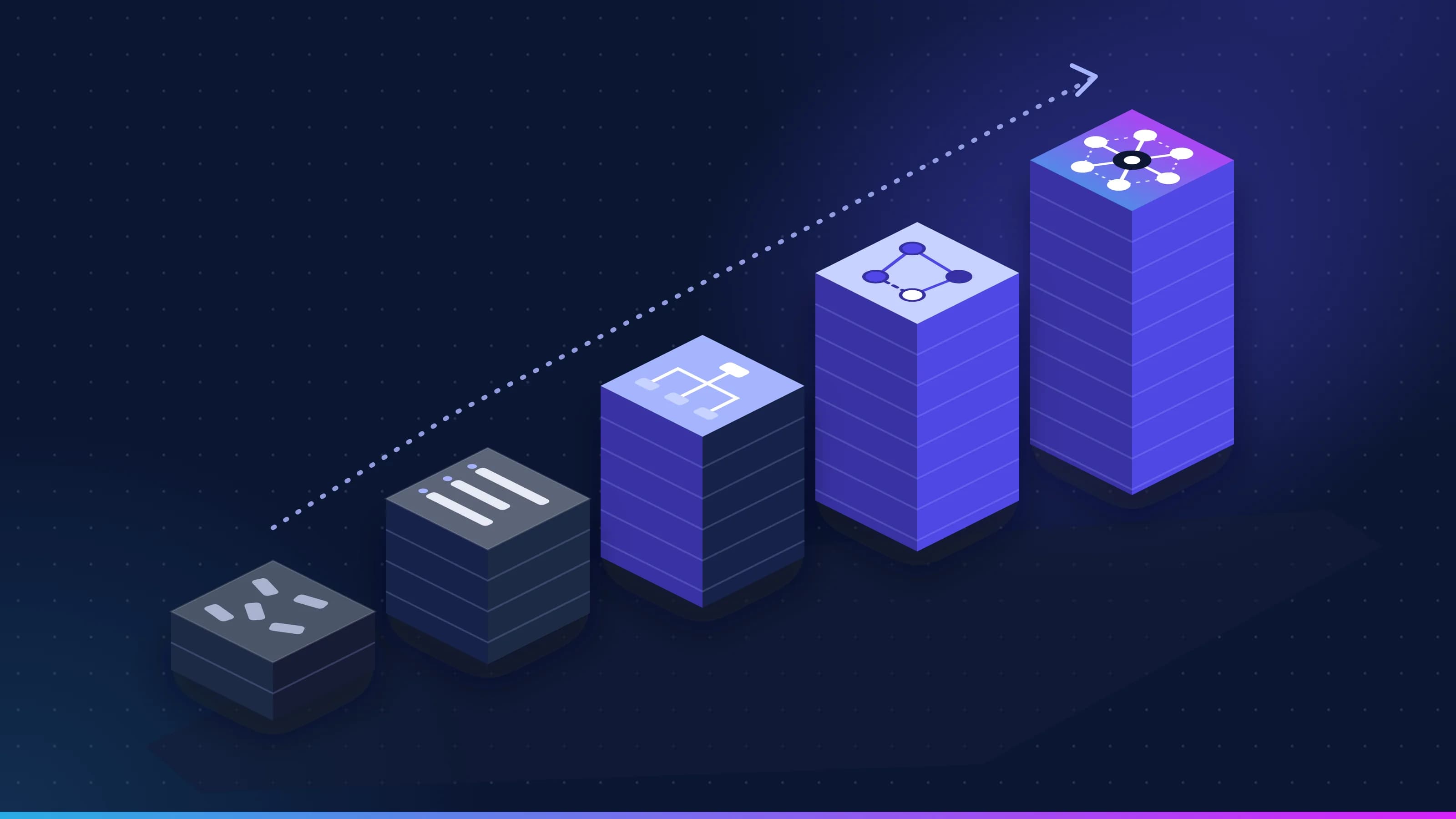 Guide · OntologyOntology for AI agents: how to build one in five stagesHow to build an ontology AI agents can use, in five gated stages from a controlled vocabulary to a knowledge graph. The W3C standards for each stage, competency questions, Turtle and SPARQL for a worked example, entity resolution, versioning and "as of" queries. · updated November 18, 2026 · 21 min read
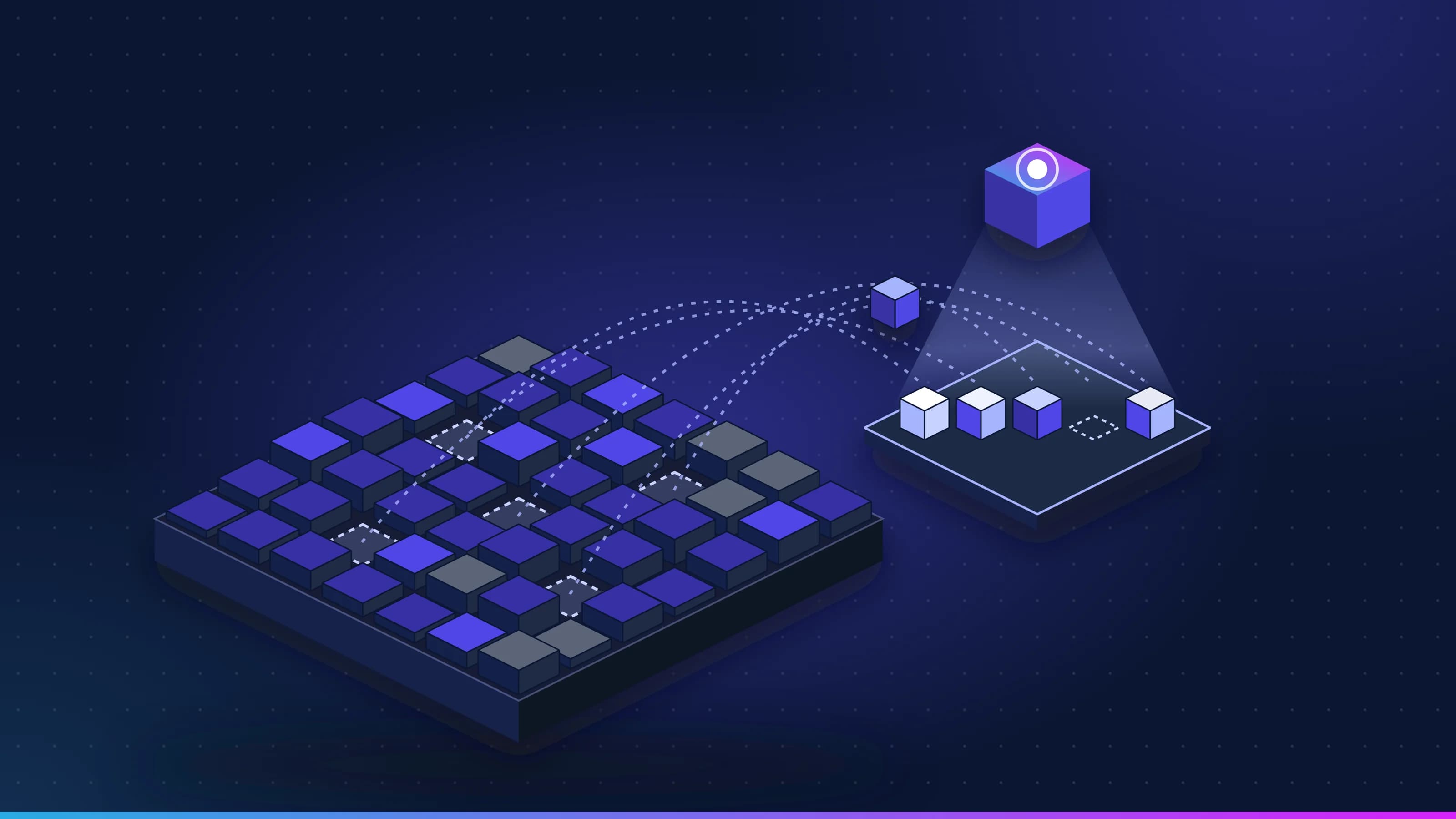 Article · Context engineeringWhat is a context layer, and why do AI agents need one?A context layer tells an AI agent what your words mean, which rules apply, which records it may open and what was decided before. Gartner now calls it a core part of data infrastructure, and Forrester the next step after semantic layers and knowledge graphs. Here is what goes in one, in plain words. · updated November 18, 2026 · 11 min read
 Guide · KnowledgeKnowledge layer: questions and answersStraight answers to the questions buyers and architects ask about the knowledge layer for AI agents, from ontologies, knowledge graphs and semantic layers to context engineering, GraphRAG, semantic caching, small models and who owns it all. · updated November 18, 2026 · 12 min read
See it on your work
See how one of your tasks runs, start to finish.
A 30-minute walkthrough of one of your workflows, the approval step and the audit record, with the people who build the platform.