

Series · The knowledge layer, explained
Business rules or AI guardrails? Why regulated work needs both
Guardrails filter what an AI model takes in and says. Business rules check what the work itself must satisfy. In regulated work you need both, plus a model's judgment for the messy parts. What each one catches, a worked example, and what to ask a vendor.
Inovagio team · Published · Updated · 12 min read
On this page
AI guardrails vs business rules is a question of what gets checked. Guardrails screen the conversation with the model; business rules check the work itself. Regulated work needs both.
A business customer sends a pallet of pump seals back to Halvercott Supply and asks for a credit (Halvercott Supply · Example company). An AI agent reads the email, works out the credit and drafts the credit note and a reply. The reply is polite, contains no other customer's data and passes every safety filter the distributor bought. The amount is wrong. The agent credited the full invoice, but Halvercott's terms of sale say a return the customer chooses to make more than 30 days after delivery carries a restocking fee.
AI guardrails are filters on what a model takes in and says: they block prompt injection, leaked personal data and unsafe content. Business rules are deterministic checks of what the work itself must satisfy: the restocking fee, the approval limit, the second signature. The Halvercott reply passed the first kind of check and needed the second.
Most of the market uses "guardrails" for both, and that's where buyers get hurt. Below we pull the two apart, add a third, the model's own judgment, and then follow all three through a single credit from the email to the record.
Three different kinds of check
#Each one answers a different question, and mixing them up is how the Halvercott credit got out the door.
Guardrails decide whether an input or output is safe to pass. They screen the text going into the model and the text coming out. Most use classifiers and pattern checks. They catch a prompt that tries to override the agent's instructions, a reply that includes a customer's account number, or content no business should send. They're probabilistic or pattern-based by design, because their job is to catch a wide range of bad things quickly, and a filter that tried to be exact about everything would block half your legitimate mail.
A business rule decides whether the work meets your policy. It's a precise statement with an owner, such as "a credit above the team's approval limit needs a supervisor's approval". Give it the same facts twice and you get the same answer twice, along with the rule and version that produced it.
Then there's the model's own judgment, which handles everything nobody could write a rule for. It reads a long, chatty email, notices a line saying a few of the seals arrived cracked, which would make that part of the return Halvercott's error rather than the customer's choice, and drafts a reply in plain English. No rulebook anticipates every way a customer phrases an email.
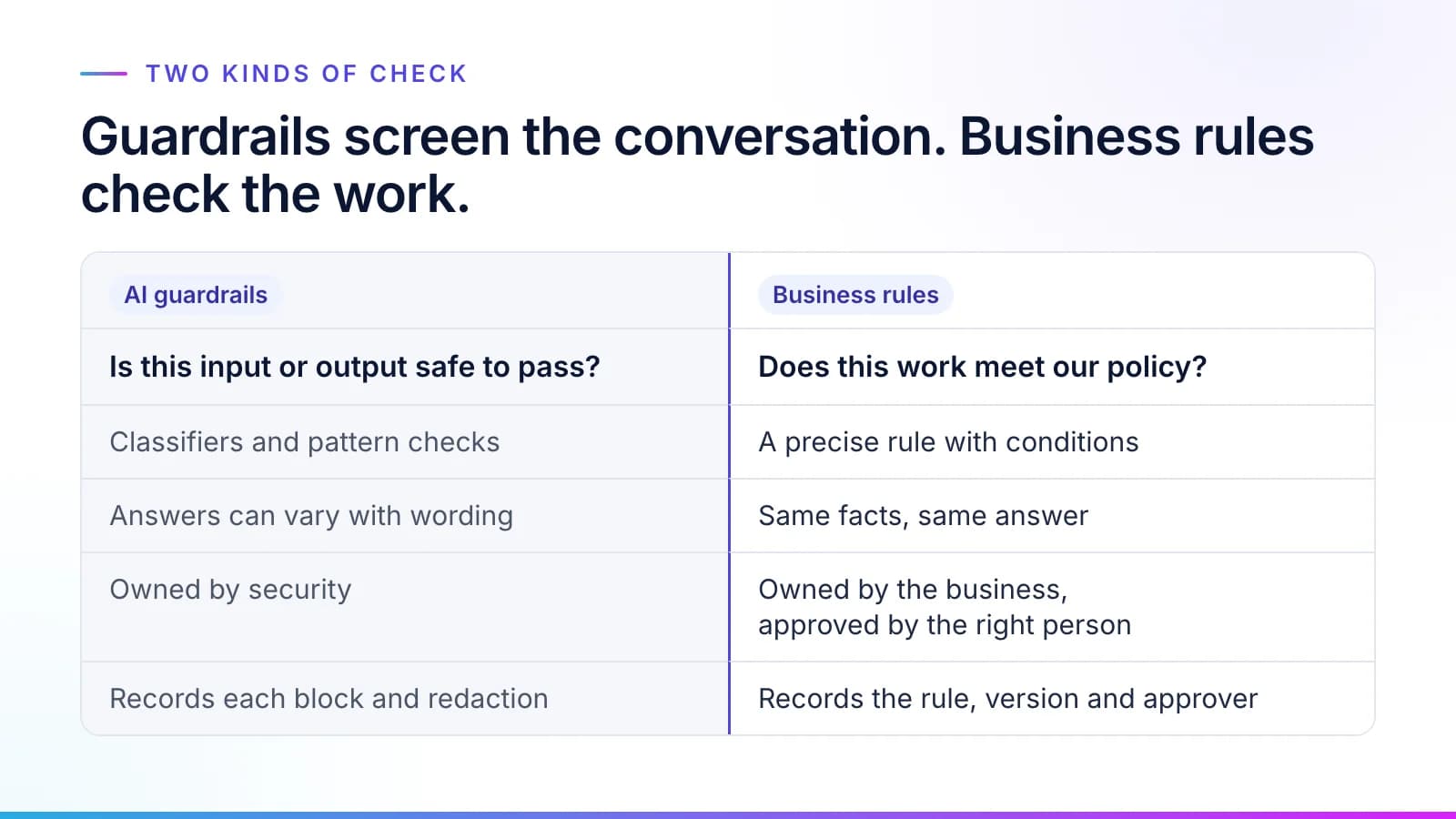
A guardrail would never have caught Halvercott's credit. Nothing about the reply was unsafe. It was just wrong, in a way only someone who knew the terms of sale could see.
Why guardrails alone can't run regulated work
#Regulators and auditors want to know why a decision was made, and guardrails can't tell them. "The output passed our content filter" isn't a reason. "Rule CR-12, version 3, approved by the controller in June, applies the restocking fee to a customer-choice return made more than 30 days after delivery" is. A credit note reduces revenue, so it's also a control the external auditors test.
The security community has written down what guardrails are for. OWASP's Top 10 for LLM Applications puts prompt injection and sensitive information disclosure first and second in its 2025 edition (OWASP GenAI Security Project). Its Top 10 for Agentic Applications, published in December 2025, starts with agent goal hijack and tool misuse: hidden instructions that redirect what an agent is trying to do, and an agent manipulated into turning its legitimate tools to harmful ends (OWASP GenAI Security Project, December 9, 2025). Screening inputs and outputs is a necessary defense there. None of the entries on either list is "the agent waived a fee the terms require", because that isn't a security failure. It's a policy failure, and policy lives in rules.
The cost of getting this wrong shows up in project outcomes. Gartner predicts over 40% of agentic AI projects will be canceled by the end of 2027, due to escalating costs, unclear business value or inadequate risk controls (Gartner, June 25, 2025). In a regulated firm, one plain form of inadequate risk control is an agent that nobody can show followed the firm's own rules.
Decision tables are rules people can read
#Business rules have a standard form that predates generative AI by years. The Object Management Group's Decision Model and Notation (DMN) defines decision tables; a decision requirements diagram that shows how decisions depend on each other and on the data they use; an expression language called FEEL (Friendly Enough Expression Language) for the logic in each cell; and an XML format for exchanging models between tools. The current formal version, 1.6, was adopted in September 2026 (OMG, DMN specification page). A decision table puts its inputs in the first columns and its outputs in the last, one rule per row, and names its hit policy. Here is Halvercott's restocking fee as one.
Restocking fee (hit policy U, Unique)
| Rule | Return reason | Days since delivery | Restocking fee rate |
|---|---|---|---|
| 1 | "supplier error" | - | 0 |
| 2 | "customer choice" | <= 30 | 0 |
| 3 | "customer choice" | > 30 | 0.15 |
The cells are FEEL. A dash matches any value, <= 30 means 30 days or fewer, and the rate is a plain number, so 0.15 is fifteen cents on the dollar. That's an example rule, written for this piece; real terms vary by product line and by customer contract.
The approval is a second decision, and the diagram is where that shows. Whether a supervisor signs depends on the size of the credit, and the credit depends on the fee, so the approval decision takes the credit amount as its input:
Approval (hit policy U, Unique)
| Rule | Credit amount | Approval |
|---|---|---|
| 1 | <= Team limit | "none" |
| 2 | > Team limit | "supervisor" |
Put both in one table and you'd be asking whether the credit is over the limit before you'd worked out the credit. Splitting decisions along their real dependencies is most of the craft of decision modeling. The point is that the controller can read every row, check it against the terms of sale and approve it. An auditor can read it too. A model's weights can't be read by anyone.
Two properties of decision tables matter for AI work. A table states what happens when more than one row matches, which DMN calls the hit policy. Unique means no two rows may match the same case; First takes the first match in row order; Priority picks the match whose output ranks highest; Collect returns every match. Overlaps become a design choice instead of an accident, and a modeling tool can flag rows that overlap or leave a gap, such as a return reason the table never mentions. And because the inputs are explicit, a table can be tested completely: one case per row, the boundaries (day 30 and day 31) and a check that no input falls through. Nobody can do that for a prompt.
DMN isn't the only open form. A rule that checks data rather than picks an outcome ("every credit note above the limit carries a supervisor's approval") is often written as a shape in SHACL, the W3C's constraint language for graph data, which is one of the open formats our rulebook exports in. Our guide on how a rule is approved shows the parts every rule carries in Inovagio. Each one records what it says and where it applies, where it came from and who approved it, plus its full version history.
Neuro-symbolic AI, in plain words
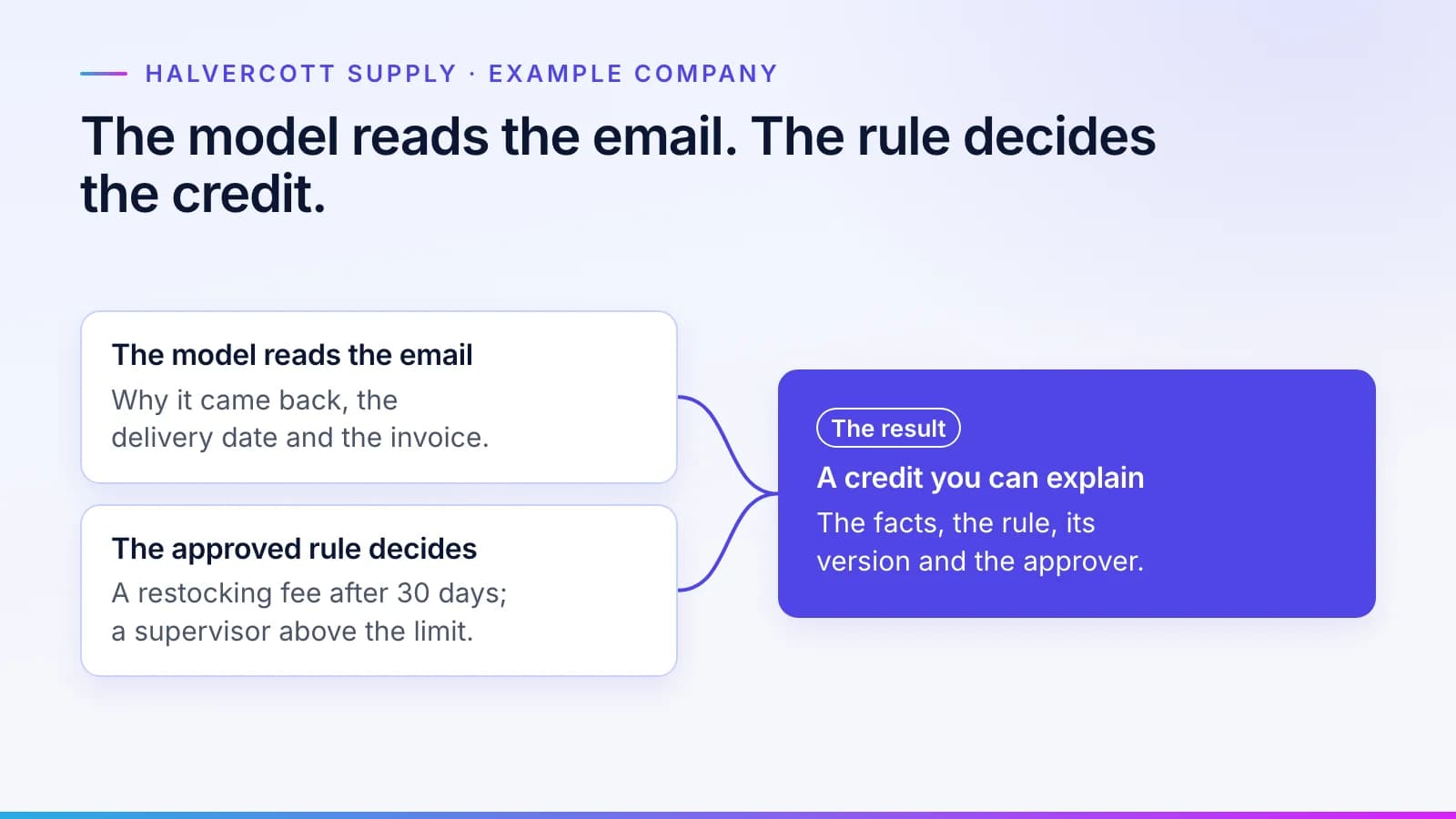
#Neuro-symbolic AI pairs a neural model, which is good at reading messy input, with symbolic logic, which is good at applying precise rules. Think of a new accounts receivable clerk and the rulebook on their desk. The clerk reads the email; the rulebook decides the credit.
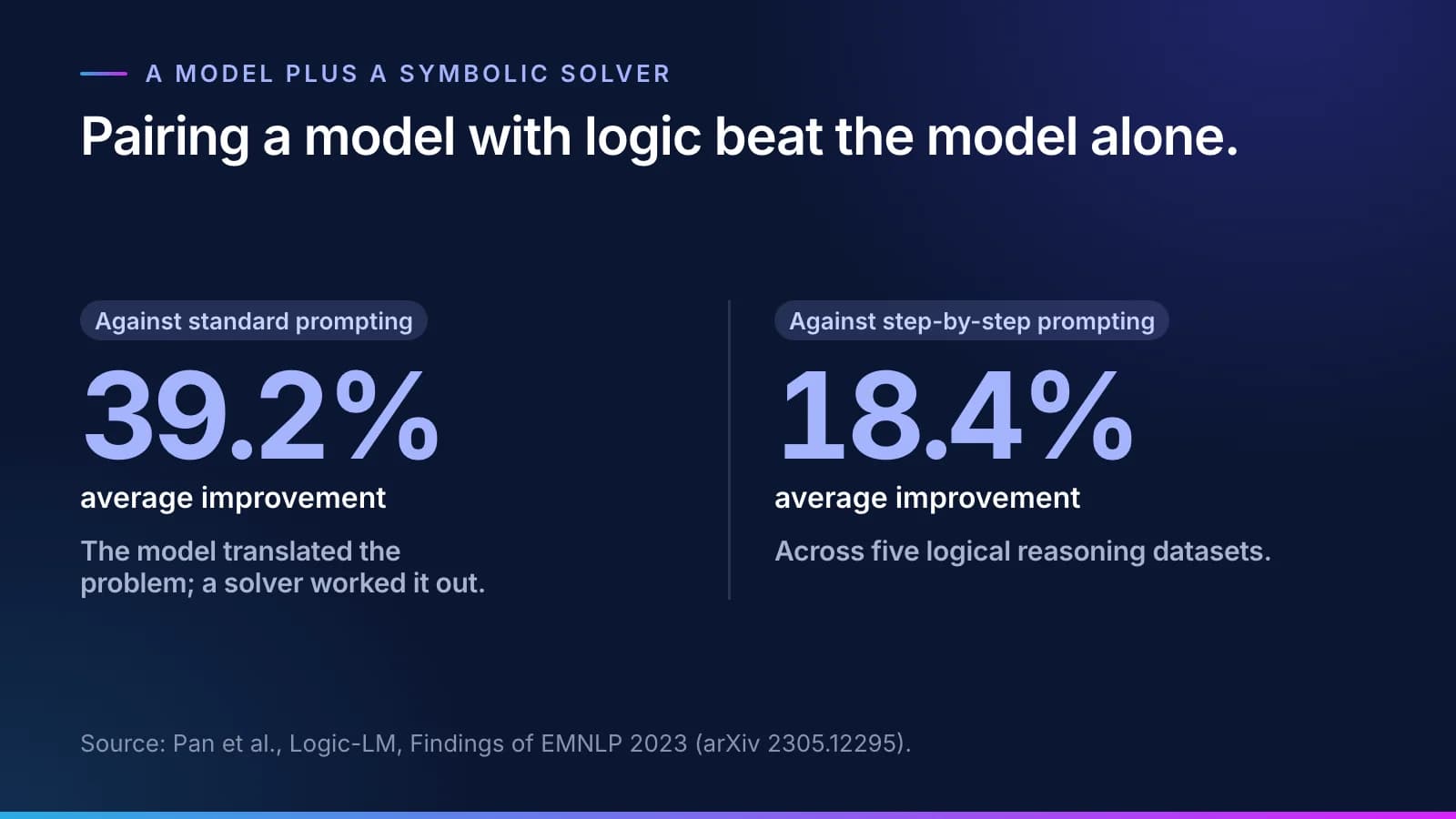
The research case for the pairing is strong. Liangming Pan and colleagues built Logic-LM, which has a language model translate a reasoning problem into a formal representation and passes it to a symbolic solver to work out the answer. Across five logical reasoning datasets, that beat the model alone by 39.2% on average with standard prompting, and by 18.4% when the model was asked to reason step by step (Pan et al., Logic-LM, Findings of EMNLP 2023).
A related result comes from enterprise data. Before running each query a model wrote, Dean Allemang and Juan Sequeda checked it against an ontology (a formal model of the business's concepts) and sent failing queries back to the model to repair. The share of answers that were either right or an honest "I don't know" rose from 54% to 72%, with "I don't know" making up 8 points of it, so the error rate fell to 20% (Allemang and Sequeda, arXiv, May 20, 2024). For a regulated firm, a system that refuses when its rules don't cover the case is worth as much as one that answers correctly.
Formal checks of model answers are an active research area too. One research team describes a system that uses a model, with optional human guidance, to translate a written policy into formal logic, then checks each answer against that logic, and reports a near-zero rate of answers wrongly passed as valid (An, Bayless et al., arXiv, November 2025, revised July 2026). And a June 2026 research agenda for regulated process automation argues for building the rules into how agents are structured, which its authors call compliance by construction, while keeping guardrails to catch the errors of meaning that structure can't (Rombach, Lauer and Mehdiyev, arXiv, June 2026). We take the same position: the policy belongs in the structure, and filters belong on the conversation.
How the three fit in one task
#Here is Halvercott's credit again, done properly.
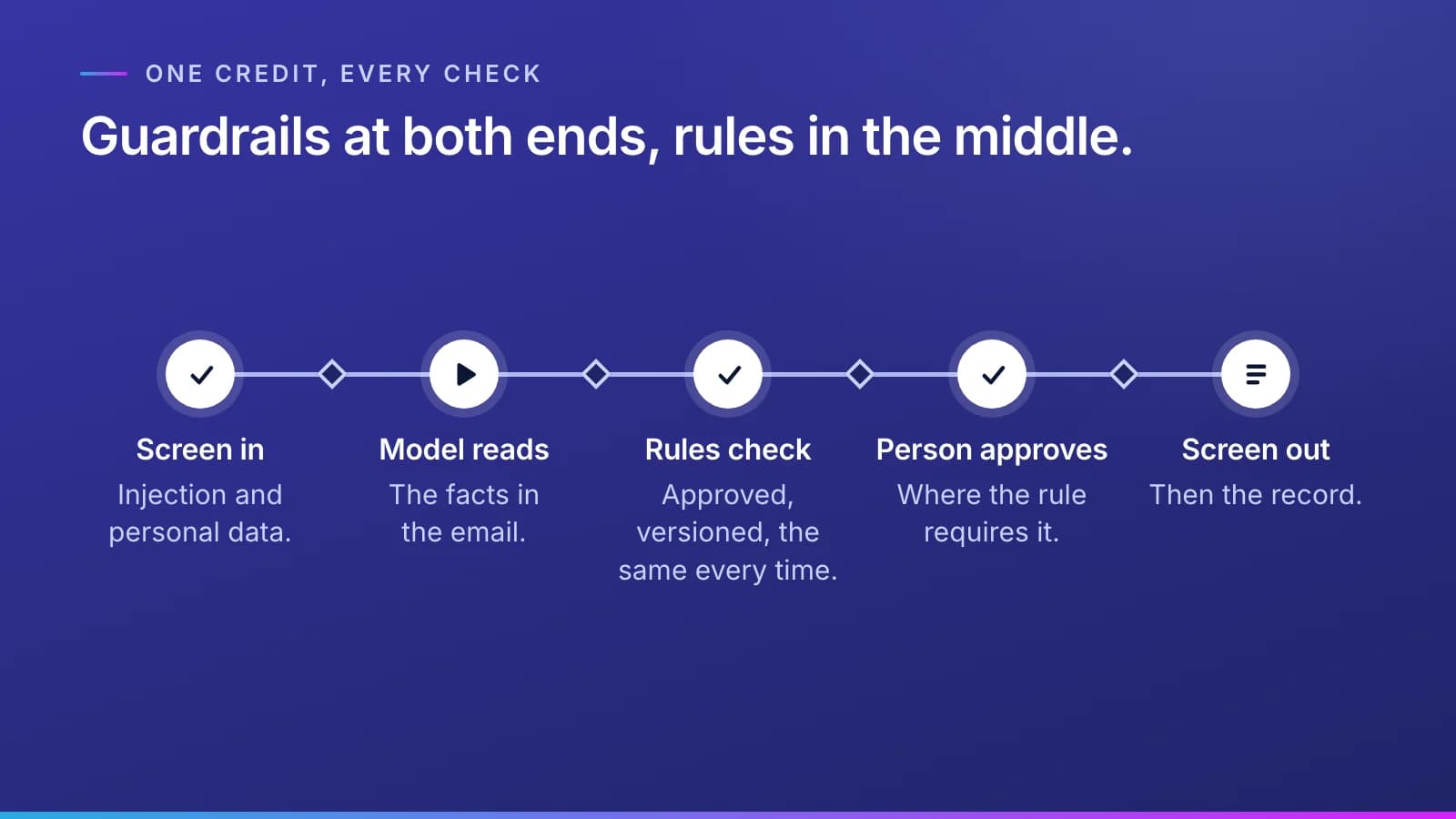
- The email comes in, and the input is screened for prompt injection and personal data that shouldn't be there.
- The model reads the email and the order record and extracts the facts: the reason for the return (the customer's choice, plus a claim that a few seals arrived cracked), the delivery date and the invoice number.
- The approved rules check the draft credit. Most of the return was the customer's choice, 45 days after delivery, so that part carries the restocking fee; the cracked seals count as supplier error and don't. The credit is above the team's approval limit, so it waits for a supervisor.
- The supervisor sees the extracted facts and the amount, with the rule that applied, and approves.
- The reply is drafted and screened on the way out.
- The record keeps it all: the email, the extracted facts, the rule with its version, the approver, the credit note and the reply.
Step 4 shows the facts, not just the answer, for a reason. A rule is only as good as the facts it's given, and here the facts came from the model. Whether those seals really arrived cracked is for the supervisor to confirm, not the model.
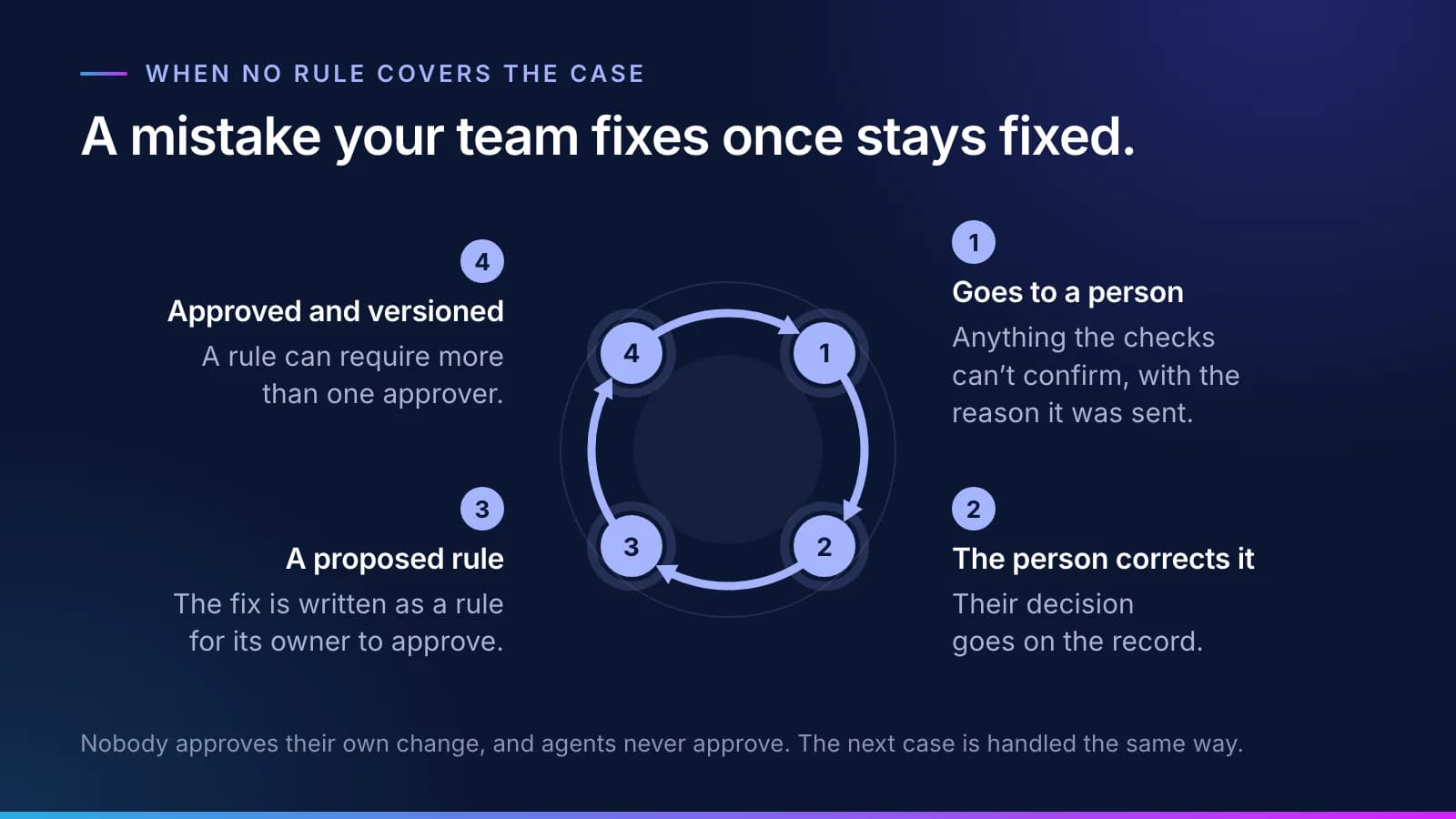
When a Virtual Employee works a credit like Halvercott's, Guard does the screening at both ends: it checks every prompt and response, and the inputs to every tool call, for prompt injection, personal data and unsafe content. Each block and redaction goes on the record. The rules come from Synesis, where each one is drafted from interviews and documents and approved by the right person, whoever you've made responsible for that kind of rule. A rule that touches regulated decisions can require more than one approver. An approval holds only for the exact wording that was approved, so a later edit needs approving again; nobody approves their own change, and agents never approve. Phylax checks policy before and after every protected action. Anything the checks can't confirm goes to a person, and when that person corrects it, the fix becomes a proposed rule for its owner to approve, so a mistake your team fixes once stays fixed.
Rules are also where the context layer earns its keep. An agent can only apply the right rule if it knows what "customer choice" means in your data. Our explainer on what a context layer is covers that part.
Five questions to ask any vendor
#- For a decision your AI made last week, show me the rule it applied and its version, and who approved it.
- Run the same case twice and show me the same decision both times.
- Tell me who can change a rule, and show me where that change is recorded.
- Show me a guardrail block in the record, with its reason.
- Walk me through a case no rule covers.
The right answer to the last one is "it goes to a person, with the reason", and the record shows it happening. If a vendor's answer to the first question is a description of their safety filters, you've learned which kind of check they built. Being able to stop an agent is the other half of control; our piece on turning AI agents off covers what examiners ask about that, and reading a task record shows where each rule appears after the fact.
Further reading
#- OMG, Decision Model and Notation (DMN) specification page, version 1.6, September 2026.
- W3C, Shapes Constraint Language (SHACL), W3C Recommendation, July 20, 2017.
- OWASP GenAI Security Project, OWASP Top 10 for LLM Applications, 2025 edition.
- OWASP GenAI Security Project, OWASP Top 10 for Agentic Applications, December 9, 2025.
- Gartner, Gartner Predicts Over 40% of Agentic AI Projects Will Be Canceled by End of 2027, June 25, 2025.
- Pan, Albalak, Wang and Wang, Logic-LM: Empowering Large Language Models with Symbolic Solvers for Faithful Logical Reasoning, Findings of EMNLP 2023.
- Allemang and Sequeda, Increasing the LLM Accuracy for Question Answering: Ontologies to the Rescue, arXiv, May 20, 2024.
- An, Bayless et al., A Neurosymbolic Approach to Natural Language Formalization and Verification, arXiv, November 12, 2025, revised July 13, 2026.
- Rombach, Lauer and Mehdiyev, Neuro-Symbolic Agents for Regulated Process Automation: Challenges and Research Agenda, arXiv, June 11, 2026.
Questions
What people ask.
What are AI guardrails?
AI guardrails are filters on what a model takes in and says. They screen prompts and responses for prompt injection, leaked personal data and unsafe content, usually with classifiers and pattern checks. They catch a wide range of problems quickly, but they don't decide whether the work follows your policy.
What is the difference between AI guardrails and business rules?
Guardrails screen what goes into and comes out of an AI model, catching prompt injection, leaked personal data and unsafe content. Business rules check whether the work itself meets your policy, such as a restocking fee or an approval limit. Guardrails make the conversation safe; business rules make the decision correct and explainable.
Are AI guardrails enough for a regulated business?
No. A reply can pass every guardrail and still be wrong under your policy. Regulators and auditors ask why a decision was made, and the answer has to be a rule with an owner and a version, which guardrails do not provide.
What is a DMN decision table?
DMN, or Decision Model and Notation, is a standard from the Object Management Group for writing business decisions in a form both people and software can read. A decision table lists its inputs in the first columns and its outputs in the last, one rule per row, and its hit policy states what happens when more than one row matches.
What is neuro-symbolic AI?
Neuro-symbolic AI combines a neural model, which reads messy input such as letters and emails, with symbolic logic, which applies precise rules. The model extracts the facts and the rules decide. Research has found that the pairing answers reasoning problems more accurately than a language model alone.
What should happen when no business rule covers a case?
The case should go to a person with the reason it was sent, and the person's decision should be recorded. If the same kind of case keeps coming up, the person's fix should be written as a new rule and approved by the rule's owner, so the next case is handled the same way.
The products, industries and examples it covers.
- Governance and auditPhylaxSign-in, policy, secrets and one audit trail from the screen to the disk, so you can show any examiner what happened.
- AI safetyGuardContent safety on every prompt, response and tool call.
- Knowledge layerSynesisTurns your policies, procedures, records and your people’s know-how into a rulebook your experts approve, which you own and can take anywhere.
- IndustryFinance operationsInvoices matched to orders and receipts and coded by your rules, and payments to changed bank details held until a callback is logged. Your team releases every payment.
- IndustryFinancial servicesCredit, account and claims files checked against your policy, and answers to exam requests drafted from records on file. Your compliance officer approves every response.
- IndustryInsurance claimsEach claim file audited against your state’s standards, deadlines kept with letters drafted, and bills checked. Adjusters decide.
- IndustryHealthcare providersEach denial matched to the payer’s reason and the record, with an appeal drafted for a person to sign, and each remittance checked against the contract. Staff and clinicians decide.
- IndustryLegalEach party on a new matter searched with its parent companies and former names, ethical wall requests drafted for lateral hires, and contracts compared with your playbook. Lawyers decide.
- OverviewTrust and governanceEvery action checked, every step recorded.
- OverviewHow it worksTen checked steps from your first decision to the day it handles real cases.
Read next.
 Guide · GovernanceHow an AI business rule is written and approvedEvery Virtual Employee works from rules approved one at a time by the people you make responsible. What a rule contains, who signs it, how a correction becomes a new version, and how any change is rolled back. · updated November 18, 2026 · 9 min read
 Article · Context engineeringWhat is a context layer, and why do AI agents need one?A context layer tells an AI agent what your words mean, which rules apply, which records it may open and what was decided before. Gartner now calls it a core part of data infrastructure, and Forrester the next step after semantic layers and knowledge graphs. Here is what goes in one, in plain words. · updated November 18, 2026 · 11 min read
 Article · GovernanceCan you turn your AI agents off? What examiners now askUS bank regulators have started asking how banks would shut their AI agents down, while the new model risk guidance leaves agents out of scope. Here's what examiners are asking, which deadlines arrive in Colorado and the EU, and what a working kill switch looks like. · updated November 18, 2026 · 11 min read
See it on your work
See how one of your tasks runs, start to finish.
A 30-minute walkthrough of one of your workflows, the approval step and the audit record, with the people who build the platform.