

Series · The knowledge layer, explained
Get ahead of data cleanup before AI: a 90-day plan
Data cleanup before AI goes wrong when it tries to fix everything. A 90-day plan that fixes only what the first AI queue reads, at the system it comes from, with a named owner for each source, plus the quick wins and what to leave alone.
Inovagio team · Published · Updated · 7 min read
On this page
Getting ahead of data cleanup before AI means fixing only the records your first AI queue will touch, in the system they come from, with a named owner for each, and leaving everything else alone until a later queue needs it. Done that way, it fits in about 90 days; aimed at everything, it rarely finishes.
The other way is common enough to describe. A company decides it needs clean data before it can use AI, so it starts a cleanup of everything: the customer master, the vendor file, the document shares, the warehouse. Six months in, there's a dashboard full of red, a backlog nobody owns and no AI working a single queue. The cleanup wasn't wrong. It was aimed at the whole estate instead of at one piece of work.
Why data cleanup before AI stalls when it aims at everything
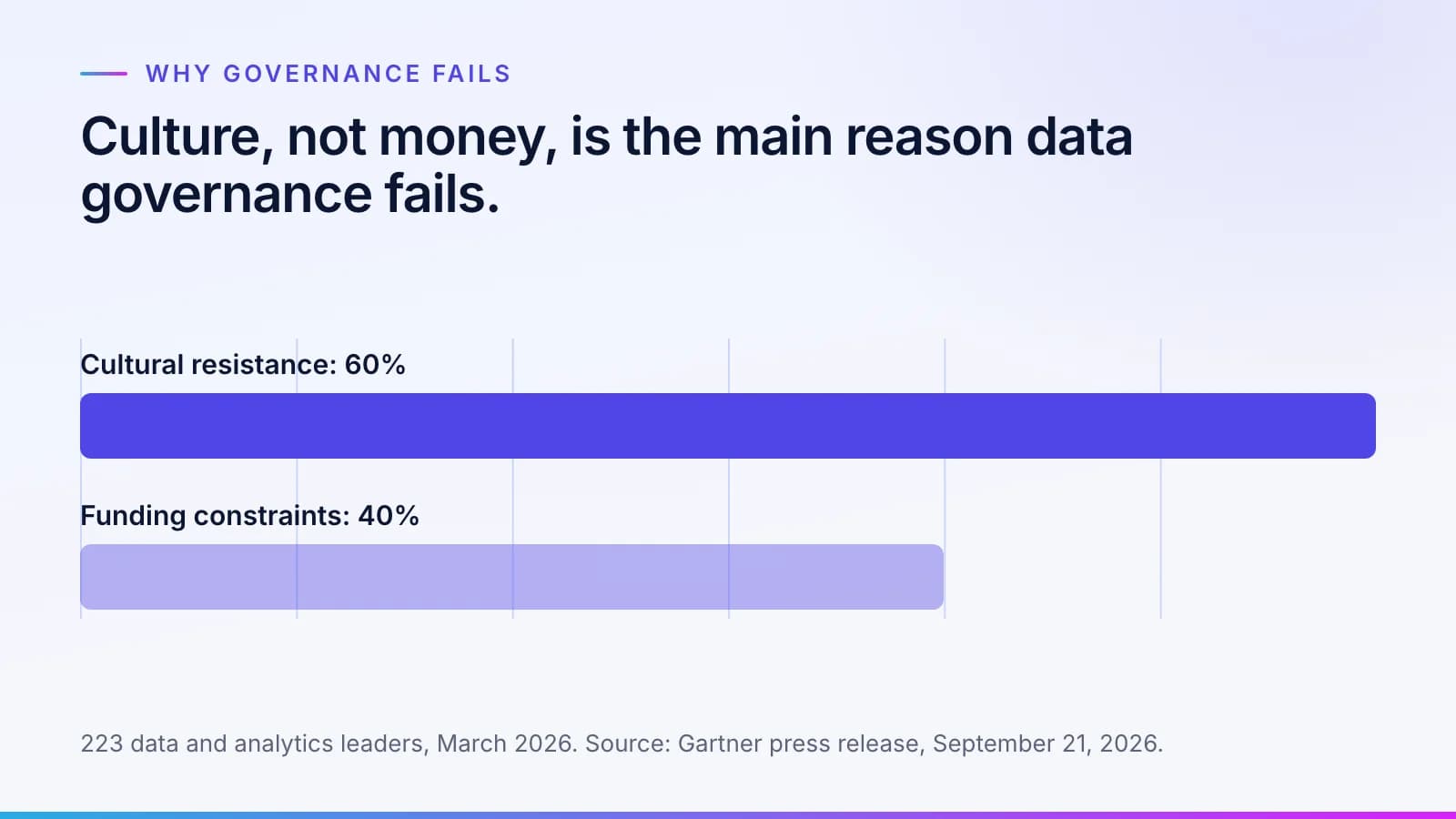
#The obvious explanation is money, and it's usually not the real one. When Gartner surveyed 223 data and analytics leaders in March 2026 about why data governance initiatives fail, cultural resistance (60%) came well ahead of funding constraints (40%) (Gartner, September 21, 2026). Put plainly, people don't fix data they don't own for a project they can't see.
A queue answers both halves of that sentence. It gives the cleanup a finish line (the data this queue reads is ready) and an owner who wants it done (the person who runs the queue). That's why we recommend you pick one queue for your first AI work. It also fits what we wrote in why the knowledge build stalls: most delays in a knowledge build come from waiting on people, not from the work itself.
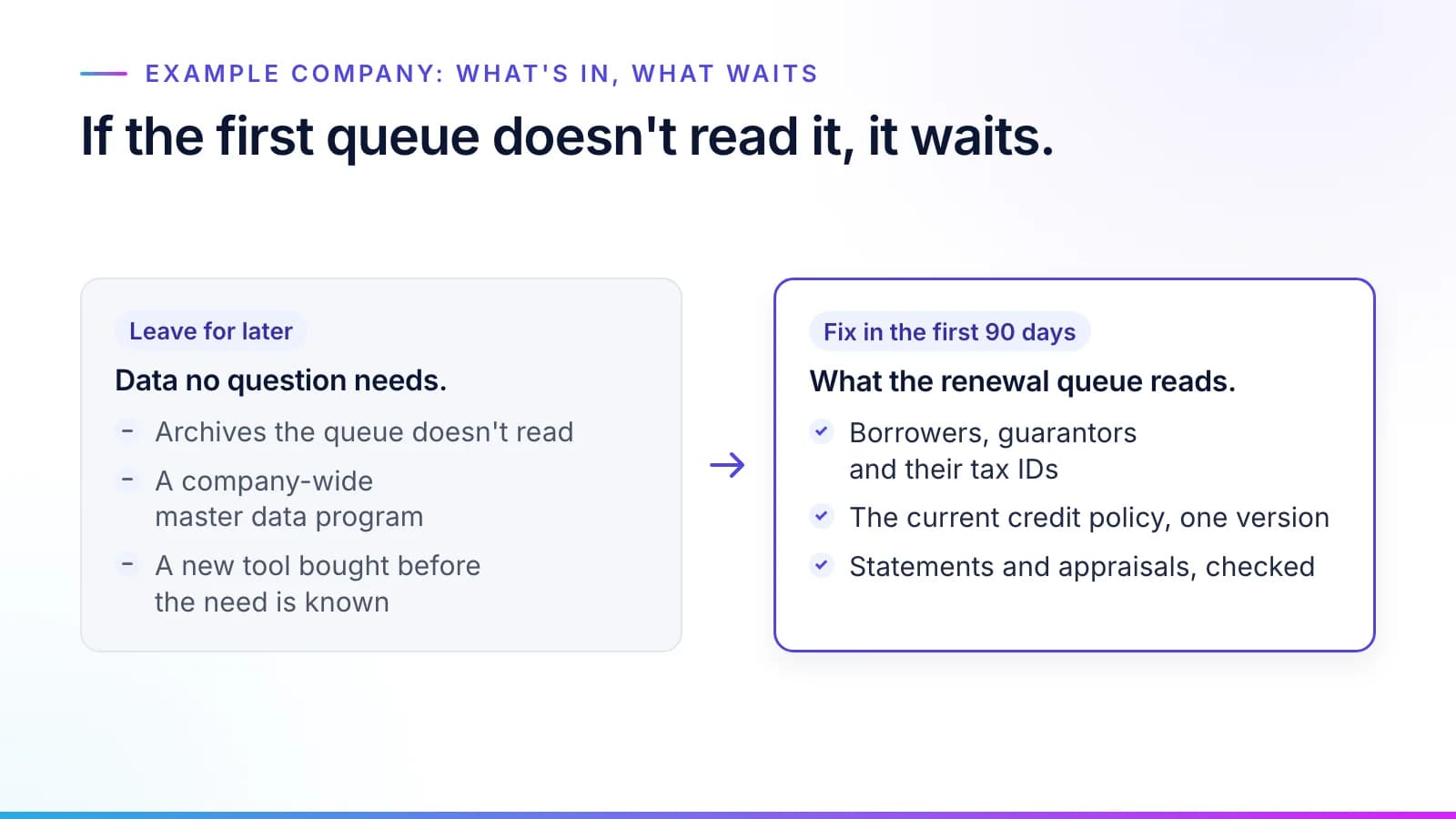
So the plan below has one rule. If the first queue doesn't read it, it waits.
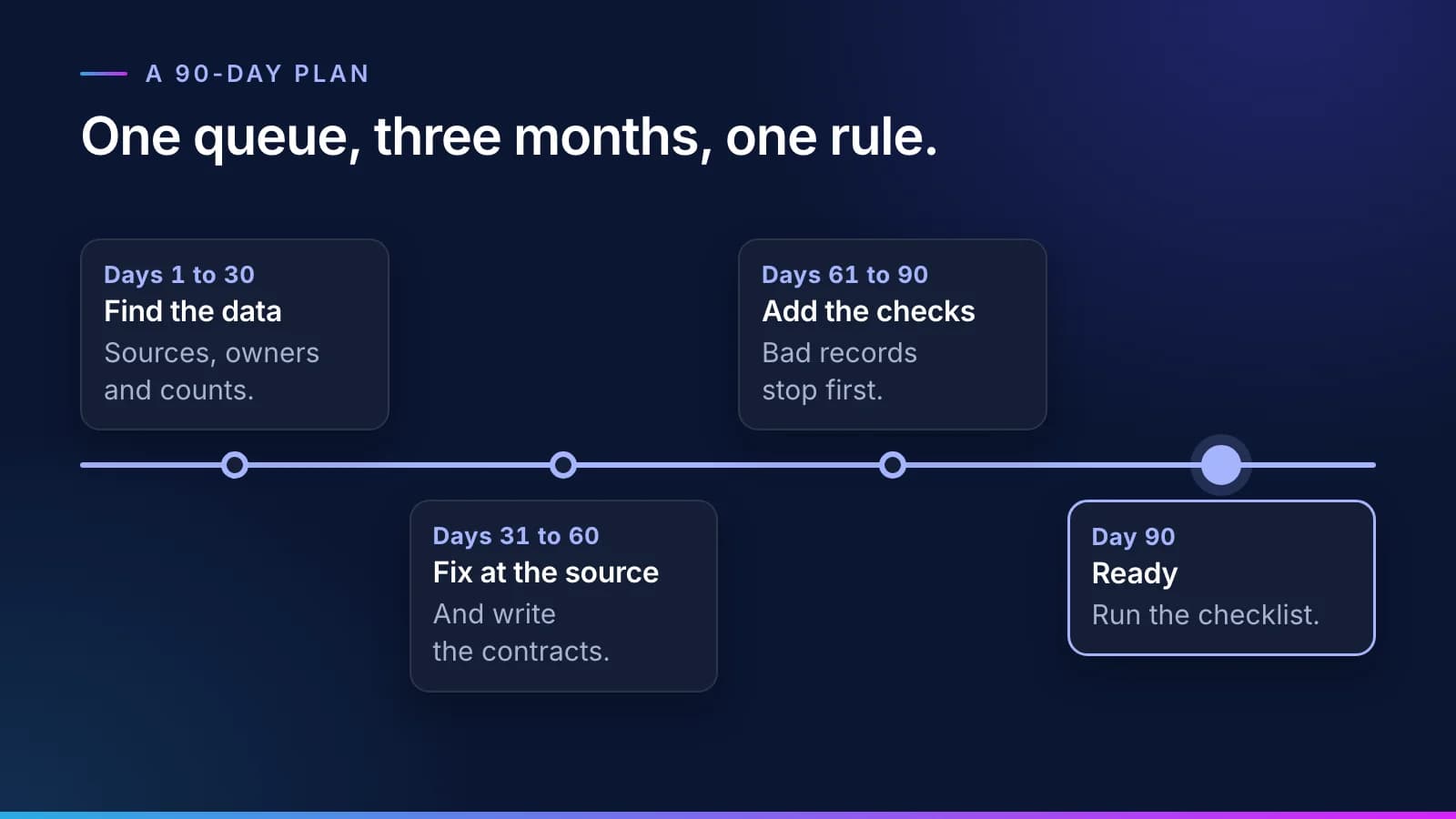
In the first 30 days, find the queue's data
#Start with the queue and the questions it has to answer. Take Pellmoor Savings Bank (Example company), whose first queue is preparing commercial loan renewal files. The AI assembles the files, and the credit team decides every loan. The renewal analyst can tell you over coffee what every file needs: the borrowers and guarantors, their financial statements, the covenants under the current credit policy and a current appraisal. Those four answers define the data.
Then walk each answer back to where it lives. For every source, write down whether it's the system of record or a copy, how often it refreshes and who owns it. If nobody owns it, that's your first finding. At Pellmoor the shared drive of borrower files had no owner, which is why some statements existed three times.
Measure only the fields the queue needs, and nothing else. Count the missing tax IDs, the borrowers that appear twice, the documents with more than one version. Those counts are your cleanup list. They're also your baseline, so you can show progress at day 60.
Three quick wins usually show up in the first month:
- Retire superseded versions of the policies the queue relies on, so only the current one can be found.
- Merge the obvious duplicates among the vendors and business customers the queue touches, where a tax ID agrees and nothing else contradicts it, and record each merge so it can be undone. Leave any merge of two people for month two.
- Fill the missing keys (tax IDs, account numbers) on the active records the queue will read.
In days 31 to 60, fix it at the source
#Month two is about where each fix lands. Make it in the system of record, never in a spreadsheet or a downstream copy, or the next feed will quietly undo it. The cautionary tale is a lender whose credit reporting system kept overriding its staff's corrections with its monthly updates; our post on data hygiene for AI tells that story and two others from regulators' files.
Work the harder matches with a person in the loop. Two records with the same name and address aren't always the same person; a father and son can share both. Keep any merge you aren't sure of as a link the right person approves, and make sure it can be undone.
Clean the documents the queue reads. Pick one current version of each, remove near-duplicates, have a person read a sample of the scanned pages and mark anything sensitive before it goes anywhere near an agent. Tax returns carry Social Security numbers that a renewal agent never needs to see.
Then write the first data contracts. A data contract is a short agreement between a source's owner and the people who use it: what each field means, the quality rules it must meet, how fresh it must be and who to call. Think of it as the service agreement for one table. Our step-by-step guide to preparing data for a knowledge layer has an example in the open standard format.
In days 61 to 90, put checks in front of the agent
#By the last month the data is cleaner, but data doesn't stay clean on its own. New records arrive every day. So the third month puts checks between the data and the AI: a record that fails a rule stops in a queue a person works, and the agent never acts on it. Our guide to data quality checks for AI agents covers how those checks work.
This is also when you start measuring the things that tell you the data is staying fit: how many records the checks stop each week, how long they wait for a fix and how many fixes were made in the source system instead of a copy. A steward who looks at those numbers each week will catch a slipping source long before an agent does anything with it.
Before you call the first queue ready, run the AI-ready data checklist against it.
What to leave alone
#Saying no is most of the plan. In the first 90 days, leave these for later:
- Data no question in the first queue needs, however messy it is.
- Archives and history the queue doesn't read.
- A company-wide master data program. The queue's own matching rules come first, and they'll feed one later.
- A new catalog or data quality tool bought before anyone knows what the first queue needs from it.
None of this means the rest of your data doesn't matter. It means the second queue pays for its own cleanup, starting from what the first one settled: the shared customers and policies, and who owns them.
Who owns what
#| Role | Owns in the 90 days |
|---|---|
| Sponsor | The queue choice, and clearing blockers when a team doesn't answer |
| Queue owner | The questions the queue must answer, and when its data is ready |
| Source owners | Fixing their system of record, and their data contract |
| The approver you name for each area | What each term means, and approving uncertain merges |
| Data engineer | Profiling, the checks and the dead-letter queue |
When we run this with you, our agents interview your people to capture the terms and rules, and the right person approves each one in Synesis, our knowledge layer. Synesis also reads the schemas of the databases the queue touches and proposes mappings from their tables, which are approved like any other change. Perception reads the documents in with the source kept on every passage, and the records and their history live in MNEMOS. By default, the Virtual Employees that take on the queue read only the knowledge you've approved. That knowledge stays yours. Your rulebook exports free, in open standards. The How it works page lays out the steps and who decides each one.
Further reading
#- Gartner Predicts 60% of Organizations That Ignore Data Governance Culture Challenges Will Fail to Govern AI Successfully by 2027, Gartner, September 21, 2026: gartner.com
- Lack of AI-Ready Data Puts AI Projects at Risk, Gartner, February 26, 2025: gartner.com
- Open Data Contract Standard, Bitol at LF AI & Data, v3.2.0, September 8, 2026: github.com
Questions
What people ask.
What data should we clean before starting with AI?
Only the data your first AI queue reads. List the questions that queue must answer, trace each one to the systems that hold the answer, and clean those fields and documents. Everything else waits until a later queue needs it.
How long does data cleanup for AI take?
For one queue's data, about 90 days is a realistic plan: a month to find the data and its owners, a month to fix problems at the source and a month to put checks in front of the AI. Cleaning a whole company's data first takes far longer and often stalls.
Why fix data at the source instead of in a copy?
Because the next automated feed from the source overwrites the copy. A correction made downstream disappears the next time the data is refreshed, and the AI acts on the error again.
Who should own data cleanup for AI?
Each source needs a named owner who fixes it in the system of record, and each area of the business needs someone who approves what its terms mean: a department head, a governance body or compliance, whoever your organization makes responsible. The person who runs the first queue decides when its data is ready.
What are the quick wins in data cleanup before AI?
Three usually show up in the first month: retiring old versions of the policies the queue relies on, merging duplicate vendor and business-customer records where a tax ID agrees and nothing contradicts it, and filling missing keys on the active records the queue reads.
The products, industries and examples it covers.
- Knowledge layerSynesisTurns your policies, procedures, records and your people’s know-how into a rulebook your experts approve, which you own and can take anywhere.
- Data ingestionPerceptionTurn documents, scans, email and system data into cited knowledge.
- Data engineMNEMOSRecords, documents, vectors, graph and agent memory in one engine, with a ledger behind every write.
- IndustryFinancial servicesCredit, account and claims files checked against your policy, and answers to exam requests drafted from records on file. Your compliance officer approves every response.
- OverviewHow it worksTen checked steps from your first decision to the day it handles real cases.
Read next.
 Guide · Data qualityPreparing data for a knowledge layer: a step-by-step guideHow to get data ready for a knowledge layer and the AI agents that read it, in the order that works. Scope by the first queue, profile against named quality dimensions, name owners, resolve entities reversibly, clean documents, record lineage, map to the ontology and put a contract on every source. · updated November 18, 2026 · 17 min read
 Guide · Data qualityAI-ready data checklist for regulated teamsTwenty-eight checks to run against the data an AI process will read, before it goes live and at set intervals after. Grouped by stage, from sources and owners to documents, mapping and run-time checks, each with why it matters to an examiner and how to test it. · updated November 18, 2026 · 8 min read
 Guide · ApproachYour first AI use case: pick one queueThe best first AI use case is a queue, not an idea from the offsite. How to spot one, the triggers that make it urgent, the cases that are not a fit, and the charter to sign before any work starts. · updated November 18, 2026 · 7 min read
See it on your work
See how one of your tasks runs, start to finish.
A 30-minute walkthrough of one of your workflows, the approval step and the audit record, with the people who build the platform.