Series · How we solve it
Faster AI makes owning it more valuable
If AI models keep improving this fast, why own any of it? Because a better model still doesn't know your business, and every layer you own gains value with each new model.
Inovagio team · Published · Updated · 3 min read
On this page
Every company deciding how to adopt AI hears the same argument: models improve so quickly that anything built around them will be out of date by next year. Wait, and the next model will do it all.
The evidence points the other way. On open vs closed AI models, the best open ones now trail the closed leaders by about four months. Faster-improving models make the parts you own more valuable, not less. That is the case for owning your AI: your data, your business knowledge, your models and the record of every task stay yours, and your Virtual Employees work from them whichever model is underneath.
Open vs closed AI models: open is close behind
#Epoch AI, which tracks the capabilities of AI models, found that since January 2026 the most capable open-weight models have lagged the leading closed models by an average of four months on its Epoch Capabilities Index (Epoch AI, May 29, 2026). In its 2024 report, the lag was about one year (Epoch AI, November 4, 2024).
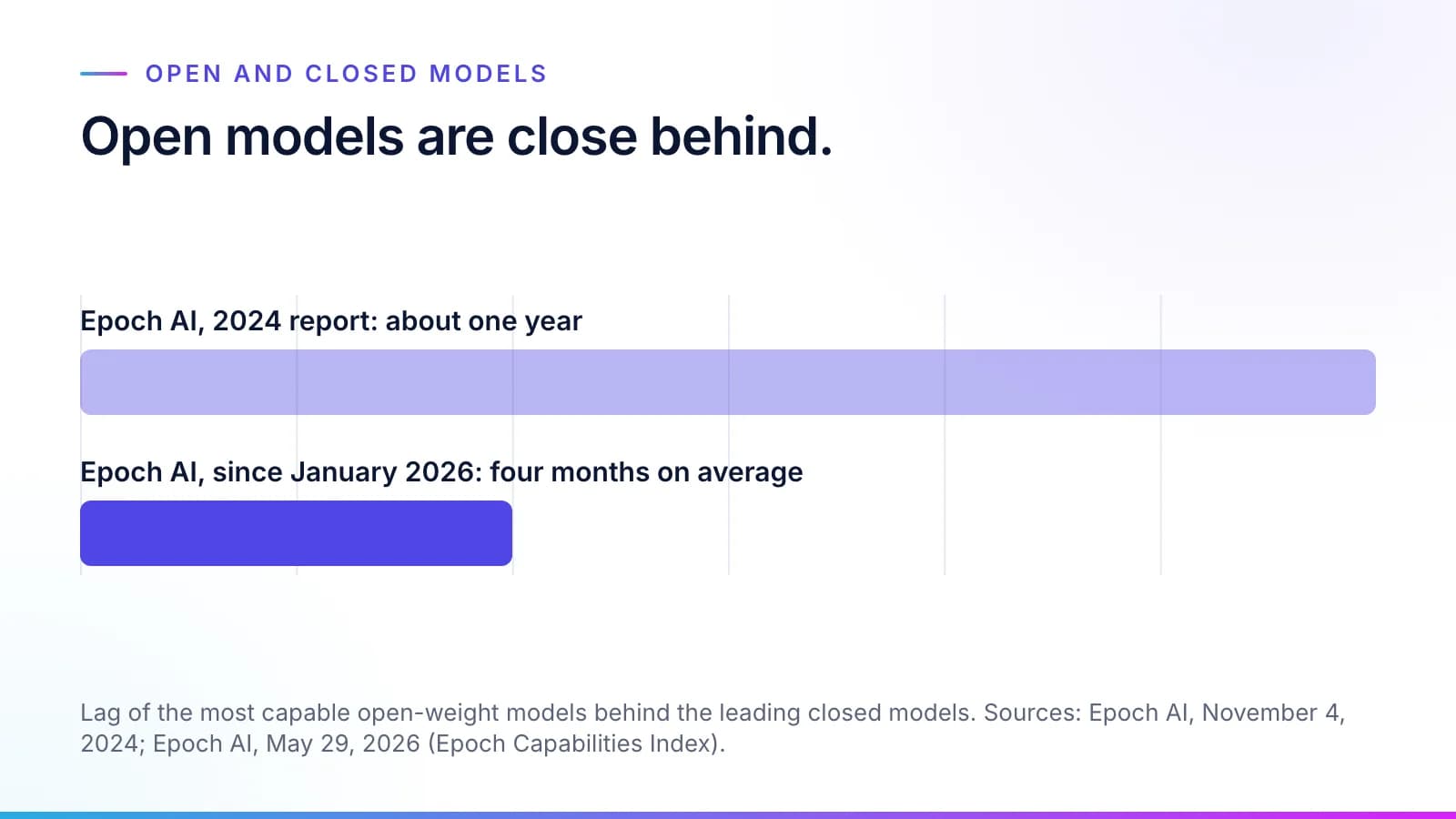
So what the best model can do today, a model you can run on your own hardware can do within months. A defense supplier that isn't allowed to send controlled drawings to an outside model, for example, can run an open model on its own servers instead. Raw capability is becoming something a company can own, not only rent.
What a better model still doesn't know
#A smarter model still doesn't know your payment approval limits or who signs off on what, or the exception your most experienced analyst handles every week. Box's State of AI in the Enterprise 2026 report found that "96% of organizations say it's important or very important that agents can access company-specific content and knowledge" (Box, 2026).
What holds AI back at work is context and governance. Context is knowing how the business runs; governance is following its rules and proving what was done. No model release supplies either. Both have to be built inside the company. They come from its documents and systems and, above all, from its people.
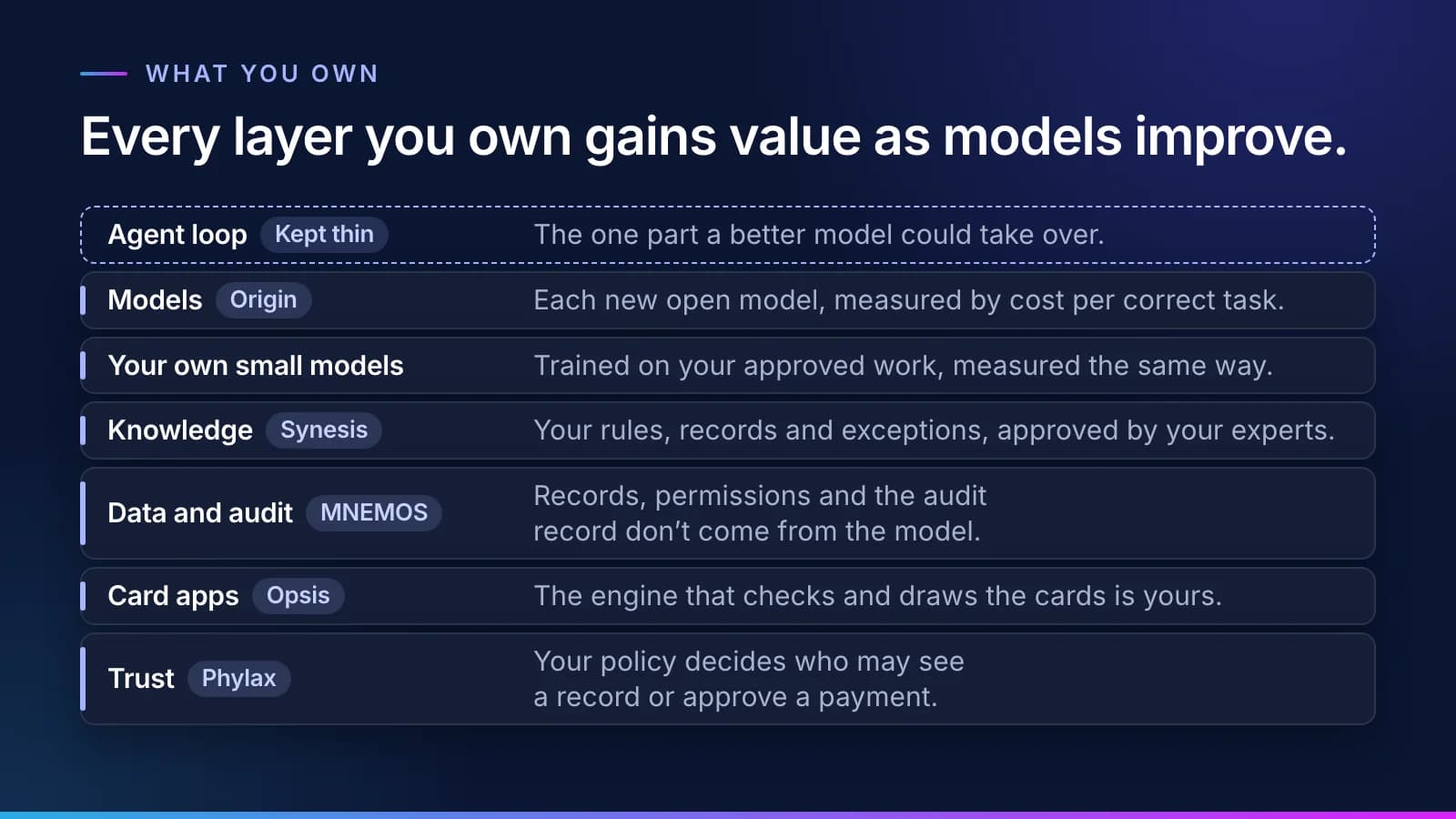
Every layer you own gains value as models improve
#| Layer | What happens when models get better |
|---|---|
| Models (Origin) | Each new open model is scored on your approved work before it goes live. |
| Your own small models | Small, task-specific models trained on your checked results take on routine work, measured by cost per correct task, counted the same way as today. |
| Knowledge (Synesis) | The model still doesn't know your rules, records and exceptions. Synesis supplies them, approved by your experts. |
| Data and audit (MNEMOS) | Records, permissions and the audit record don't come from the model. |
| Card apps (Opsis) | A smarter model asks for better cards. The engine that checks and draws them is yours. |
| Trust (Phylax) | Better reasoning doesn't decide who may see a record or approve a payment. Your policy does. |
The one part a better model could take over is the agent loop itself, the code that turns a model's answers into steps. So Inovagio keeps that part thin and fits it to each new model. Your knowledge and data stay put, along with the controls around them.
Three hedges
#- Serve any model. Open models on your own hardware or a frontier model, through one API, so you can switch as the market changes without rewriting a workflow. Outside models are off by default, and only an administrator you name can turn one on, for the tasks you choose.
- Train small models of your own. Routine tasks move to compact models trained on your own checked results, each measured by its cost per correct task, counted the same way as today. Small language models explains why most business work doesn't need the largest model.
- Keep the knowledge independent of every model. Your rules and terms live in Synesis with their approvals, in open standards you can export (RDF, OWL, SKOS and SHACL), so no change of model takes them with it. The knowledge layer questions and answers cover what to insist on.
The models will keep changing. What your company knows, and the record of what its AI did, shouldn't have to change with them.
If you'd like to see how this applies to one of your workflows, request a briefing.
Questions
What people ask.
How far behind are open models?
Epoch AI found that since January 2026 the most capable open-weight models have lagged the leading closed models by an average of four months on its Epoch Capabilities Index. In its 2024 report, the lag was about one year.
If models improve this fast, why own any of it?
Because a smarter model still doesn't know your business. Context (how the business runs) and governance (following its rules and proving what was done) have to be built inside the company.
Can we switch models later?
Yes. Inovagio serves open models on your own hardware or a frontier model through one API, so you can switch as the market changes without rewriting a workflow. Outside models stay off until an administrator you name turns one on.
What are the three hedges?
Serve any model, train small models of your own on your checked results, and keep the knowledge independent of every model in open standards you can export.
The products, industries and examples it covers.
- ModelsOriginRun open models on your own hardware, or a frontier model, through one API, never locked to one vendor.
- Model trainingForgeTrain task-specific models on your data, with the evidence built in.
- Knowledge layerSynesisTurns your policies, procedures, records and your people’s know-how into a rulebook your experts approve, which you own and can take anywhere.
- Data engineMNEMOSRecords, documents, vectors, graph and agent memory in one engine, with a ledger behind every write.
- Card appsOpsisAnswers arrive as card apps: approvals, documents, sheets, charts and forms.
- Governance and auditPhylaxSign-in, policy, secrets and one audit trail from the screen to the disk, so you can show any examiner what happened.
- IndustryDefenseFirst articles checked against the drawing and purchase order, each supplier’s required cybersecurity level tracked, and outgoing drawings compared with your release rules. Engineers and reviewers decide.
- OverviewWhy InovagioOwn AI that knows your business.
- OverviewArchitectureHow the platform fits together, from your data to finished work.
Read next.
 Article · Small language modelsSmall language models: why smaller AI does most business workMost steps an AI agent takes at work are narrow, like reading a field or sorting a document. A small language model can do them on your own server. Here's what the research says about how much work fits one, and where small models still fall short. · updated November 18, 2026 · 10 min read
 Article · ModelsThe model is a replaceable partThe best AI model this quarter won't be the best next quarter. When you can switch AI models without touching your rules, approvals or audit record, every better model shows up on the scoreboard in your cost per correct task. · updated November 20, 2026 · 7 min read
 Article · OwnershipForward-deployed engineers: what you should ownMore AI vendors now send forward-deployed engineers to build inside your company, and Gartner predicts most of those systems will be abandoned. Here's what leaves with the engineers, what to write into the contract, and what you should own on the day they go. · updated November 20, 2026 · 9 min read
Get the next one
New articles and guides, at most once a month.
Occasional news for teams putting AI to work in regulated industries. Unsubscribe in one click.