

Series · Knowledge layer deep dives
AI-ready data checklist for regulated teams
Twenty-eight checks to run against the data an AI process will read, before it goes live and at set intervals after. Grouped by stage, from sources and owners to documents, mapping and run-time checks, each with why it matters to an examiner and how to test it.
Inovagio team · Published · Updated · 8 min read
On this page
An AI-ready data checklist is a set of pass/fail tests you run against the data one AI process will read, before it goes live and at set intervals after. For a regulated team, each test should answer a question an examiner or auditor could reasonably ask, and leave evidence that answers it. This one has 28 checks in seven groups, each with why it matters and how to test it.
We wrote it for the people who get asked those questions: the head of a lending or loan servicing operation, a model risk manager, a data governance lead. It is the short form of two longer guides. Preparing data for a knowledge layer explains the method behind the first six groups, and data quality checks for AI agents explains the run-time group. For the business case, data hygiene for AI shows what a duplicate record does in an agent's hands, and data cleanup before AI sets out what to fix first. The examples come from Pellmoor Savings Bank (Example company), a community bank where an AI agent prepares commercial loan renewal files and the credit team decides every loan.
What regulators already expect from data
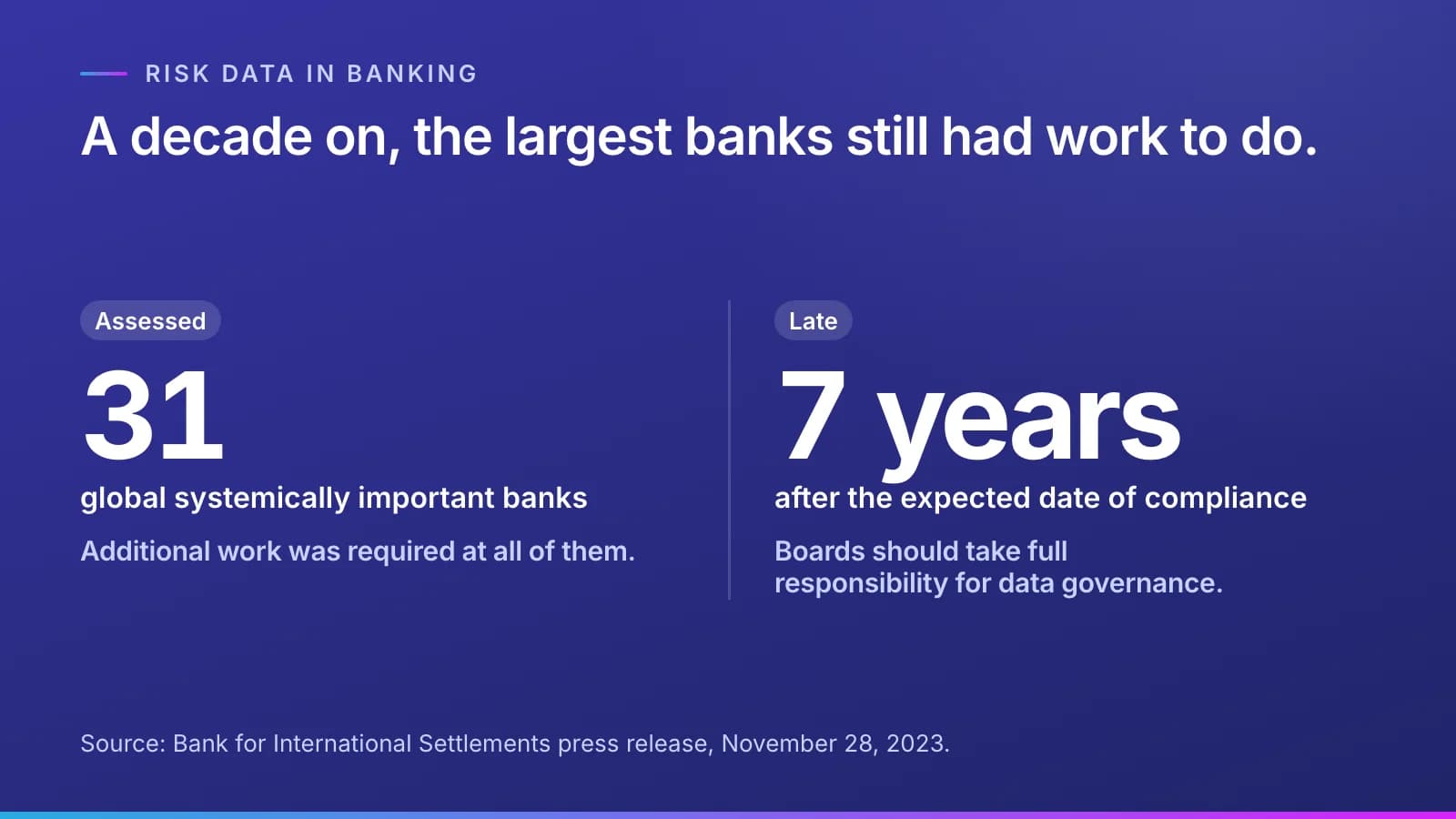
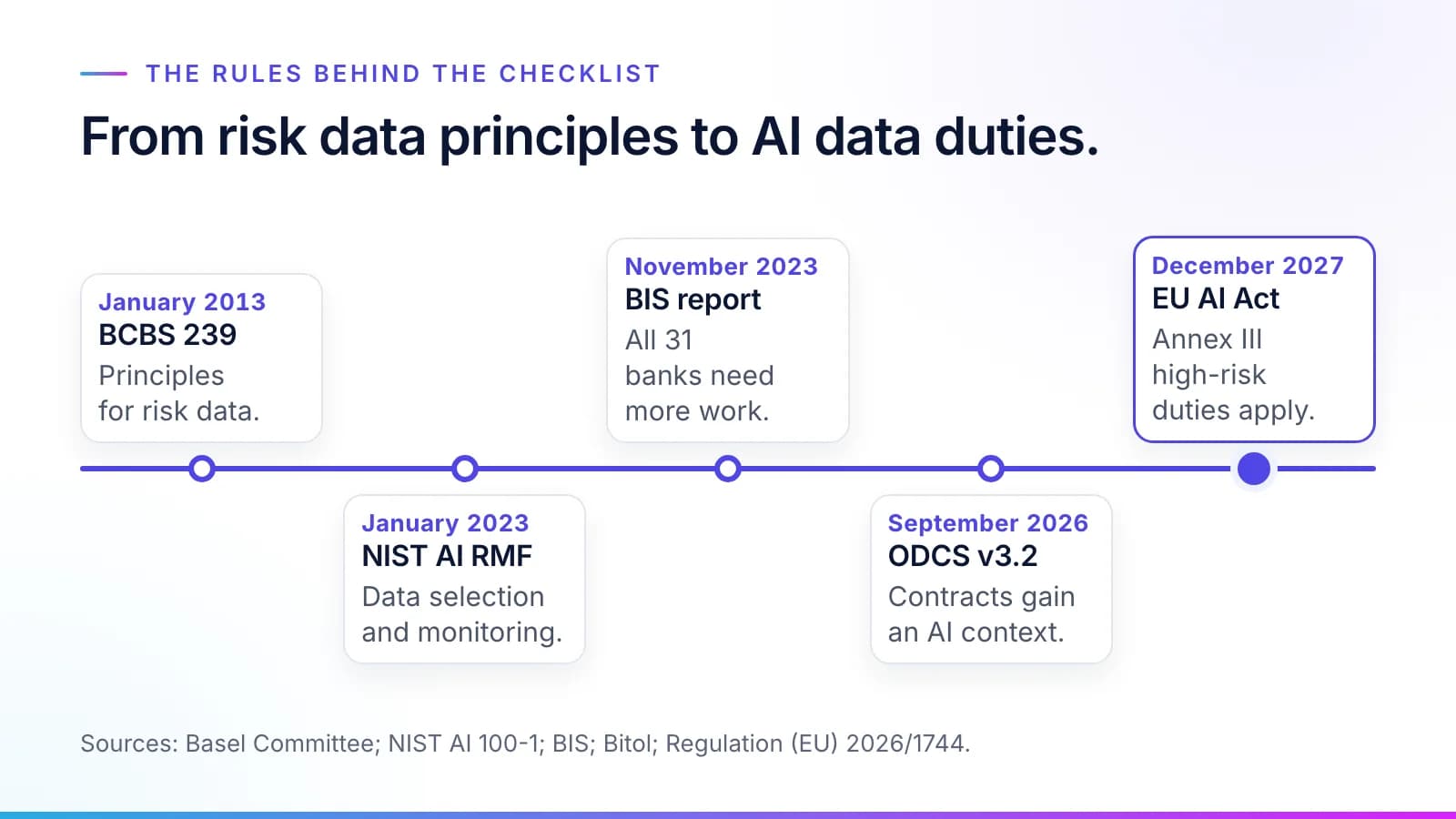
#None of this is new to banking. The Basel Committee's principles for risk data aggregation, known as BCBS 239, were published on January 9, 2013, and four of them set the bar for aggregating risk data: accuracy and integrity, completeness, timeliness and adaptability (Basel Committee). A decade later, the Committee's progress report on 31 global systemically important banks found that additional work was required at all of them, "seven years after the expected date of compliance", and said boards should take full responsibility for their data governance frameworks (BIS, November 28, 2023). The principle most relevant to an AI build is the one people quote least. Under Principle 2, paragraph 33 asks for integrated data taxonomies and "single identifiers and/or unified naming conventions" for everything from legal entities to accounts, and paragraph 34 gives business and IT owners joint responsibility for the quality of risk data. Checks 6 and 12 below ask the same thing.
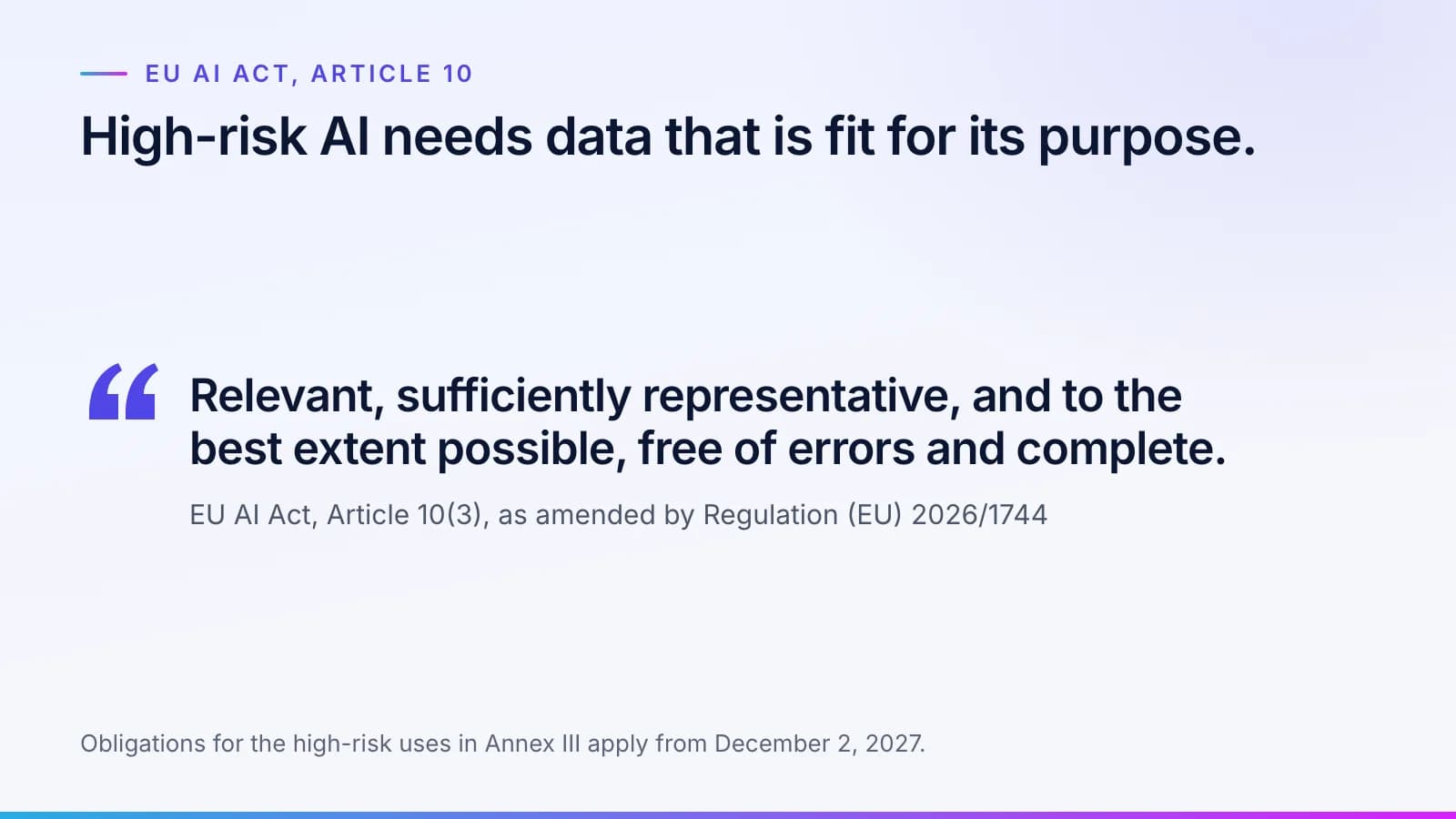
For AI specifically, Article 10 of the EU AI Act sets data governance duties for the data high-risk systems learn from and are tested on: the relevant design choices, how the data was collected and where it came from (and, for personal data, why it was originally collected), preparation steps such as cleaning and labelling, an examination for bias, and identifying data gaps and how to close them. The data sets it is trained and tested on must be "relevant, sufficiently representative, and to the best extent possible, free of errors and complete" (EU AI Act, Article 10). The Digital Omnibus, Regulation (EU) 2026/1744, amended the article in July 2026 and moved the obligations for the high-risk uses in Annex III to December 2, 2027. Article 10 is written for training and test data rather than the records an agent reads at run time, but expect an examiner to hold those records to the same bar.
In the US, the NIST AI Risk Management Framework asks organizations to document how data was collected and selected, including whether it is representative and suitable for the purpose (MAP 2.3), to monitor systems once deployed (MEASURE 2.4), and to have contingency plans for failures in third-party data (GOVERN 6.2) (NIST AI 100-1, January 26, 2023). State bank examiners have their own framework from the Conference of State Bank Supervisors (CSBS), which our CSBS AI framework checklist maps control by control.
The checklist below doesn't claim to satisfy any of these. It gives you evidence you can point to when someone asks.
Not legal advice. The rules above are summarized from the dated sources linked to each one. Check your obligations with counsel and your regulators.
How to use the AI-ready data checklist
#Scope it to one AI process and the data that process reads, because a checklist run against the whole data estate produces a long list of red that nobody owns and nobody finishes. At Pellmoor that's the renewal queue: four questions, seven sources, a few thousand documents. Grade each check:
- Pass: the check holds, and the evidence shows who tested it, when, and what they found.
- Partial: it holds for some of the data, or the evidence is incomplete. Every Partial gets a named owner and a date.
- Fail: it doesn't hold.
Our bar for go-live is plain: no Fail in sources, ownership or sensitive data, and no Fail anywhere on a check that blocks the agent. Your risk team may set a stricter one.
1. Sources
#| # | Check | Why it matters | How to test it |
|---|---|---|---|
| 1 | The AI process and the questions it must answer are written down | Readiness is defined per use case; without the questions there is no finish line | The process owner signs a one-page list of questions |
| 2 | Every source those questions touch is listed | An unlisted source is a hidden dependency nobody checks | Trace each question to the systems that hold its answer; compare with a sample run's task records |
| 3 | The system of record is named for each critical field | Fixes made in a copy are overwritten by the next feed | For each field, name the system that wins when two disagree |
| 4 | Each feed is reconciled for completeness | Records that never arrive can't fail a check | Compare the count each source says it sent with the count received, for a week |
Most teams skip check 4, and it's the costliest one to miss. The data quality checks guide describes a bank that went more than four years without a check that every relevant transaction was reaching its monitoring system, while a feed error kept some of them out.
2. Ownership
#| # | Check | Why it matters | How to test it |
|---|---|---|---|
| 5 | Each source has a named owner | Data nobody owns doesn't get fixed | A person's name, not a team mailbox |
| 6 | Each domain has a named approver for what its terms mean, whoever your organization makes responsible | Two teams' definitions of the same word produce two answers | The approver is recorded against each approved term |
| 7 | Owners have agreed how quickly they fix their source | A fix with no deadline waits behind everything else | The time is written into the source's data contract |
| 8 | Third-party data has a contingency plan | Bought feeds fail too, and you answer for them | The plan says what the AI process does when the feed stops or is wrong |
At Pellmoor, the shared drive of borrower files failed check 5 on day one. The credit administration manager took it on, and checks 17 and 18 got easier the same week.
3. Quality
#| # | Check | Why it matters | How to test it |
|---|---|---|---|
| 9 | Critical fields are profiled against named quality dimensions | "Good data" means different things to different teams | Results per dimension (the DAMA UK six, or ISO/IEC 25012) are recorded with a date |
| 10 | Duplicate records are resolved with evidence, and merges can be undone | A false merge puts one person's obligations on another | Pick ten merged records, show the evidence for each, and undo one |
| 11 | Every source code maps to one approved term | Unmapped codes are silently dropped or guessed | Count the codes in the source with no approved term; the count is zero |
| 12 | Identifiers outlive any one system and contain no personal data | Row IDs change on migration and break every link; a tax ID in an identifier is copied into every log | Show that an entity keeps its identifier across a system change |
4. Sensitive data
#| # | Check | Why it matters | How to test it |
|---|---|---|---|
| 13 | Every field the AI process reads is classified | Access rules can only follow a classification that exists | The classification is set for each field in the data contract |
| 14 | Fields the process doesn't need are masked before ingestion | Anything indexed can be retrieved and repeated | Search the index for a known Social Security number pattern; there are no hits |
| 15 | Retrieval respects the permissions of the person the agent acts for | An agent can otherwise show one user another's documents | Ask the same question as two users with different access and compare the citations |
| 16 | The origin and original purpose of personal data are recorded | Purpose limitation under the GDPR (Article 5(1)(b)) depends on it, and Article 10 of the EU AI Act asks for both for training and test data | Each source's record shows where the data came from and why it was collected |
5. Documents
#| # | Check | Why it matters | How to test it |
|---|---|---|---|
| 17 | One current version of each document can be found, with its effective date | An agent that finds the old policy applies last year's rules | Search for each policy title; count the versions that come back |
| 18 | Near-duplicate documents are removed before indexing | Copies crowd better passages out of the results | Run a duplicate scan on the collection; the residue is reviewed |
| 19 | Optical character recognition (OCR) quality on scans is sampled by a person, and every extracted value keeps its confidence | Published research found the OCR it tested not adequate for retrieval knowledge bases | A person reads twenty scanned pages against their extracted text |
| 20 | Every passage carries its owner, date, classification and source | The agent can cite the page, and access can follow the label | Inspect ten indexed passages |
Check 19 rests on the OHRBench study, which tested 8,561 document images and found answer quality fell as OCR noise rose (Zhang et al., arXiv 2412.02592, ICCV 2025). Pellmoor's scanned tax returns failed it the first time. A fax had turned a 7 into a 1 in a debt service figure.
6. Mapping and lineage
#| # | Check | Why it matters | How to test it |
|---|---|---|---|
| 21 | The process's questions run as queries and return the answers an expert expects | It is the acceptance test for the whole knowledge layer | Run them; the expert compares the results with the answers they'd give |
| 22 | Sources are mapped to the ontology and the result validates | A mapping error spreads to every answer that uses it | The SHACL (Shapes Constraint Language) validation report shows no violations, or each one has an owner |
| 23 | Every derived value can be traced to its source | An examiner will ask where a number came from | Pick one figure from an output and follow it back to the page or row |
| 24 | Each source has a versioned data contract signed by its owner | A source can change shape without anyone noticing | The contract exists, its version matches the live schema, and its owner signed it |
Three of these checks have open standards behind them. Check 22 maps with R2RML, the W3C language for mapping relational tables to an ontology (W3C, September 27, 2012), and validates with SHACL (W3C, July 20, 2017). Check 23 usually needs two records: W3C PROV-O for where each fact in the graph came from, and OpenLineage for which job runs read and wrote which datasets. And for check 24, the Open Data Contract Standard added a context section for AI agents in its version 3.2.0 on September 8, 2026 (ODCS releases).
7. Run time
#| # | Check | Why it matters | How to test it |
|---|---|---|---|
| 25 | Checks run before the agent acts, and each one is set to block, warn or sample | An agent acts on whatever it is given | The data contract records the response for each check |
| 26 | Failed records go to a dead-letter queue with an owner, never a silent drop | Dropped records are invisible; ignored ones are worse | Send a known-bad test record and find it in the queue |
| 27 | Freshness limits and recertification dates are set, and alerts fire | Stale data looks exactly like current data | Let a test source go stale and confirm the agent holds its work |
| 28 | Each task's record shows the records and versions it read, the checks that ran and the rule version applied | An auditor needs to reconstruct a decision without an engineer | Pick a task at random and reconstruct it from its record |
Read a task record shows what the record behind check 28 looks like in our platform.
When to run it again
#Passing once tells you about one day. Run it again whenever one of four things happens.
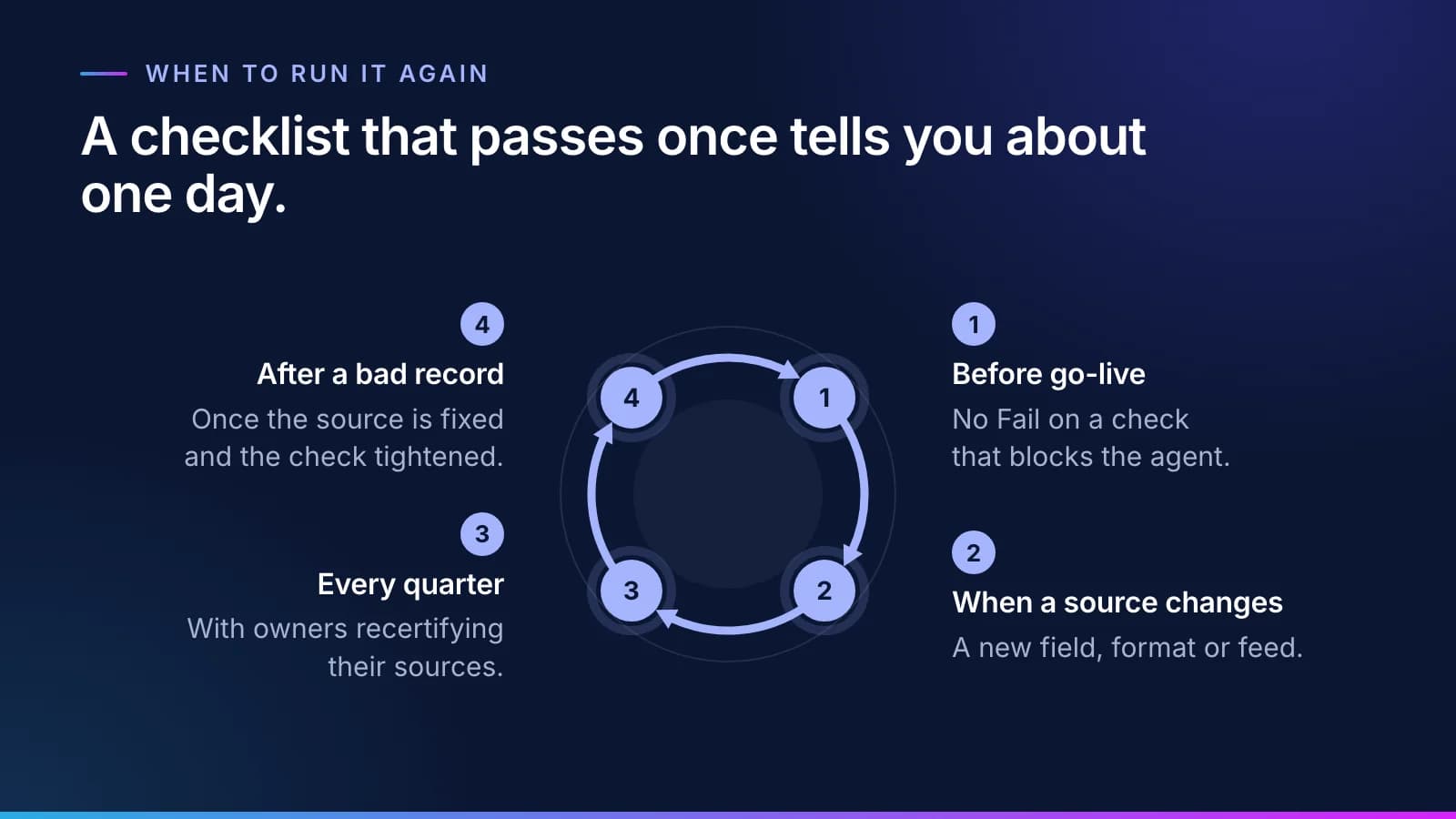
The four are before go-live, when a source changes, every quarter and after a bad record reaches the agent. Each run's evidence should be kept, with who ran it and when, because the history is what shows control. A single Pass on a single date shows only that someone looked once, while four quarters of runs with the same owners and the fixes they made show an examiner a process that works.
Where Inovagio fits
#Several checks map directly to what the platform does. Synesis keeps the approved terms with their approvers (checks 6 and 11), resolves entities with explainable, reversible merges, with a person approving any merge of two people and a second approver if you require one (check 10), runs competency questions as executable queries (check 21), and proposes R2RML mappings from your database schemas that the right person approves before SHACL validates the result (check 22). Every approved fact keeps a PROV-O chain back to its table and column or its page (check 23). Perception keeps the source and confidence on every extracted value and masks personal data before storage (checks 14, 19 and 20). MNEMOS trims every result to the documents the person could open (check 15) and runs durable queues with dead-letter handling (check 26). Phylax keeps the hash-chained audit trail behind check 28. The evidence stays yours, too: your rulebook exports free, in open standards, so what backs checks 6 and 11 doesn't depend on us. The checks about owners and their contracts are yours; no software can sign them for you.
Further reading
#- Principles for effective risk data aggregation and risk reporting (BCBS 239), Basel Committee, January 9, 2013: bis.org
- Progress in adopting the Principles for effective risk data aggregation and risk reporting, BIS press release, November 28, 2023: bis.org
- EU AI Act, Article 10: Data and data governance, as amended by Regulation (EU) 2026/1744: artificialintelligenceact.eu
- Artificial Intelligence Risk Management Framework (AI RMF 1.0), NIST AI 100-1, January 26, 2023: nist.gov
- OCR Hinders RAG, Zhang et al., ICCV 2025: arxiv.org
- R2RML: RDB to RDF Mapping Language, W3C, September 27, 2012: w3.org
- Shapes Constraint Language (SHACL), W3C, July 20, 2017: w3.org
- Open Data Contract Standard, Bitol at LF AI & Data, v3.2.0, September 8, 2026: github.com
Questions
What people ask.
What is AI-ready data?
AI-ready data is data that is fit for one specific AI use: owned by someone, measured against named quality dimensions, identified consistently, traceable to its source, protected where sensitive, and checked again every time the AI reads it. Readiness is proven per use case, not declared once for a whole company.
How many checks does an AI-ready data checklist need?
Enough to cover each stage the data passes through. This checklist has 28 in seven groups: sources, ownership, quality, sensitive data, documents, mapping and lineage, and run time. A team can add checks its own regulators ask about.
Who should run the AI-ready data checklist?
The owner of the AI process runs it, with each source owner and each domain's approver supplying evidence for their checks. A risk or audit function should review the results before go-live and at each rerun.
How often should we rerun it?
Before go-live, whenever a source the process reads changes, at least every quarter and after any bad record reaches the AI. Keep the evidence from every run, because the history is what shows control.
Does passing the checklist mean we meet the EU AI Act or BCBS 239?
No checklist can make that determination. This one gives you evidence for the data questions those rules raise, such as data origin, completeness, accuracy and governance. Whether you meet a specific rule is for your compliance team and your regulators to decide.
How do I know if my data is ready for AI?
Test the data one AI process will read, not the whole estate: its sources, owners, quality, sensitive fields, documents, mappings and run-time checks. The data is ready for that process when no check that blocks the agent fails and every Partial has a named owner and a date.
The products, industries and examples it covers.
- Knowledge layerSynesisTurns your policies, procedures, records and your people’s know-how into a rulebook your experts approve, which you own and can take anywhere.
- Data ingestionPerceptionTurn documents, scans, email and system data into cited knowledge.
- Data engineMNEMOSRecords, documents, vectors, graph and agent memory in one engine, with a ledger behind every write.
- Governance and auditPhylaxSign-in, policy, secrets and one audit trail from the screen to the disk, so you can show any examiner what happened.
- IndustryFinancial servicesCredit, account and claims files checked against your policy, and answers to exam requests drafted from records on file. Your compliance officer approves every response.
- IndustryInsurance claimsEach claim file audited against your state’s standards, deadlines kept with letters drafted, and bills checked. Adjusters decide.
- IndustryHealthcare providersEach denial matched to the payer’s reason and the record, with an appeal drafted for a person to sign, and each remittance checked against the contract. Staff and clinicians decide.
- IndustryHealth plansEnrollment and premium files reconciled line by line, directory entries verified on schedule, and appeal case files tracked on their clocks. A physician decides every medical appeal.
- IndustryGovernmentPermit applications checked against your code and checklist before the review deadline, and records requests prepared with proposed redactions for staff to approve.
- IndustryDefenseFirst articles checked against the drawing and purchase order, each supplier’s required cybersecurity level tracked, and outgoing drawings compared with your release rules. Engineers and reviewers decide.
- OverviewTrust and governanceEvery action checked, every step recorded.
- OverviewHow it worksTen checked steps from your first decision to the day it handles real cases.
Read next.
 Guide · Data qualityPreparing data for a knowledge layer: a step-by-step guideHow to get data ready for a knowledge layer and the AI agents that read it, in the order that works. Scope by the first queue, profile against named quality dimensions, name owners, resolve entities reversibly, clean documents, record lineage, map to the ontology and put a contract on every source. · updated November 18, 2026 · 17 min read
 Guide · Data qualityData quality checks for AI agents in automated processesThe checks a record must pass before an AI agent may act on it, and the monitoring that catches what slips through. Shapes, business rules, freshness limits, confidence and quarantine, drift, and how a bad record is traced and fixed at the source, with the audit record each step leaves. · updated November 18, 2026 · 13 min read
 Guide · GovernanceCSBS AI Supervisory Framework: a checklist for banksState examiners now have a framework for reviewing AI, with its own section on AI that takes actions on its own. The questions they are directed to ask, turned into a checklist, and the control in Inovagio that answers each one. · updated November 18, 2026 · 9 min read
See it on your work
See how one of your tasks runs, start to finish.
A 30-minute walkthrough of one of your workflows, the approval step and the audit record, with the people who build the platform.