

Series · The knowledge layer, explained
Can you turn your AI agents off? What examiners now ask
US bank regulators have started asking how banks would shut their AI agents down, while the new model risk guidance leaves agents out of scope. Here's what examiners are asking, which deadlines arrive in Colorado and the EU, and what a working kill switch looks like.
Inovagio team · Published · Updated · 11 min read

On this page
In October, Reuters reported that US bank regulators were asking banks how they would shut their AI agents down (Reuters, October 13, 2026, via Khaleej Times). An AI agent kill switch is a tested way to stop an agent's work at the level the problem needs, from one agent to everything at once, with a record of who stopped it and why.
Most banks can answer that question for a payment system or a trading desk. Far fewer can answer it for software that reads documents, plans its own steps and acts in several systems. No regulator has defined a good answer yet. Have the evidence behind yours ready before the next exam asks for it.
Not legal advice. The rules below are summarized from the dated sources linked to each one. Check your obligations with counsel and your regulators.
What US bank regulators are asking
#People familiar with the matter told Reuters that the Federal Reserve, the Office of the Comptroller of the Currency (OCC) and the Federal Deposit Insurance Corporation (FDIC) have been sending written and verbal questions to banks large and small. The questions cover:
- what limits are placed on AI agents, and how their actions are monitored and approved;
- whether the bank can clearly track and audit the decisions its agents make;
- what safeguards stop an agent from exceeding its authority, and whether people stay involved in key decisions;
- how the bank would shut autonomous systems down.
According to three of the people, regulators also asked whether banks use technology developed in China. The sources described the effort as information gathering, with regulators "not yet being prescriptive about what lenders should be doing". The three agencies declined to comment.
Read the list again and it looks like an exam work program written before the rule. A bank that can answer each line with evidence today is ahead of whatever guidance follows.
Why there's no rulebook to answer from
#In April, the Federal Reserve replaced its 2011 model risk guidance, SR 11-7, with SR 26-2, issued jointly with the OCC and the FDIC (Federal Reserve, SR 26-2, April 17, 2026). It says it's most relevant to larger banks, and that it is guidance rather than an enforceable standard: departing from it won't by itself bring supervisory criticism. Unsafe or unsound practices still can. A footnote in the attachment carries the news for anyone deploying agents. Generative and agentic AI models are "novel and rapidly evolving", so they're outside the guidance; a bank's own risk management and governance should decide the controls (SR 26-2 attachment, footnote 3).
So the bank writes its own standard for its agents, and then has to show an examiner it follows it. That's harder than following one.
There's a useful detail in the same document. SR 26-2's definition of a model excludes deterministic rule-based processes with no statistical, economic or financial theory behind them. An approved business rule that checks an agent's work (a payment over a limit waits for a person, say) falls on that side of the line. It's still a control, so it sits under your change management like any other, and you can version it and replay it later. The part with no rulebook is the model's judgment. A sensible design puts as much of the decision as possible into the first kind and keeps a person beside the second; business rules or AI guardrails explains the difference.
State examiners have moved first. The CSBS AI Supervisory Framework, released September 16, directs them to review whether a bank can restrict or shut down an agent's automated activity, among five checks for agentic AI. Our CSBS AI framework checklist maps each check to the evidence a bank should have ready.
The deadlines arriving outside banking
#The banking questions are informal for now. Three other regimes have dates.
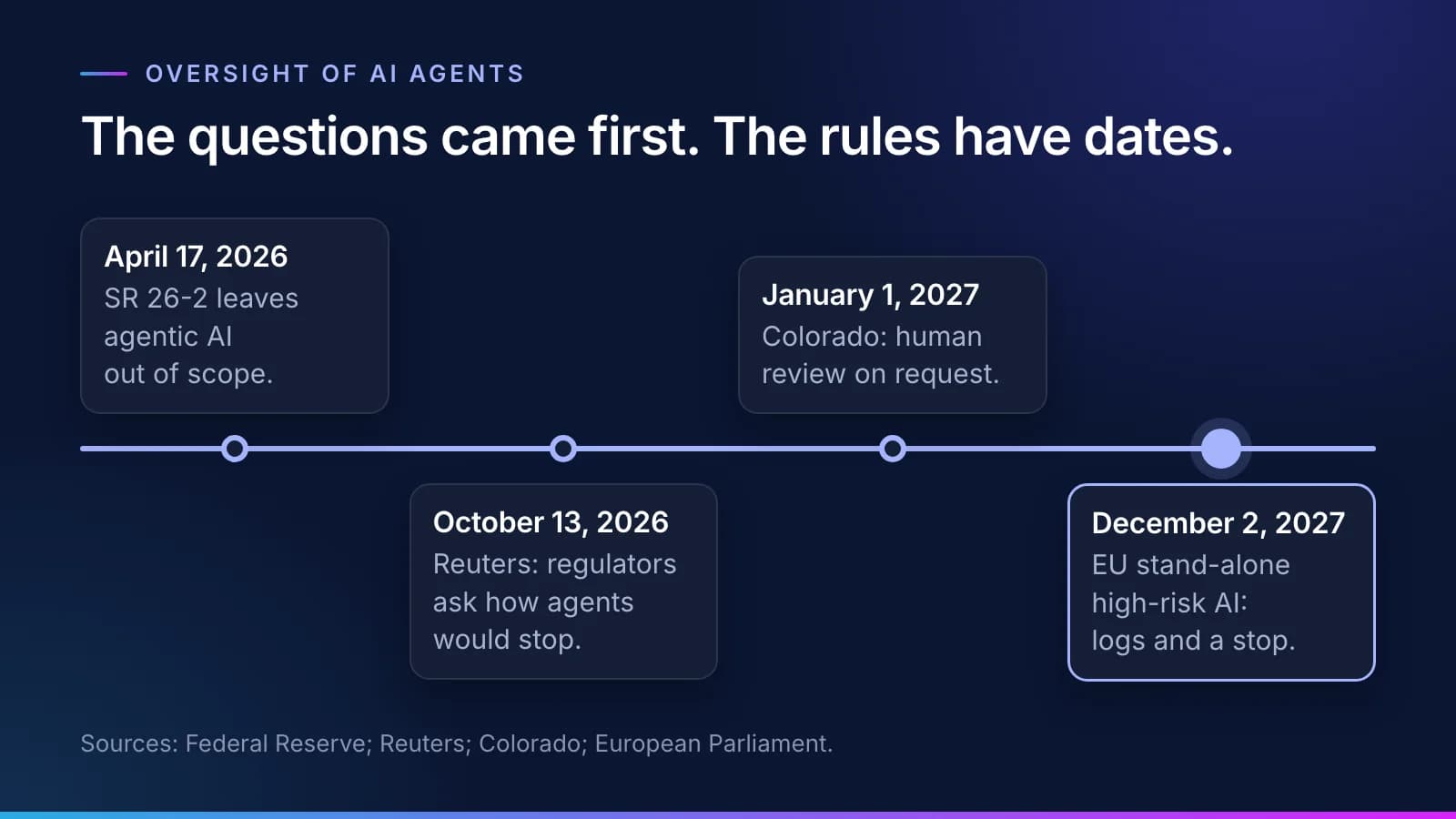
Colorado's SB26-189, signed on May 14, 2026, repeals and replaces the state's 2024 AI Act, and its duties apply from January 1, 2027. It covers automated decision-making technology used to materially influence a consequential decision, including lending and insurance decisions as well as employment and housing. A company that uses it must give notice, explain within 30 days what role the system played in an adverse outcome, let consumers correct their data and offer meaningful human review and reconsideration. Records showing compliance must be kept for at least three years (Colorado General Assembly, SB26-189).
In the EU, the AI omnibus, Regulation (EU) 2026/1744, published in the Official Journal on July 24, 2026, moved the date for stand-alone high-risk AI systems to December 2, 2027, and for high-risk AI built into regulated products to August 2, 2028 (European Parliament Legislative Train, Digital Omnibus on AI, updated October 25, 2026).
Those include AI used to assess creditworthiness or to price life and health insurance, as well as AI used in hiring. The obligations behind the date are specific.
Article 12 requires that the system can record events automatically over its lifetime, and Article 14 requires that a person overseeing it can override its output or stop it (Regulation (EU) 2024/1689, the AI Act). Those two articles bind the provider that builds the system.
A bank that deploys one has duties of its own under Article 26: it must give oversight to trained people with the authority to exercise it, and keep the logs under its control for at least six months, inside the records its financial-services rules already require.
Treat the delay as time to prepare: 13 months is about one procurement cycle.
For US insurers, the oversight already applies: 30 U.S. jurisdictions have adopted the NAIC AI Model Bulletin (NAIC adoption map, November 13, 2026), which expects each insurer to keep a written program for its AI systems and sets out what an examiner may ask to see.
What an AI agent kill switch means in practice
#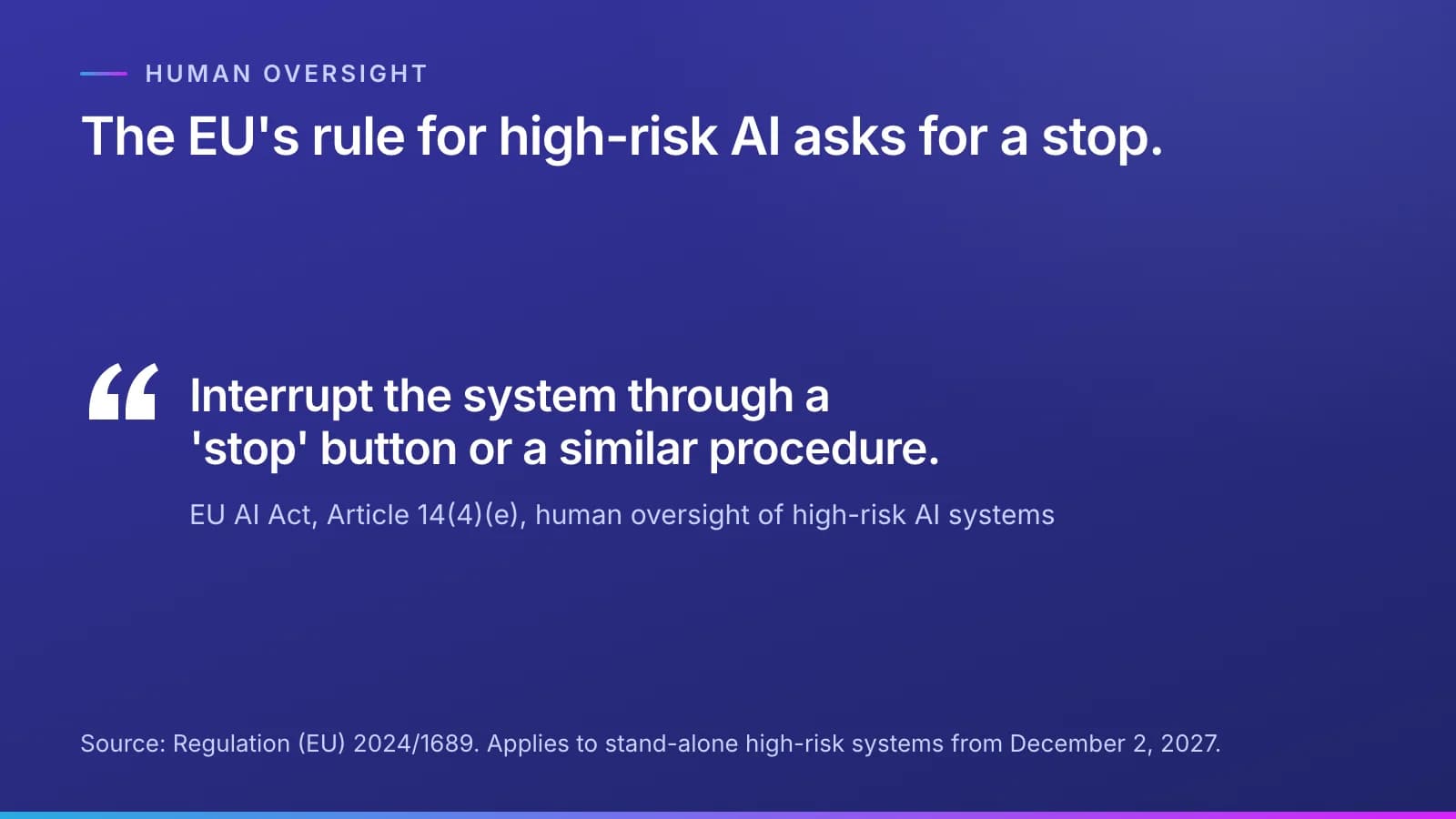
The EU text is the most concrete statement of the requirement: the person overseeing a high-risk system must be able to "interrupt the system through a 'stop' button or a similar procedure". That sentence leaves three design decisions open: what gets stopped, who may press it and what happens to the work already in flight. The NIST AI Risk Management Framework, the voluntary US reference for AI risk, asks the same thing in plainer terms: subcategory MANAGE 2.4 calls for mechanisms to disengage or deactivate AI systems that behave outside their intended use, and for named people responsible for using them (NIST AI 100-1, January 2023).
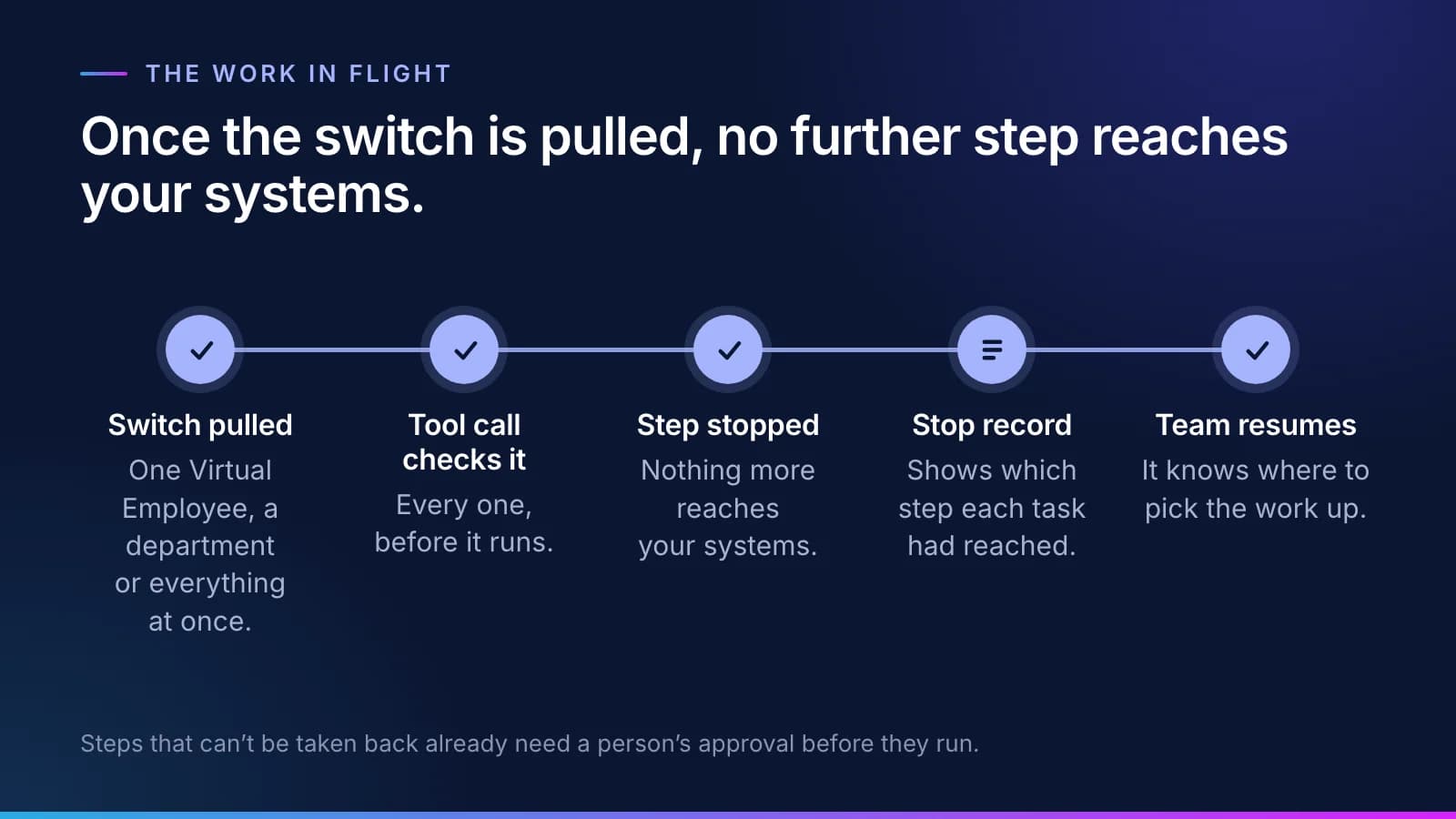
We answer those with three levels of stop. The kill switch in Archon, the control plane that can stop any AI agent, works for one Virtual Employee, a department or everything at once, from the screen that shows what each one is doing, and Guard enforces it. Stop at the level the problem needs: a switch that can only stop everything gets pressed too late, because stopping everything stops the business too.
Two more stops sit underneath. A Virtual Employee that works on your network has its own account in your directory, so disabling the account stops it too. And spending limits stop work the moment they're reached. A stop doesn't always wait for a person, either: Phylax's kill rules can pull the same switch when a monitored control trips, and the record shows what triggered it.
The work in flight is the third question. Once the switch is pulled, every tool call checks it before it runs, so no further step reaches your systems. Steps that can't be taken back already need a person's approval before they run, and the stop record shows which step each task had reached, so the team that picks the work up knows where to resume.
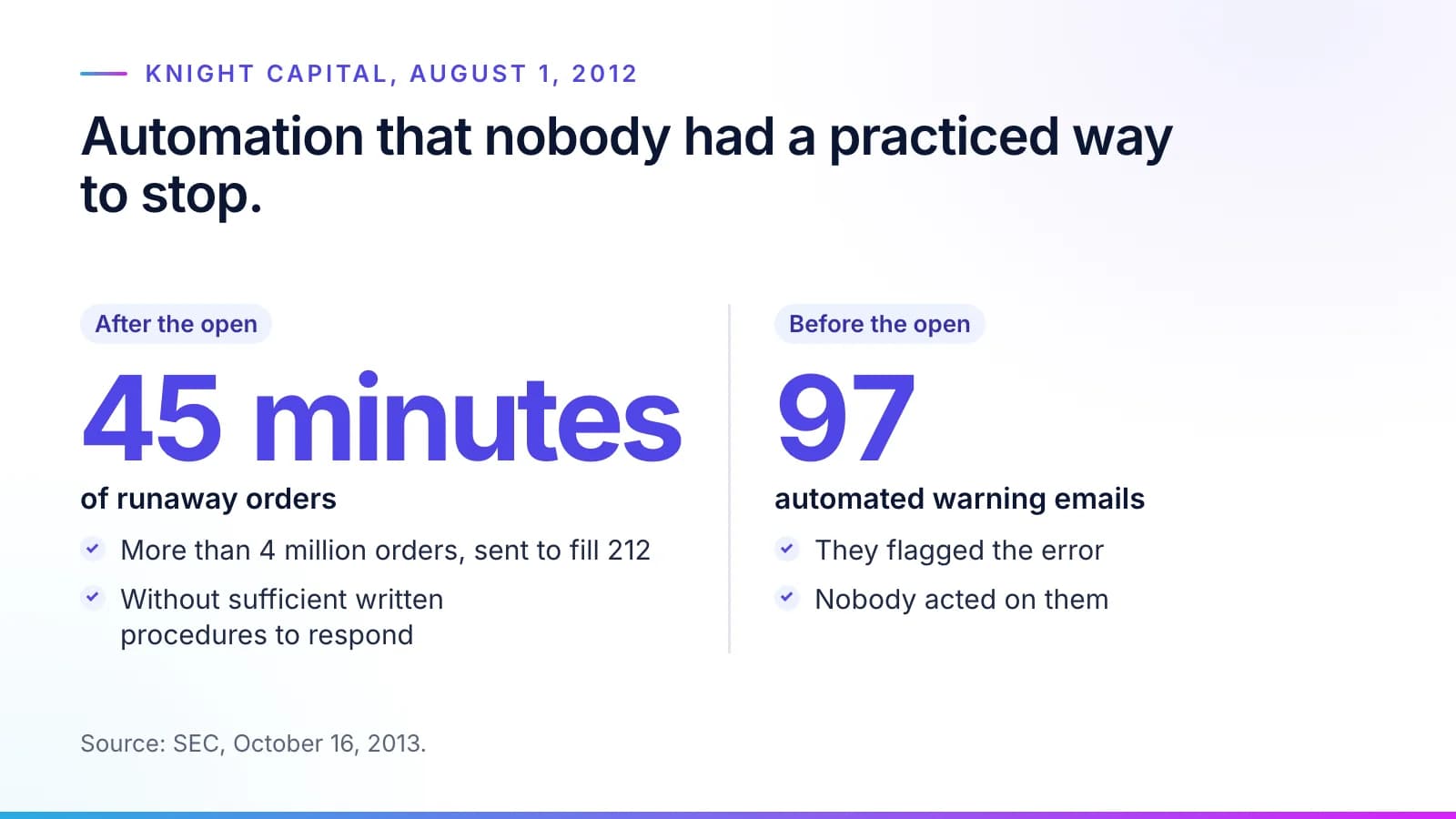
An untested switch can't be relied on, and the clearest lesson is older than AI. On August 1, 2012, an automated order router at Knight Capital sent more than 4 million orders in 45 minutes while trying to fill 212 customer orders. Before the market opened, its systems had sent 97 automated emails flagging the error; nobody acted on them.
The SEC found the firm lacked sufficient controls and written procedures to guide its staff's response to an incident like it (SEC, October 16, 2013). The order adds a detail every runbook author should read.
Staff tried removing the new code from the seven servers where it had installed correctly, and that made things worse: those servers then ran the same faulty old code as the eighth (SEC order, Release No. 34-70694, paragraph 27). A rollback is a change too, and in an incident it needs the same discipline as the change it reverses.
Writing the procedure down is half the job. People have to practice it, which is why stop drills are a published measure on our scoreboard, with the date of each drill and the time it took to stop each Virtual Employee and each department.
The record an examiner will ask for
#When an examiner asks whether you can stop your agents, the follow-up is "show me the last time you did". The stop itself goes on the record: who stopped what, when and why, and what the work was doing at the time. Every attempt the policy check blocked is counted and shown, never silently dropped, because a rising count is the early sign that something is pushing on the controls.
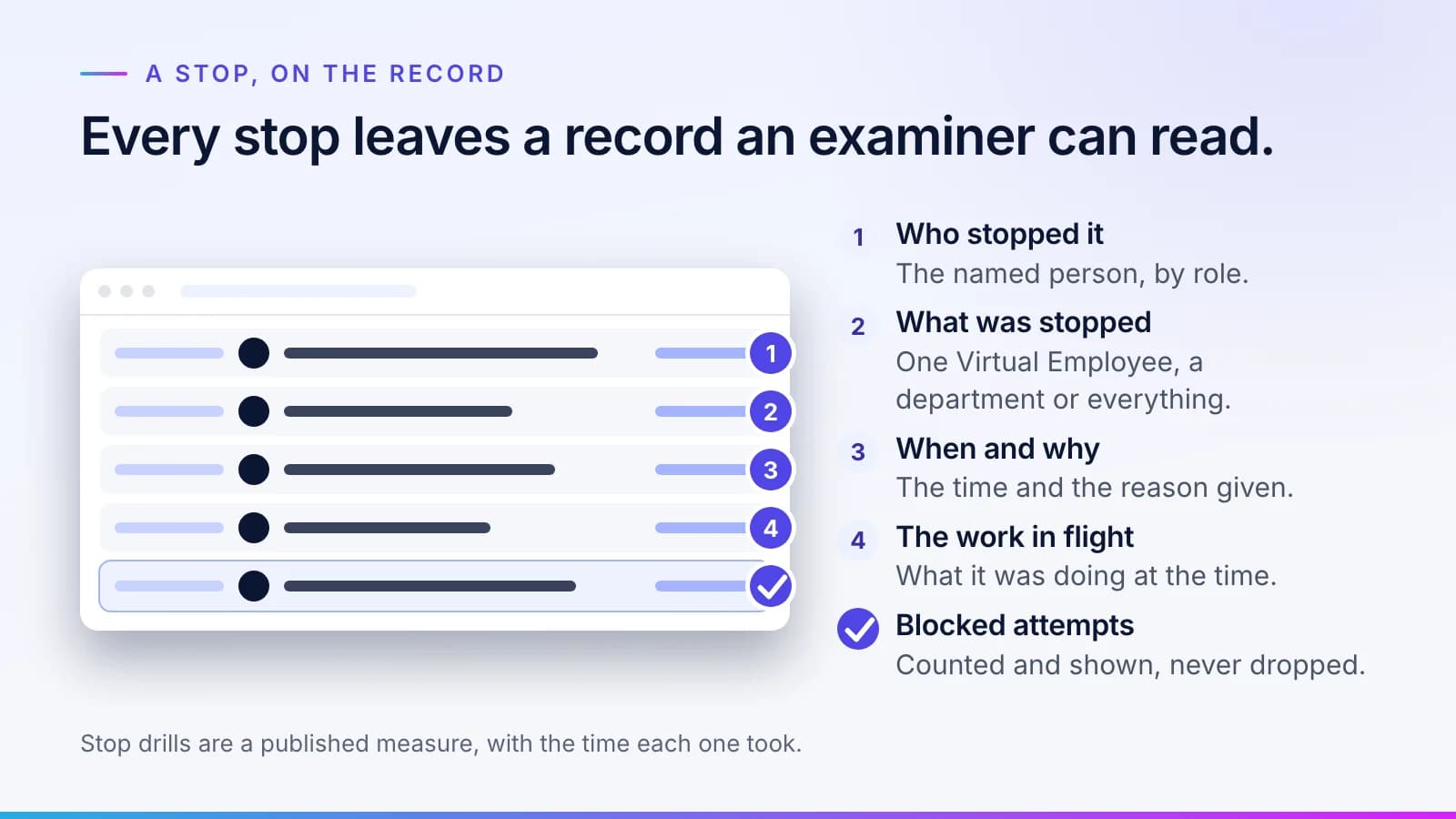
The stop record sits beside the task receipts. Each task records the identity that did it, the checked plan, the model, the rules it ran under, what it touched, the cost and the outcome. Phylax keeps every receipt and approval timestamped and tamper-evident, along with each queue move, and Archon exports every control action for audit review. Our guide to reading an AI task record walks through one entry by entry. The security and trust page sets out the controls.
Stopping the agents shouldn't stop the knowledge
#One worry keeps people from using a kill switch: that turning the agents off loses what they learned. It shouldn't. The knowledge lives in the knowledge layer, and the agents only read it. Stopping a Virtual Employee leaves the vocabulary and the approved rules exactly where they were, so starting it again picks up the same rulebook, including every fix your team approved along the way (a mistake fixed once stays fixed). Our knowledge layer questions and answers cover how that layer is built.
The work still has to go somewhere. Work the checks can't confirm already goes to a Needs a person queue, and the same team should know it inherits the routine queue during a stop. Write that into the stop procedure before you need it, and say how long the team can carry the extra load.
Identity is half of this, and our piece on AI agent identity and access covers it, from short-lived credentials to the gateway that limits where each Virtual Employee can reach.
Five things to have ready before the examiner asks
#Start with the drill; the rest follows from it.
- A demonstration that you can stop one agent without stopping the rest, and everything at once if you must.
- A written list of who may stop what, matched to their roles.
- The date and duration of your last stop drill for every agent and department.
- The record of every stop and every blocked attempt, exportable for review.
- A named team that takes the queue while the agents are stopped.
Gartner predicts over 40% of agentic AI projects will be canceled by the end of 2027, due to escalating costs, unclear business value or inadequate risk controls (Gartner, June 25, 2025). Of those three causes, inadequate risk controls is the one fully in a bank's own hands. Bring your exam questions to a briefing, and we'll walk your team through each control, the stop included, on the control and cost screen.
Further reading
#- Reuters, Banking watchdogs ramp up AI scrutiny as stability fears mount, sources say, October 13, 2026, as published by Khaleej Times.
- Federal Reserve, SR 26-2: Revised Guidance on Model Risk Management, April 17, 2026, and its attachment.
- Colorado General Assembly, SB26-189, Automated Decision-Making Technology, signed May 14, 2026.
- European Parliament, Legislative Train: Digital Omnibus on AI, on Regulation (EU) 2026/1744, updated October 25, 2026.
- European Union, Regulation (EU) 2024/1689, the AI Act, Articles 12, 14 and 26.
- NIST, Artificial Intelligence Risk Management Framework (AI RMF 1.0), NIST AI 100-1, January 2023.
- NAIC, Implementation of the NAIC Model Bulletin on the Use of AI Systems by Insurers, status as of November 13, 2026.
- SEC, SEC Charges Knight Capital With Violations of Market Access Rule, October 16, 2013, and the order, Release No. 34-70694.
Questions
What people ask.
What is an AI agent kill switch?
An AI agent kill switch is a tested way to stop an agent's work at the level the problem needs: one agent, one department or everything at once. A working one is drilled on a schedule, and every stop leaves a record of who stopped what, when and why, and what the work was doing at the time.
What are bank regulators asking about AI agents?
According to Reuters, the Federal Reserve, OCC and FDIC have asked banks what limits they place on AI agents, how agents are monitored and approved, whether their decisions can be tracked and audited, whether people stay in key decisions, and how the bank would shut autonomous systems down. Reuters's sources describe it as information gathering for now.
Does SR 26-2 cover AI agents?
No. SR 26-2, the model risk guidance the Federal Reserve issued with the OCC and FDIC on April 17, 2026, says generative and agentic AI models are novel and rapidly evolving and are outside its scope. A bank's own risk management and governance are expected to set the controls for them.
When do the Colorado and EU AI rules take effect?
Colorado's SB26-189 applies from January 1, 2027, with notice, explanation of adverse outcomes, human review on request and three years of records. The EU AI Act's rules for stand-alone high-risk systems, such as credit scoring and life and health insurance pricing, apply from December 2, 2027.
Does stopping an AI agent lose what it has learned?
It shouldn't. In a well-built system the knowledge lives in a knowledge layer that the agents only read. Stopping a Virtual Employee leaves the vocabulary and the approved rules where they were, so restarting it picks up the same rulebook. Plan who takes the queue while it is stopped.
The products, industries and examples it covers.
- Agent control planeArchonSee every agent at work, and stop or start any of them.
- Governance and auditPhylaxSign-in, policy, secrets and one audit trail from the screen to the disk, so you can show any examiner what happened.
- AI safetyGuardContent safety on every prompt, response and tool call.
- Identity and sign-inAuthOne sign-in for every person, service and AI agent.
- IndustryFinancial servicesCredit, account and claims files checked against your policy, and answers to exam requests drafted from records on file. Your compliance officer approves every response.
- IndustryLending and account operationsBorrowers’ statements and tax returns spread, covenants tested and annual review memos drafted against your credit policy. Your credit team decides.
- IndustryInsurance claimsEach claim file audited against your state’s standards, deadlines kept with letters drafted, and bills checked. Adjusters decide.
- IndustryHealthcare providersEach denial matched to the payer’s reason and the record, with an appeal drafted for a person to sign, and each remittance checked against the contract. Staff and clinicians decide.
- IndustryHealth plansEnrollment and premium files reconciled line by line, directory entries verified on schedule, and appeal case files tracked on their clocks. A physician decides every medical appeal.
- IndustryGovernmentPermit applications checked against your code and checklist before the review deadline, and records requests prepared with proposed redactions for staff to approve.
- IndustryDefenseFirst articles checked against the drawing and purchase order, each supplier’s required cybersecurity level tracked, and outgoing drawings compared with your release rules. Engineers and reviewers decide.
- OverviewTrust and governanceEvery action checked, every step recorded.
- OverviewControl and costStop it any time, set limits, and see what every task costs.
- OverviewHow it worksTen checked steps from your first decision to the day it handles real cases.
Read next.
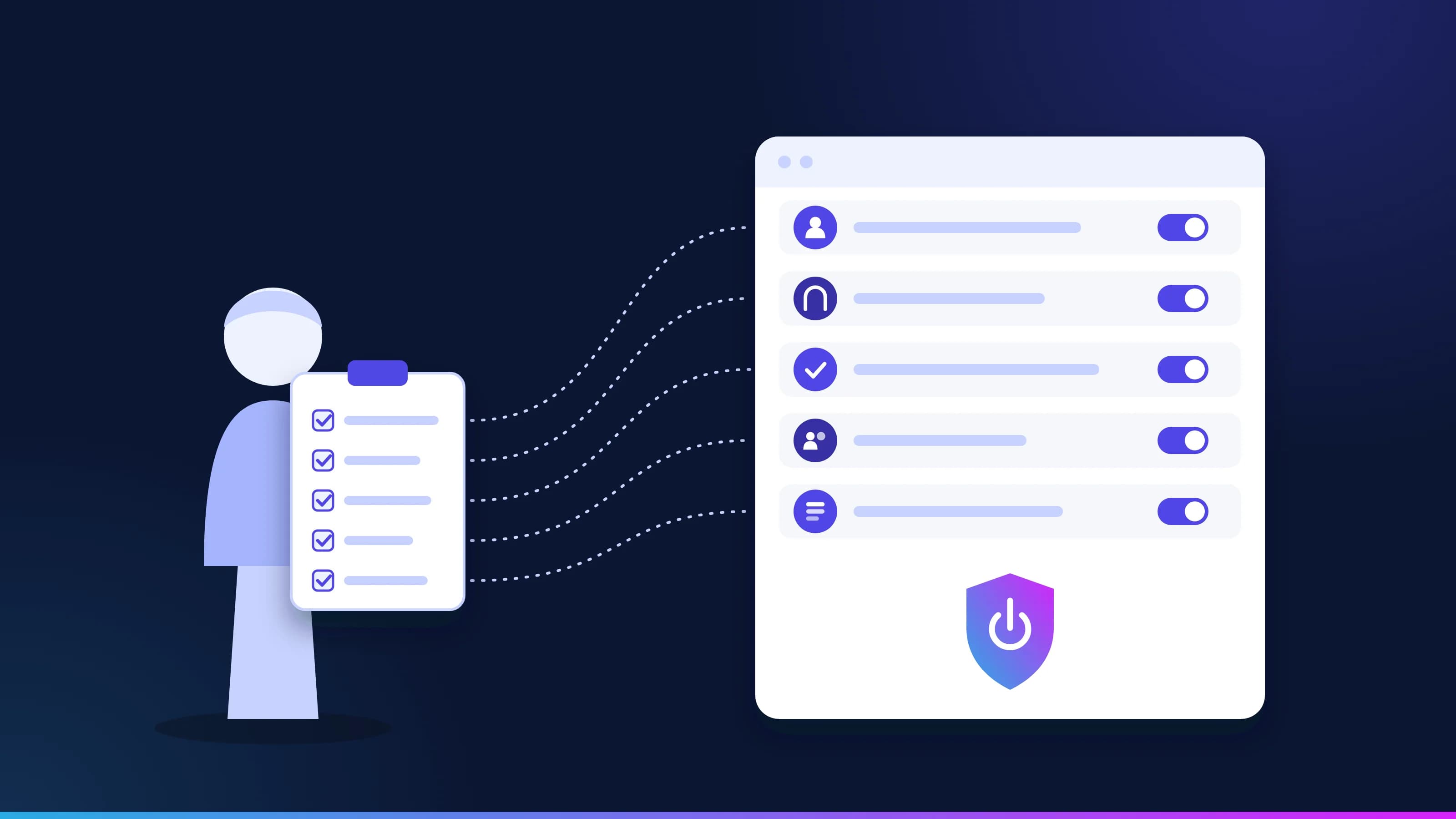 Guide · GovernanceCSBS AI Supervisory Framework: a checklist for banksState examiners now have a framework for reviewing AI, with its own section on AI that takes actions on its own. The questions they are directed to ask, turned into a checklist, and the control in Inovagio that answers each one. · updated November 18, 2026 · 9 min read
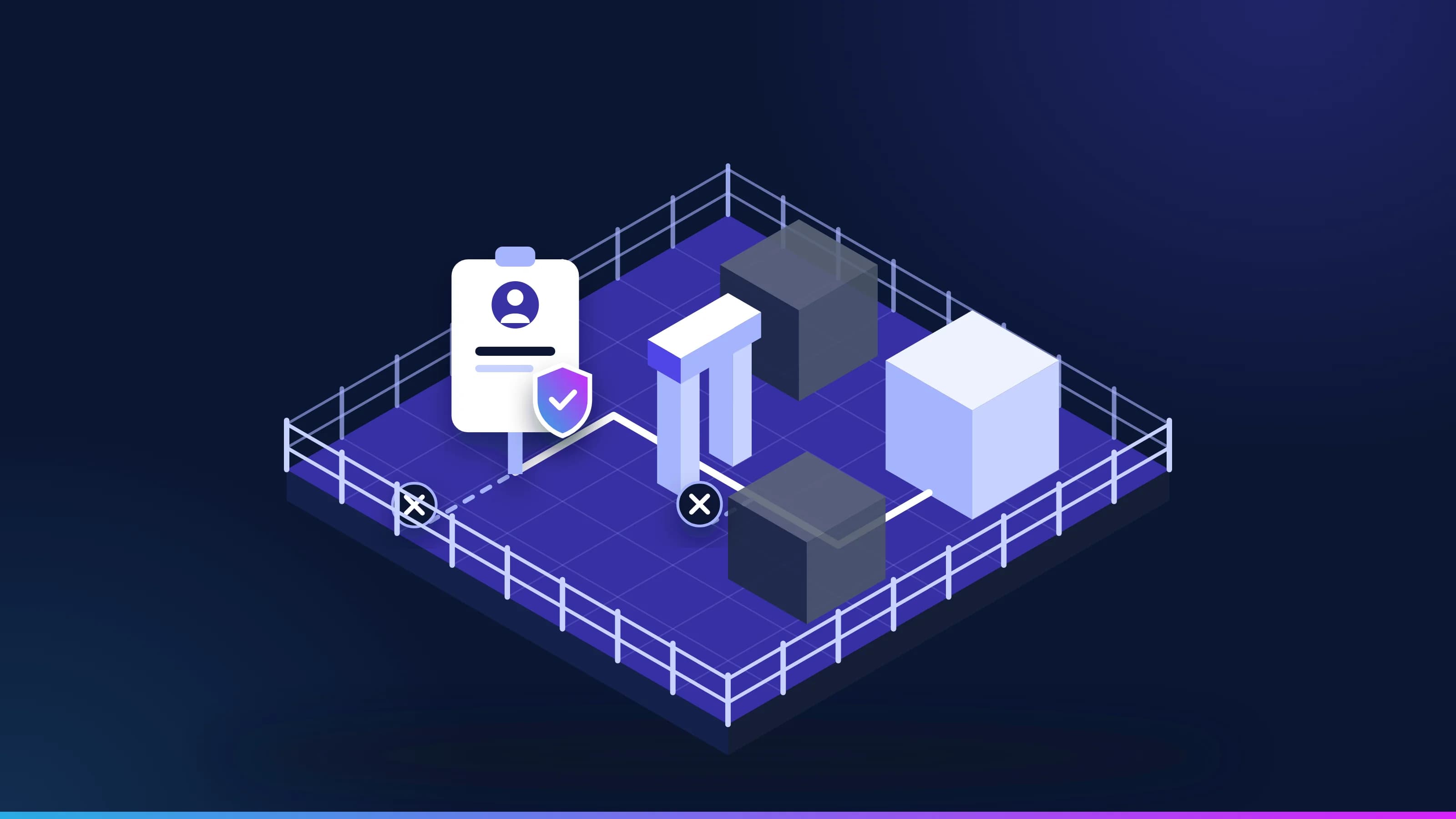 Article · GovernanceIs it safe to give AI a login?Work that crosses systems needs a login, and a login is what a security team guards hardest. These are the five controls that make a Virtual Employee safe to credential, how the kill switch works, and the one number a security team should watch. · updated November 18, 2026 · 8 min read
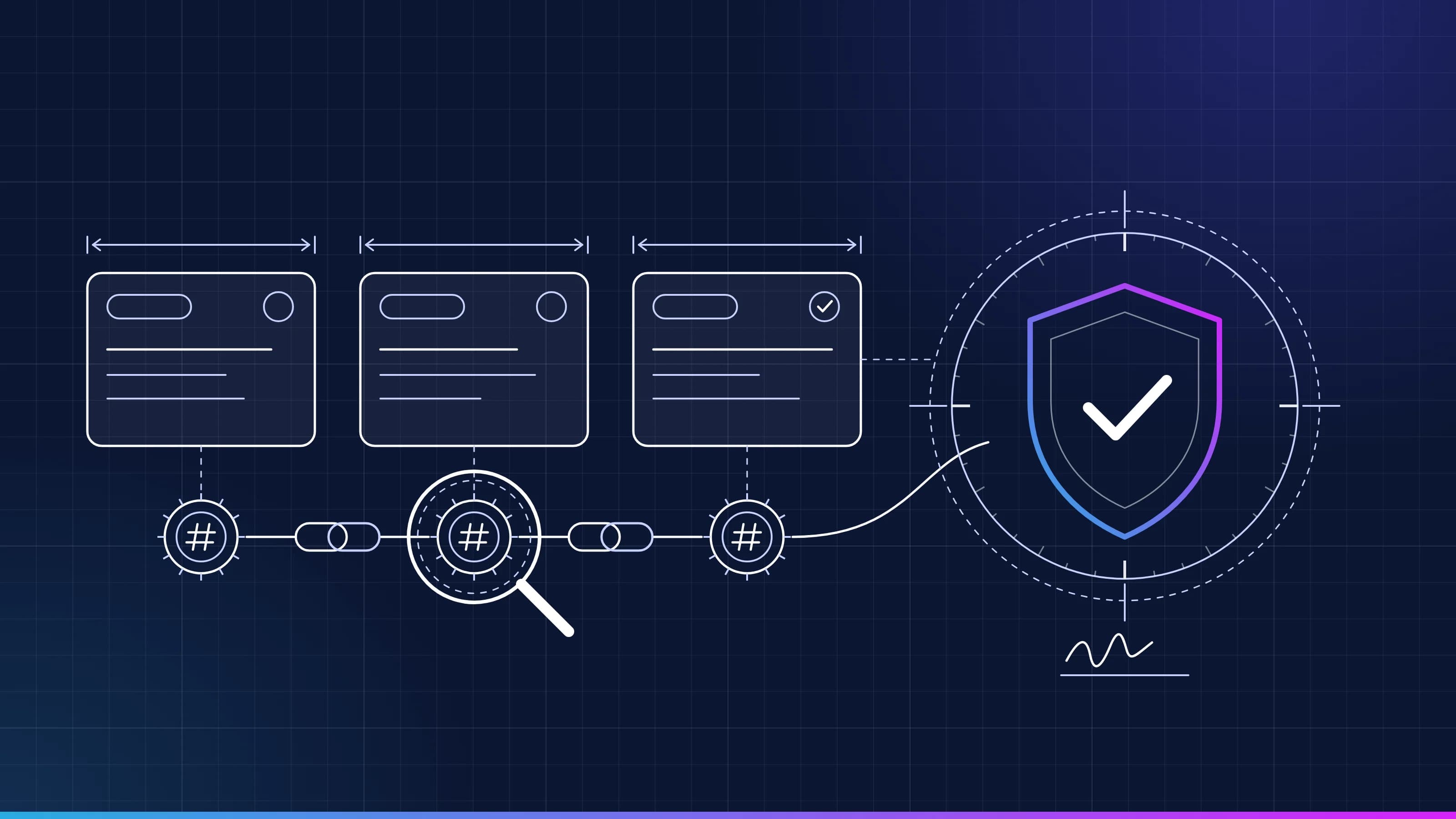 Guide · AI audit trailRead a task recordEvery task Inovagio runs leaves a tamper-evident record. Here is what each line means, how the seals chain together, and how to replay a task end to end. · updated November 18, 2026 · 5 min read
See it on your work
See how one of your tasks runs, start to finish.
A 30-minute walkthrough of one of your workflows, the approval step and the audit record, with the people who build the platform.