

CSBS AI Supervisory Framework: a checklist for banks
State examiners now have a framework for reviewing AI, with its own section on AI that takes actions on its own. The questions they are directed to ask, turned into a checklist, and the control in Inovagio that answers each one.
Inovagio team · Published · Updated · 9 min read
On this page
A community bank's exam letter used to ask about AI in a line or two, if at all. That is changing. On September 16, 2026, the Conference of State Bank Supervisors released the CSBS AI Supervisory Framework, a guide for the state examiners who supervise state-chartered banks and state-licensed nonbank financial companies. It gives agentic AI a section of its own. This checklist turns what that section directs examiners to review into questions a bank can answer before the exam, and maps each one to the control in Inovagio that answers it.
Note
Not legal advice. The framework is a discretionary tool, and each state decides how much of it to use. Check your obligations with counsel and your state regulator.
What the CSBS AI Supervisory Framework is
#
The framework is a set of examiner materials: a core examiner guide, an examiner work program, supplements for nonbank institutions, and an optional worksheet for sorting AI use cases by risk. It draws on the NIST AI Risk Management Framework, among other sources. CSBS calls it a discretionary tool for state examiners, and each state decides how much of it to fold into its own exams. Moore & Van Allen's summary notes that it creates no new legal requirements, and reads it as a guide to how state regulators are likely to approach AI in exams from here on.
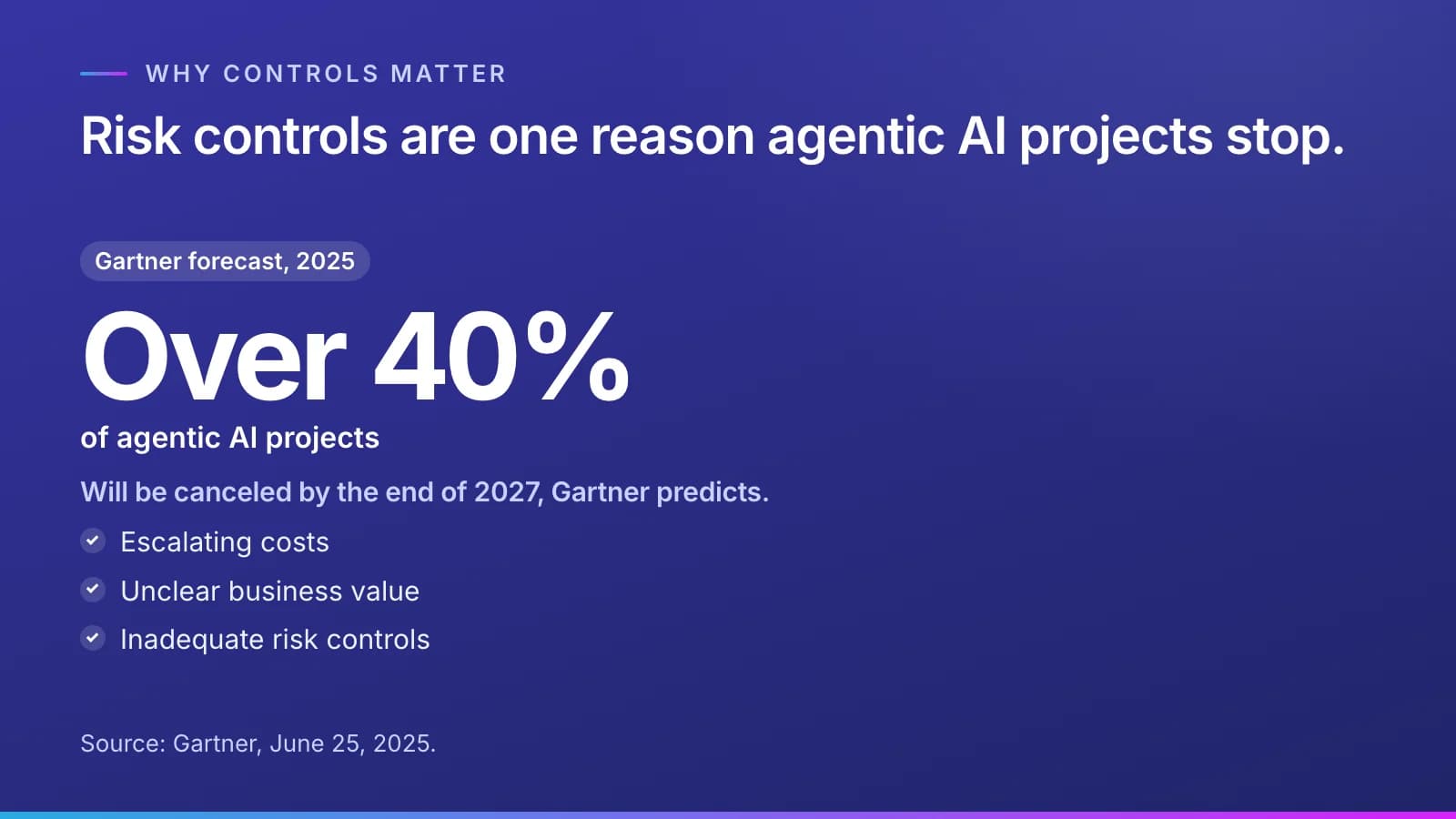
The timing makes sense. Gartner predicts over 40% of agentic AI projects will be canceled by the end of 2027, due to escalating costs, unclear business value or inadequate risk controls (Gartner, June 25, 2025). Of those three causes, risk controls are the one a bank can show an examiner.
Federal model risk guidance doesn't fill the gap for agents. On April 17, 2026, the Federal Reserve issued revised model risk management guidance jointly with the Office of the Comptroller of the Currency and the Federal Deposit Insurance Corporation. It supersedes SR 11-7 (Federal Reserve, SR 26-2). A footnote in it puts generative and agentic AI out of its scope, and the Federal Reserve expects the letter to matter most to the largest banking organizations. For agentic AI at a community bank, the CSBS framework is the more specific guide.
Sources: CSBS, the Artificial Intelligence Supervisory Framework, and Moore & Van Allen, "CSBS Releases Artificial Intelligence Supervisory Framework: What Financial Institutions Should Know" (October 19, 2026, also published on Mondaq).
The five agentic AI checks, and the control that answers each
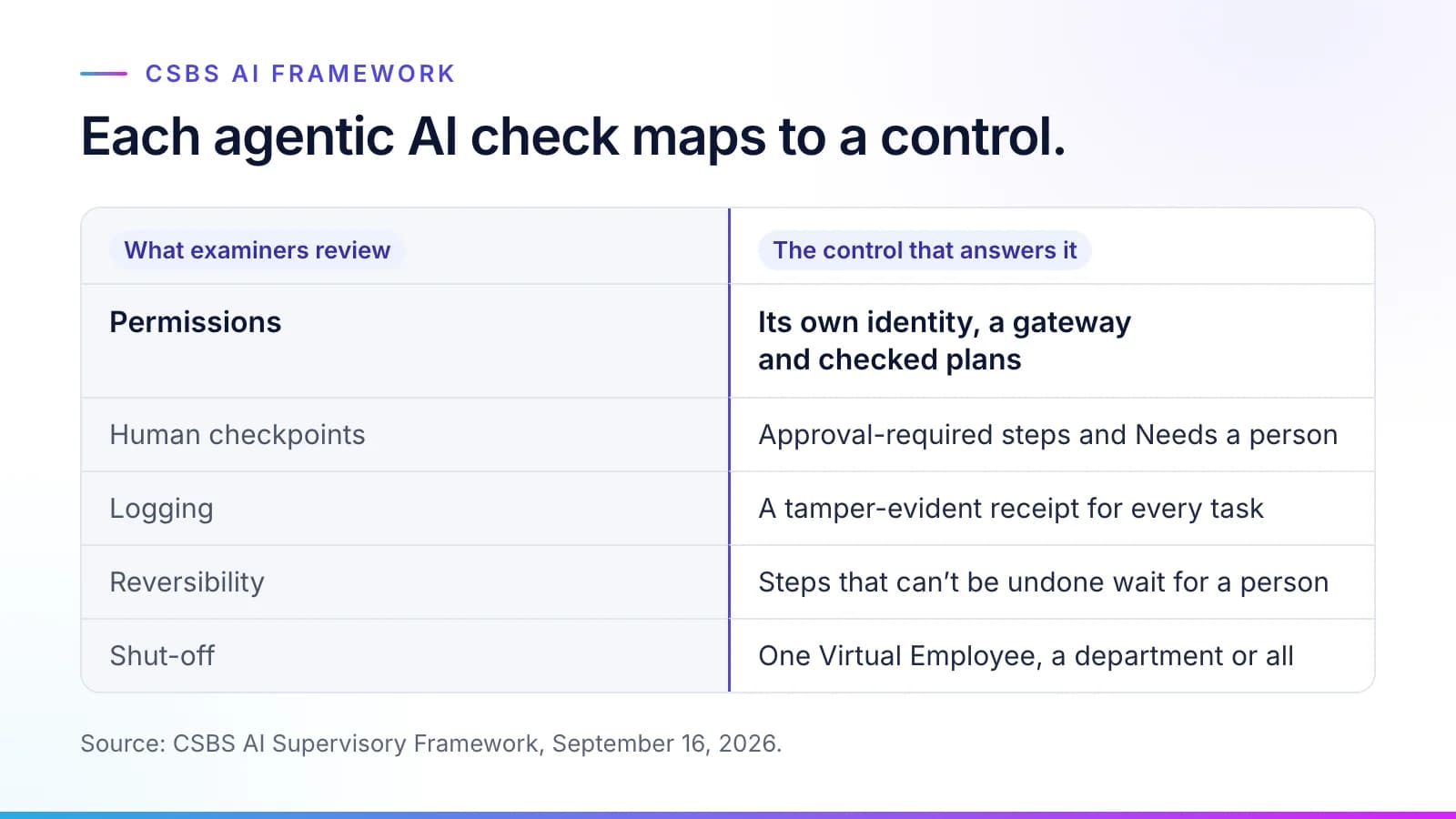
#Agentic AI here means AI that takes actions itself, with limited direction from a person. The industry also calls these systems AI agents or AI employees; ours are Virtual Employees. For them, examiners are directed to look at five things: the permissions the system has, the human checkpoints, logging, whether its actions can be reversed, and whether the bank can restrict or shut down its automated activity.
1. Permissions: what is the AI allowed to do?
#- Does each AI system have its own identity, or does it share an account with people or other systems?
- Is what it may touch limited to what its job needs, and can you show that list?
- Are its actions checked against those limits before they run?
How Inovagio answers it. Every Virtual Employee is its own principal in Auth, with its own roles and no shared accounts. For one that works on your network, the identity sits in your own directory, so your access rules and access reviews apply to it like anyone else. Every call to one of your systems goes through a gateway (APIM) that allows only the destinations that Virtual Employee is permitted, and credentials are short-lived tokens held by the gateway, never placed in a prompt. Before anything runs, the plan is checked against its permissions and your approved rules. A poisoned document can change what it proposes, not what the checks allow.
2. Human checkpoints: where does a person decide?
#- Which steps need a person's approval before they run?
- What happens when the AI can't confirm a result?
- Who decides the cases that affect a customer?
How Inovagio answers it. Approval-required steps wait for a person, and dual control applies where your rules ask for two. Anything the checks can't confirm goes to the Needs a person queue, to the team member the rule names, with the reason attached. What happens next is in a mistake your team fixes once stays fixed. Decisions about people stay with people: a Virtual Employee prepares the file, and your credit team makes every credit decision. How a checkpoint becomes part of a rule is in our guide to how an AI business rule is approved.
3. Logging: can you show what it did?
#- Is every action recorded with who acted and why?
- Can the record be changed after the fact without anyone noticing?
- Are blocked attempts recorded too?
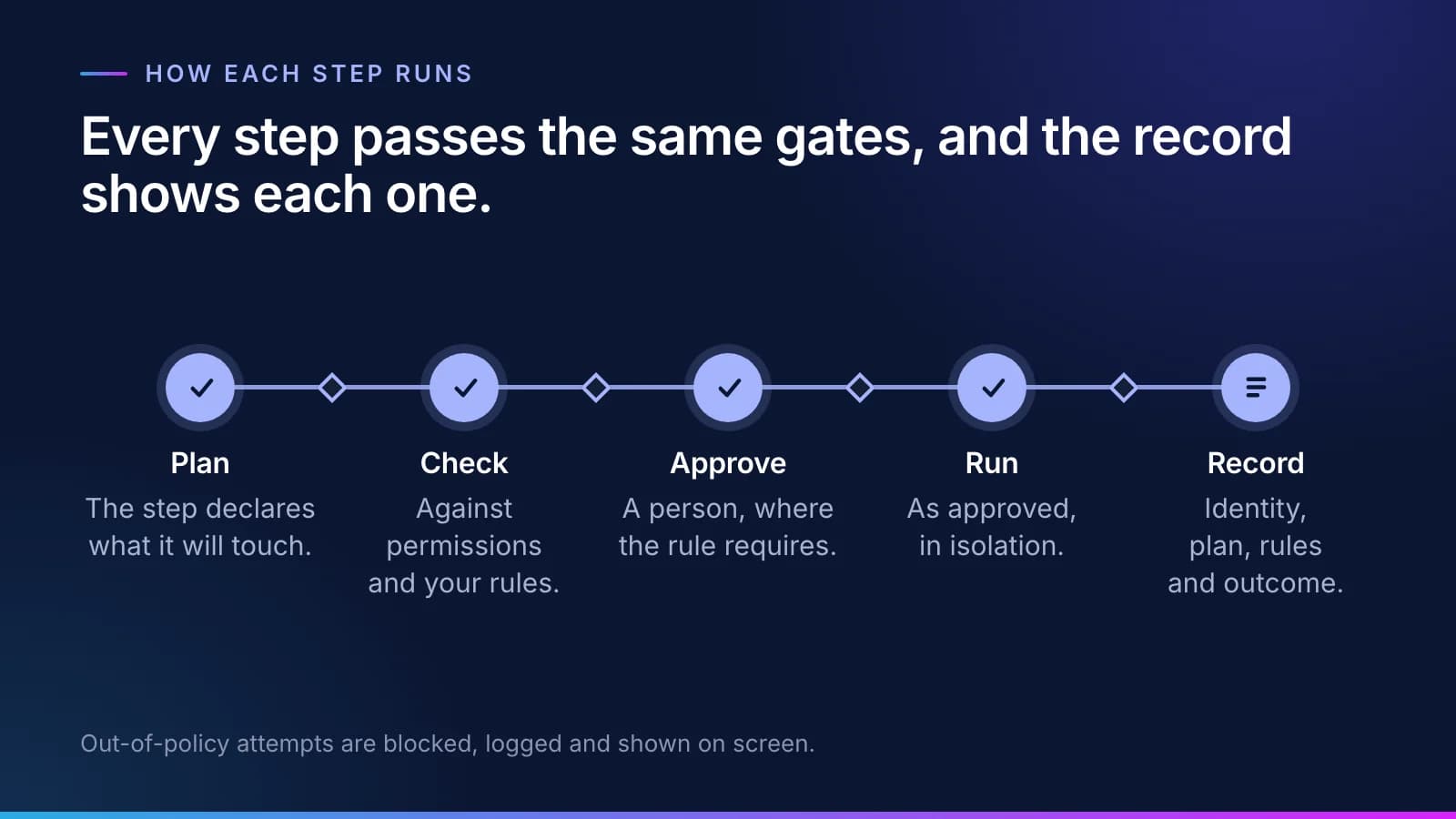
How Inovagio answers it. Every task leaves a receipt that names the identity and the checked plan behind it. The receipt also records the model and the rules it ran under. Then it lists what the task touched and what it cost, with the outcome. Receipts and approvals sit in a hash-chained trail in Phylax, with signed, timestamped checkpoints, so a later edit shows. Every action is attributable to one identity and one checked plan. An out-of-policy attempt is blocked and logged, and shows on screen; it's never dropped silently. Our guide to reading a task record walks through one entry by entry.
4. Reversibility: can its actions be undone?
#- Do you know, before an action runs, what it will change?
- Are the actions that can't be undone, such as a payment or a letter to a borrower, held for a person?
- Can a change to the AI's own rules be reversed?
How Inovagio answers it. Each step declares what it will touch before it runs, and the checked plan runs as approved inside an isolated workspace. Steps that can't be taken back are approval-required steps in your rules. Because every action is recorded against its identity and plan, an action that must be reversed in your own system can be traced exactly. Every rule change has an approver and can be rolled back.
5. Shut-off: can you stop it?
#
- Can you stop one AI system without stopping the rest, and all of them at once?
- Who can do it, and how long does it take?
- Have you tested it?
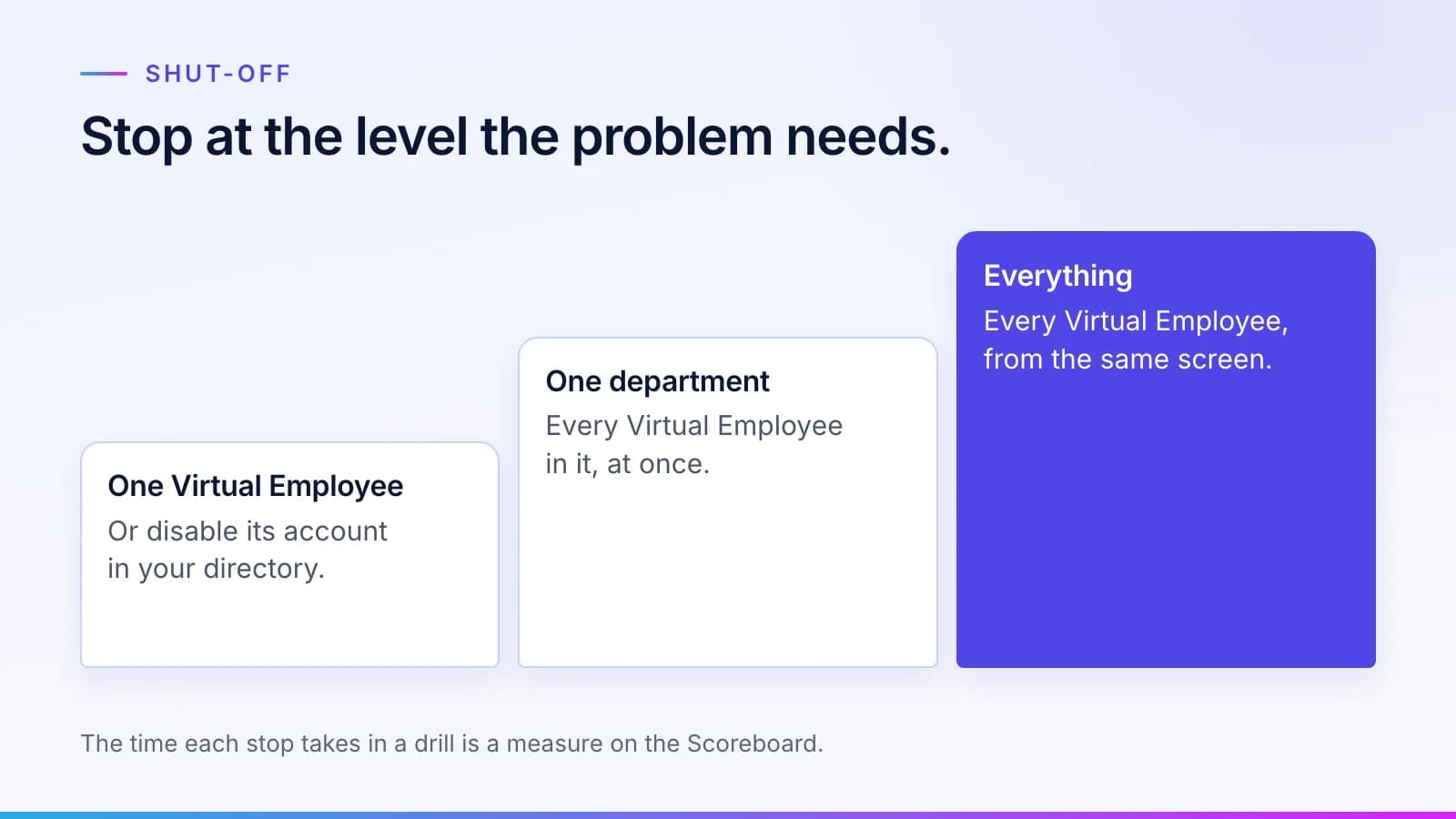
How Inovagio answers it. The stop switch in Archon works for one Virtual Employee, one department or everything at once. It's all on one screen, and Guard enforces the stop. Spending limits stop work when they are reached, not after. For a Virtual Employee on your network, disabling its account in your directory stops it too. The time taken to stop each Virtual Employee and each department in a drill is one of the measures on our scoreboard, and the controls themselves are on the control and cost page.
What else the framework covers
#The framework covers more than agentic AI. Three other areas sit beside it.
- An AI inventory. Examiners review whether the bank keeps a current inventory of its AI systems, tools, models and use cases. Each Virtual Employee is a named identity, recorded with its role and the model family it runs on. The control screen lists which ones are running.
- Vendors. The bank stays responsible for AI risk when a vendor supplies the tool. Ask every AI vendor where the system runs, where your data goes, whether your data trains anything for anyone else, whether you get the records behind each action, and whether you can take your rules with you. With Inovagio, your data never trains anything for another customer, and the rulebook exports in open formats.
- Reasons for credit decisions. AI-assisted decisions can't undermine the legal duty, where it applies, to give an applicant specific reasons when credit is declined or its terms are made worse. In lending, every figure a Virtual Employee prepares is traced to its page in the source document. The decision and its reasons stay with your credit team.
The document request list and the risk tiering worksheet
#Two of the materials shape the exam before it starts. CSBS describes the core examiner guide as including initial scoping questions, a document request list, and procedures for governance and oversight. The list itself isn't on the CSBS page, so ask your state regulator for the version your examiners use and build your files to match it.
The AI Use Case Risk Tiering Worksheet is, in CSBS's words, an optional industry tool to support a risk-based assessment of individual AI use cases. Sort every use with it. The uses that land at the top are where the five checks above need the strongest evidence.
Have these ready before the request arrives:
- the AI inventory, with an owner for each use;
- the risk tier of each use, and why it sits there;
- for each agentic use, its permissions, its approval steps, a sample of task records, how its actions are reversed and the date of the last stop drill;
- each AI vendor's answers to the questions above.
Every piece on AI risk for banks and insurers is collected under risk.
How to prepare for an exam
#- List every AI use in the bank, including the AI built into vendor tools.
- Sort each use by risk. The framework's optional worksheet is built for this.
- For each agentic use, write down the answers to the five checks above.
- Run a stop drill and keep the date and time it took. What federal examiners are now asking about stopping agents is in can you turn your AI agents off?
- Collect the records behind a sample of real tasks, so you can walk an examiner through one.
For the lending queues where this matters most, see Virtual Employees for community bank lending. Insurers working to the NAIC AI Model Bulletin can use the companion NAIC AI bulletin checklist. Why a Virtual Employee can be trusted with a login at all is in how to give AI a login safely. For short answers on what a Virtual Employee is and never does, see our Virtual Employees questions and answers.
Questions
What people ask.
What is the CSBS AI Supervisory Framework?
The CSBS AI Supervisory Framework is a set of materials for state examiners, released by the Conference of State Bank Supervisors on September 16, 2026. It covers AI governance, AI inventories and use cases, and generative and agentic AI, at the financial institutions state regulators supervise. It is a discretionary tool that creates no new legal requirements.
What do state examiners check for agentic AI?
Under the CSBS framework, examiners are directed to review the permissions an agentic AI system has, the human checkpoints where a person decides, its logging, whether its actions can be reversed, and whether the institution can restrict or shut down its automated activity. A bank should be able to answer each with evidence.
Does the CSBS AI framework create new requirements for banks?
No. CSBS calls the framework a discretionary tool for state examiners, and Moore & Van Allen's summary notes that it creates no new legal requirements. Each state regulator decides how much of it to use in its own exams. It still signals what examiners are likely to ask, so it's worth preparing your answers now.
How do I prepare my bank for an AI exam?
List every AI use, including AI inside vendor tools, and sort each by risk. For each agentic use, write down its permissions, human checkpoints, logging, how its actions are reversed and how it is stopped. Run a stop drill, record how long it took, and keep the records behind a sample of real tasks.
Is it safe to let an AI system act in a bank's systems?
It can be, when the AI has its own limited identity, every action is checked before it runs, a person approves anything that can't be undone, every step is recorded and the bank can stop it at once. Those are the same five areas the CSBS framework directs examiners to review.
The products, industries and examples it covers.
- Agent control planeArchonSee every agent at work, and stop or start any of them.
- Governance and auditPhylaxSign-in, policy, secrets and one audit trail from the screen to the disk, so you can show any examiner what happened.
- Identity and sign-inAuthOne sign-in for every person, service and AI agent.
- AI safetyGuardContent safety on every prompt, response and tool call.
- API gatewayAPI ManagementOne governed door to every model, agent and API.
- IndustryLending and account operationsBorrowers’ statements and tax returns spread, covenants tested and annual review memos drafted against your credit policy. Your credit team decides.
- IndustryFinancial servicesCredit, account and claims files checked against your policy, and answers to exam requests drafted from records on file. Your compliance officer approves every response.
- OverviewTrust and governanceEvery action checked, every step recorded.
- OverviewArchitectureHow the platform fits together, from your data to finished work.
Read next.
 Article · GovernanceCan you turn your AI agents off? What examiners now askUS bank regulators have started asking how banks would shut their AI agents down, while the new model risk guidance leaves agents out of scope. Here's what examiners are asking, which deadlines arrive in Colorado and the EU, and what a working kill switch looks like. · updated November 18, 2026 · 11 min read
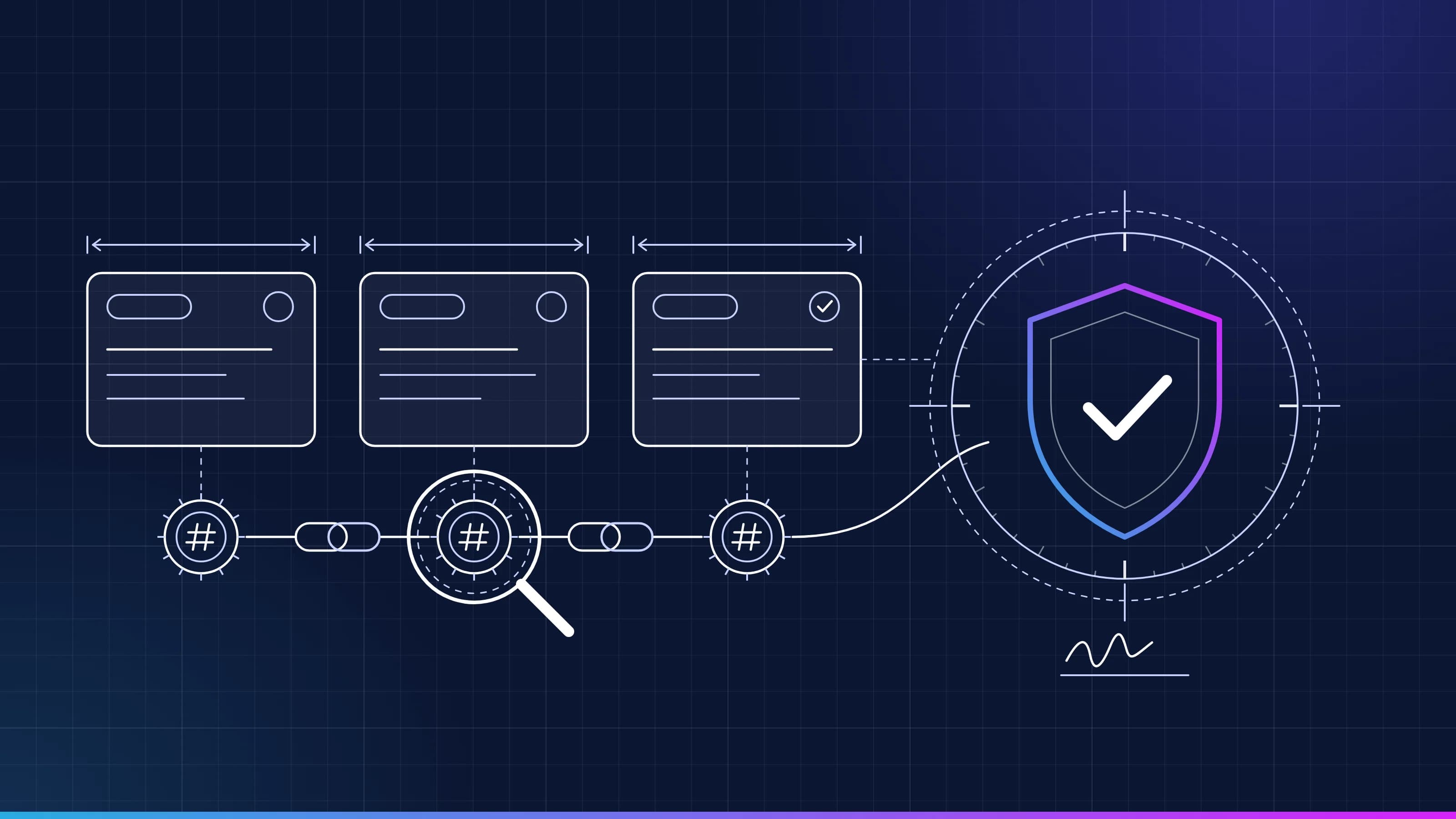 Guide · AI audit trailRead a task recordEvery task Inovagio runs leaves a tamper-evident record. Here is what each line means, how the seals chain together, and how to replay a task end to end. · updated November 18, 2026 · 5 min read
 Article · GovernanceIs it safe to give AI a login?Work that crosses systems needs a login, and a login is what a security team guards hardest. These are the five controls that make a Virtual Employee safe to credential, how the kill switch works, and the one number a security team should watch. · updated November 18, 2026 · 8 min read
See it on your work
See how one of your tasks runs, start to finish.
A 30-minute walkthrough of one of your workflows, the approval step and the audit record, with the people who build the platform.