

Read a task record
Every task Inovagio runs leaves a tamper-evident record. Here is what each line means, how the seals chain together, and how to replay a task end to end.
Inovagio team · Published · Updated · 5 min read
On this page
A tamper-evident AI audit trail is a record of every step an AI agent took, written while it works and sealed so that any later change shows. Ours is called the task record. When a Virtual Employee handles a task, an auditor will eventually ask three questions: what did it read, which rule did it apply, and who approved the result. The task record answers all three, for every task, without anyone writing it up afterwards.
This guide walks through one record line by line, using a vendor invoice as the example. Every guide and post on the subject is collected under AI audit trail.
What an AI audit trail records
#A task record is a list of entries, one for each step, in the order they happened. Every entry has the same parts:
| Part | What it tells you |
|---|---|
| Time | When the step happened, to the second. |
| Who | The Virtual Employee, the policy engine or the person who acted. |
| What | The step in plain words: read, matched, approved, closed. |
| Policy | The rule or check that applied to the step. |
| Seal | A SHA-256 hash of this entry together with the previous entry's seal. |
Here is the invoice from the example, as an auditor would see it:
| Time | Who | What | Policy |
|---|---|---|---|
| 09:14:02 | Virtual Employee (AP) | Read vendor invoice | intake.read |
| 09:14:09 | Virtual Employee (AP) | Matched purchase order and receipt | policy.check |
| 09:14:11 | Policy engine | Above approval limit | approval.required |
| 10:02:47 | Controller | Approved payment | human.approve |
| 10:02:48 | Ledger | Task closed · cost recorded | ledger.seal |
Read it top to bottom and the story is complete: the invoice came in, it matched its purchase order and receipt, it was over the controller's approval limit, so it waited for a person, the controller approved it, and the task closed with its cost on the record.
How the seals make the audit trail tamper-evident
#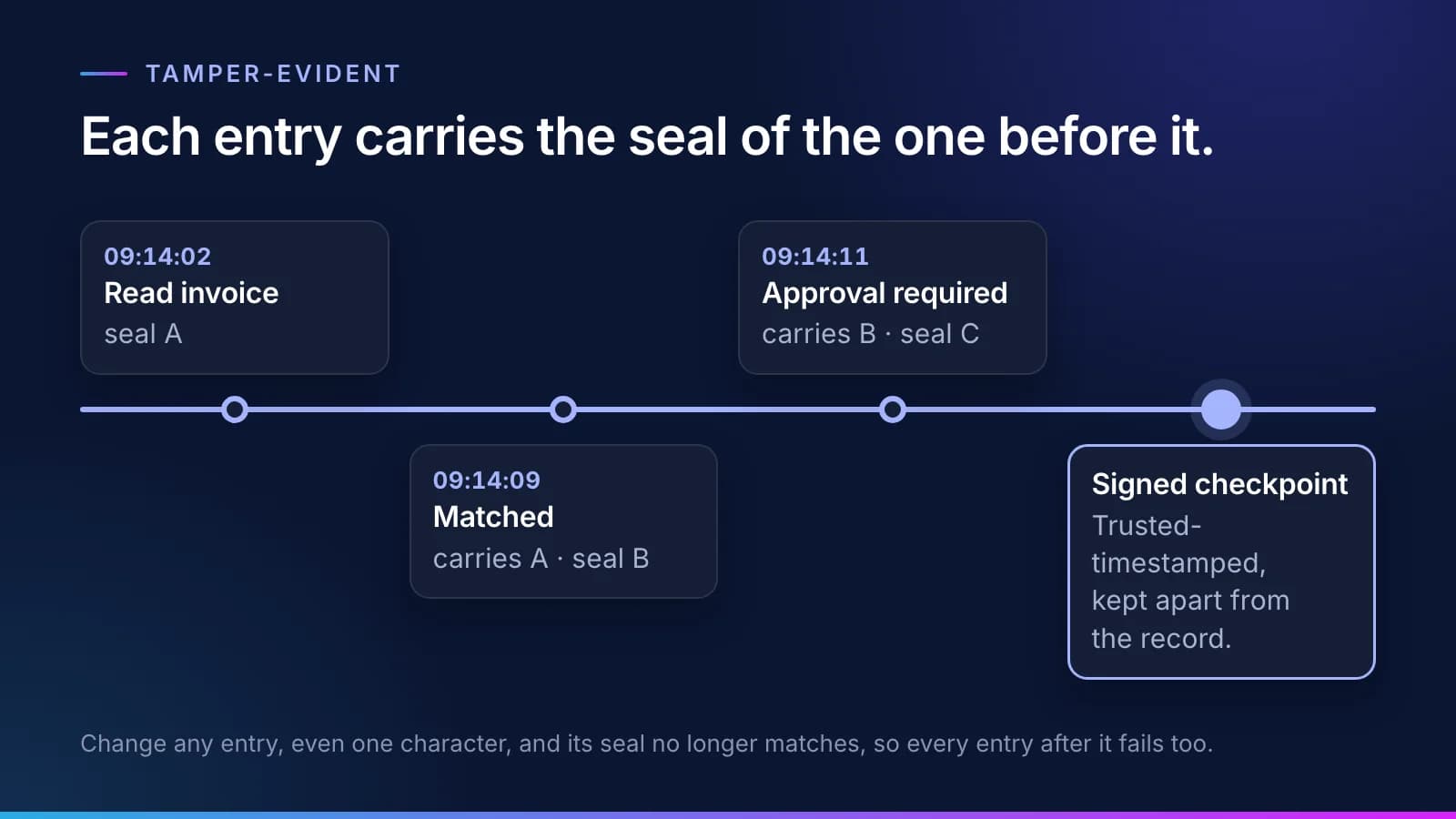
Each entry's seal is a SHA-256 hash of the entry and of the seal before it. Change an entry after the fact, even by one character, and its hash no longer matches. Verification breaks at that entry, and nothing after it can be confirmed against the checkpoint. To hide the edit, someone would have to recompute every later seal.
A hash chain on its own can't stop that. Anyone who can rewrite the whole log can rebuild the chain, and the result would check out. So the record has a second layer. Entries are batched by epoch into a Merkle tree, a hash tree whose single root commits to every entry in the batch, and that root is signed. At regular intervals, and at events such as a legal hold, the signed root goes to an RFC 3161 time-stamping authority: an outside party that returns a token binding the root to the time it saw it. The roots and their tokens sit in a write-once audit log, kept apart from the data log in MNEMOS.
Proving a single entry then takes a short inclusion proof from the entry to its signed, timestamped root. Rewriting history would mean forging the signature and getting a timestamp token for a time that has already passed. That is what tamper-evident means here. The record doesn't prevent a change; it makes any change show.
Note
Phylax keeps the hash-chained trail and verifies the chain. Panoptes shows the same tasks in its views, with the cost of each one in the cost ledger.
Where the policy checks happen
#Every protected action is checked twice: once before it runs and once on its result. The checks are deterministic: the rule your experts approved decides. In the example, the approval.required line is the check before payment: the invoice was above the limit your policy sets, so the task stopped and waited. The human.approve line is the person's decision, with their name and the time.
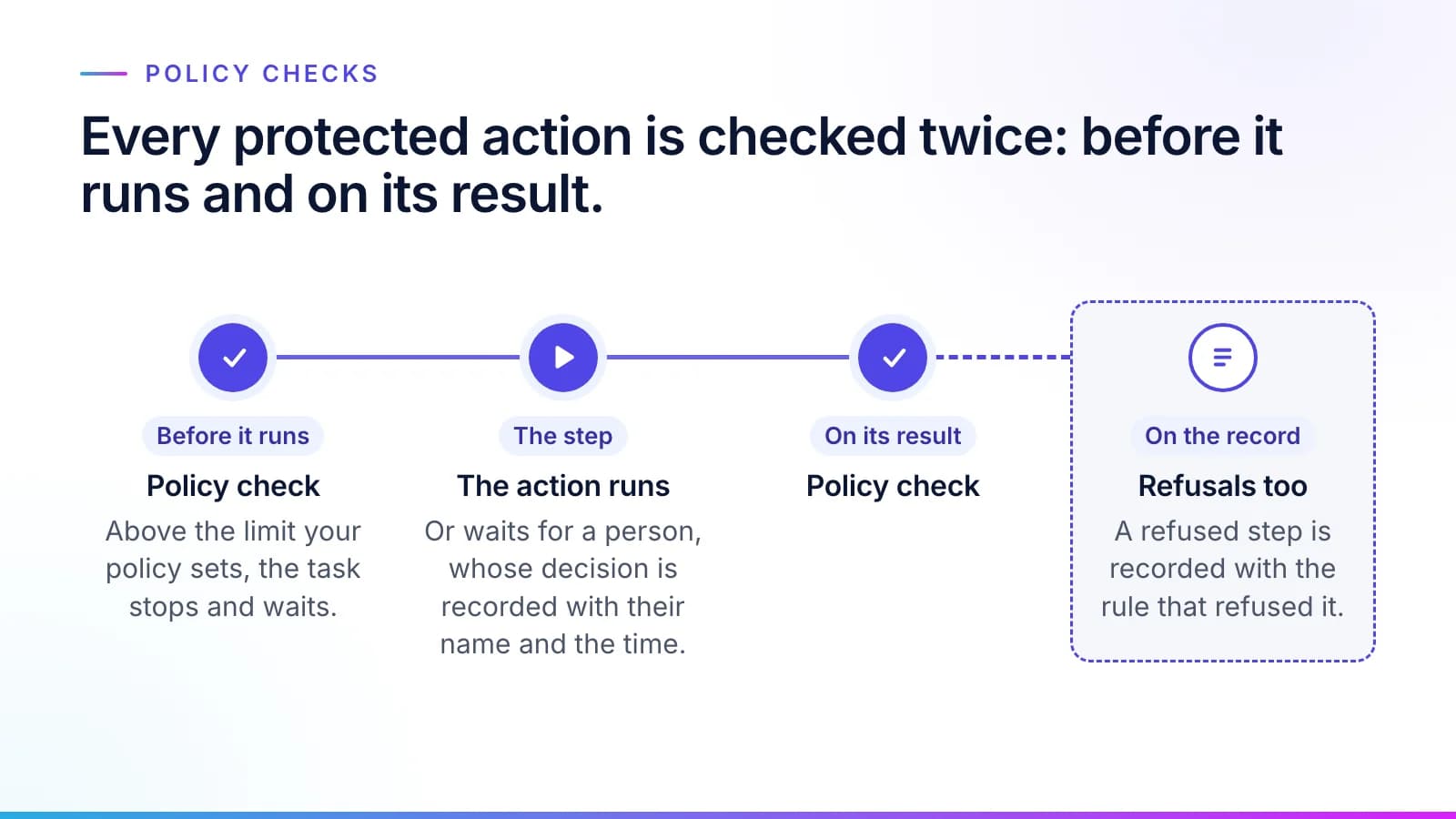
If a check refuses a step, the refusal is on the record too, with the rule that refused it. A blocked attempt is evidence as well: it shows the limits held. Why these checks are a different thing from the safety filters around a model is in business rules or AI guardrails.
Replay an AI decision for an auditor
#To answer an auditor, open the task in the console and replay it. Replay walks the record in order and shows, for each step:
- what the agent read, with a link to the source document;
- the rule that applied, as your experts approved it;
- the decision, and who made it;
- the cost of the step.
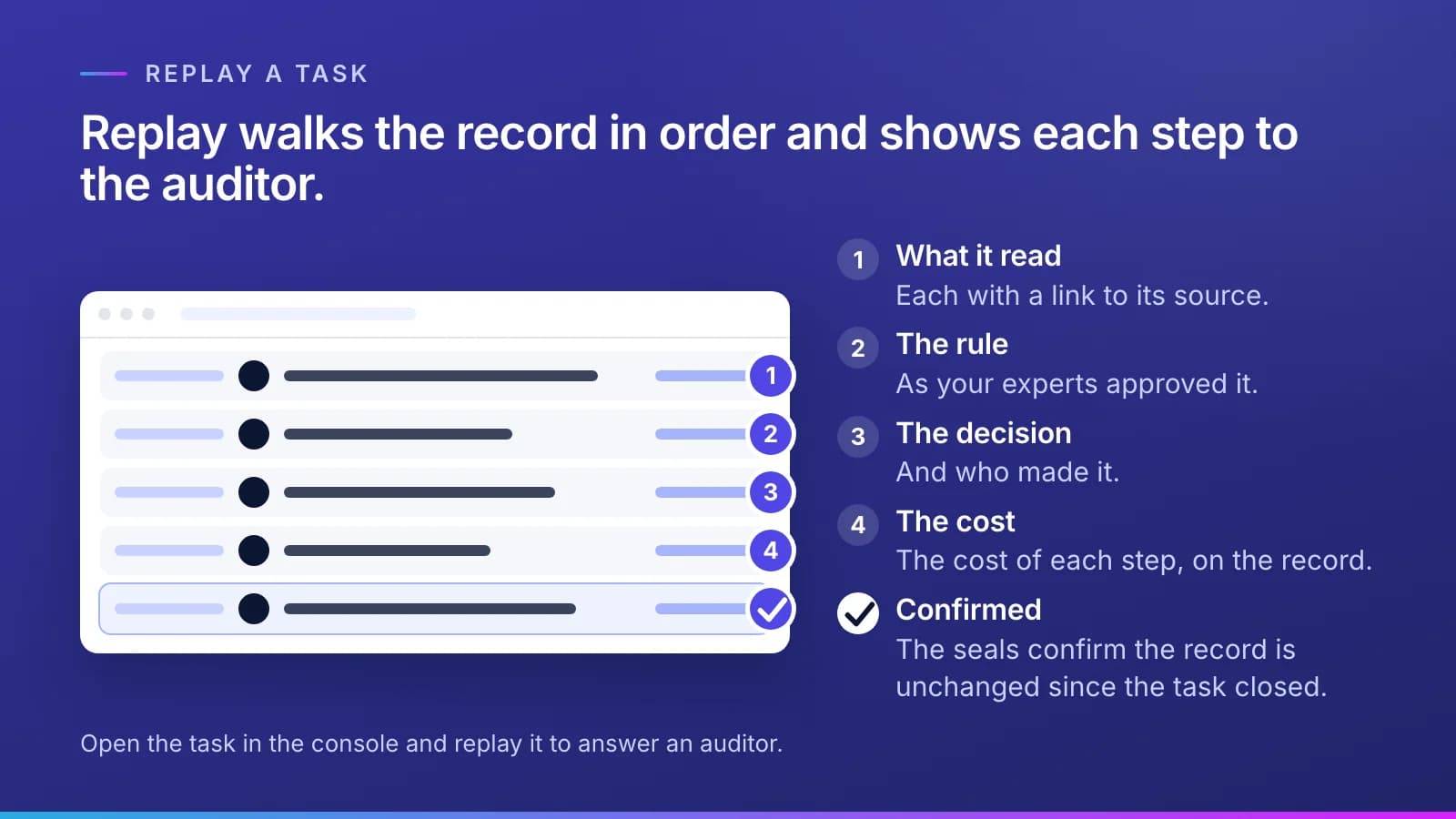
Because the seals chain to a signed, timestamped root, replay also confirms the record is unchanged since the task closed. An auditor who doesn't want to take our word for it can check the signature and the timestamp token with their own tools.
When a rule has changed since the task ran, an auditor can ask two fair questions: which version should have applied, and which version the agent knew at the time. How the knowledge layer keeps both clocks is in ontology for AI agents.
What regulators ask a record to show
#In the EU, Article 12 of the AI Act requires that a high-risk AI system can record events automatically over its lifetime (Regulation (EU) 2024/1689, the AI Act). A bank that deploys one must keep the logs under its control for at least six months, under Article 26. In the US, state bank examiners now ask whether you can show what an AI system did; the CSBS AI framework checklist maps that question to this record. The dates and the stop requirement that sit beside logging are in how to turn off AI agents.
What to read next
#- Trust and governance: how the checks and approvals work, and where the record fits.
- Phylax: the trust layer that keeps the record.
- Panoptes: the telemetry for every task, with its cost.
Questions
What people ask.
What is a task record?
It is a list of entries, one for each step a task took, in order: when it happened, who acted, what was done, the rule that applied and a seal. It is written as the task runs, not afterwards.
What does tamper-evident mean here?
Each entry carries a SHA-256 hash that covers the seal before it, so a change to any entry breaks the chain at that point. Batches of entries are also signed as a Merkle root and timestamped by an outside RFC 3161 time-stamping authority, so even someone with write access can't rewrite the past without the change showing.
How do I show an auditor what happened?
Open the task in the console and replay it. Replay shows what the agent read, the rule that applied, the decision and who made it, and the cost of each step.
Is a refused step recorded?
Yes. If a check refuses a step, the refusal is on the record with the rule that refused it.
What does an AI audit trail record?
It records every step a task took, in order: when it happened, who or what acted, what was read or done, the rule that applied and the person who approved the result. Refused steps are recorded with the rule that refused them.
The products, industries and examples it covers.
- Governance and auditPhylaxSign-in, policy, secrets and one audit trail from the screen to the disk, so you can show any examiner what happened.
- Observability and analyticsPanoptesSee every log, trace, cost and decision across the platform.
- Data engineMNEMOSRecords, documents, vectors, graph and agent memory in one engine, with a ledger behind every write.
- Card appsOpsisAnswers arrive as card apps: approvals, documents, sheets, charts and forms.
- IndustryFinance operationsInvoices matched to orders and receipts and coded by your rules, and payments to changed bank details held until a callback is logged. Your team releases every payment.
- IndustryInsurance servicing and reconciliationEach program’s bordereau matched to your policy system, the MGA’s cash matched to what is due, and every line checked against the delegated authority. Your team approves every write-off.
- IndustryInsurance claimsEach claim file audited against your state’s standards, deadlines kept with letters drafted, and bills checked. Adjusters decide.
- IndustryHealthcare providersEach denial matched to the payer’s reason and the record, with an appeal drafted for a person to sign, and each remittance checked against the contract. Staff and clinicians decide.
- IndustryLegalEach party on a new matter searched with its parent companies and former names, ethical wall requests drafted for lateral hires, and contracts compared with your playbook. Lawyers decide.
- IndustryGovernmentPermit applications checked against your code and checklist before the review deadline, and records requests prepared with proposed redactions for staff to approve.
- IndustryHealth plansEnrollment and premium files reconciled line by line, directory entries verified on schedule, and appeal case files tracked on their clocks. A physician decides every medical appeal.
- IndustryDefenseFirst articles checked against the drawing and purchase order, each supplier’s required cybersecurity level tracked, and outgoing drawings compared with your release rules. Engineers and reviewers decide.
- OverviewTrust and governanceEvery action checked, every step recorded.
- OverviewHow it worksTen checked steps from your first decision to the day it handles real cases.
- OverviewScoreboardThe measures every customer sees, and how each is counted.
Read next.
 Article · GovernanceCan you turn your AI agents off? What examiners now askUS bank regulators have started asking how banks would shut their AI agents down, while the new model risk guidance leaves agents out of scope. Here's what examiners are asking, which deadlines arrive in Colorado and the EU, and what a working kill switch looks like. · updated November 18, 2026 · 11 min read
 Guide · GovernanceCSBS AI Supervisory Framework: a checklist for banksState examiners now have a framework for reviewing AI, with its own section on AI that takes actions on its own. The questions they are directed to ask, turned into a checklist, and the control in Inovagio that answers each one. · updated November 18, 2026 · 9 min read
 Guide · GovernanceHow an AI business rule is written and approvedEvery Virtual Employee works from rules approved one at a time by the people you make responsible. What a rule contains, who signs it, how a correction becomes a new version, and how any change is rolled back. · updated November 18, 2026 · 9 min read
See it on your work
See how one of your tasks runs, start to finish.
A 30-minute walkthrough of one of your workflows, the approval step and the audit record, with the people who build the platform.