
Worked example · Calloway Finch · Example company
One law firm, five people, one year.
Calloway Finch is a mid-size law firm. Its partners have goals, its intake team runs a process spread across policies, procedures, years of records and the experience of its people, and the pieces do not always agree. This is how Inovagio learns that business and puts it to work.
Every firm has these five roles.
The partners
Set the plan
Three-year goals, and the budget that funds them.
Grace Holloway
Managing Partner
Needs every practice pulling toward the same goals.
Owen Pryce
General Counsel
Owns a conflicts policy, and the practice that has grown around it.
Nadia Petrov
Senior Conflicts Analyst
Handles the exceptions the procedures leave unclear.
Sam Clarke
Billing Specialist
Keeps every invoice inside each client’s guidelines.
The board sets the goals; the team shows how the work is really done.
Week 1
The partners’ plan goes in first
The strategy, the budget and the firm’s professional obligations become the top of the firm’s rulebook: open clean matters within one business day, no conflict missed, grow with flat staff. Each goal carries its owner and its target.
Week 2
The managing partner’s interview becomes a draft
Grace answers one question: what must be true in twelve months? Her answers become a draft the partners accept, edit or reject in one meeting.
Weeks 3 to 6
The General Counsel describes the process
“Every practice has its own intake questions, every client has its own guidelines, and our procedures, our systems and our people don’t always agree.” His interview, the firm’s policies and its matter history become a first draft, with its open questions listed, that his team corrects.
Weeks 4 to 8
It learns from the procedures, the records and the analysts
Nadia and two other analysts walk through how the work is really done: where it follows the procedures, where it differs, and where the procedures are unclear.
Week 8
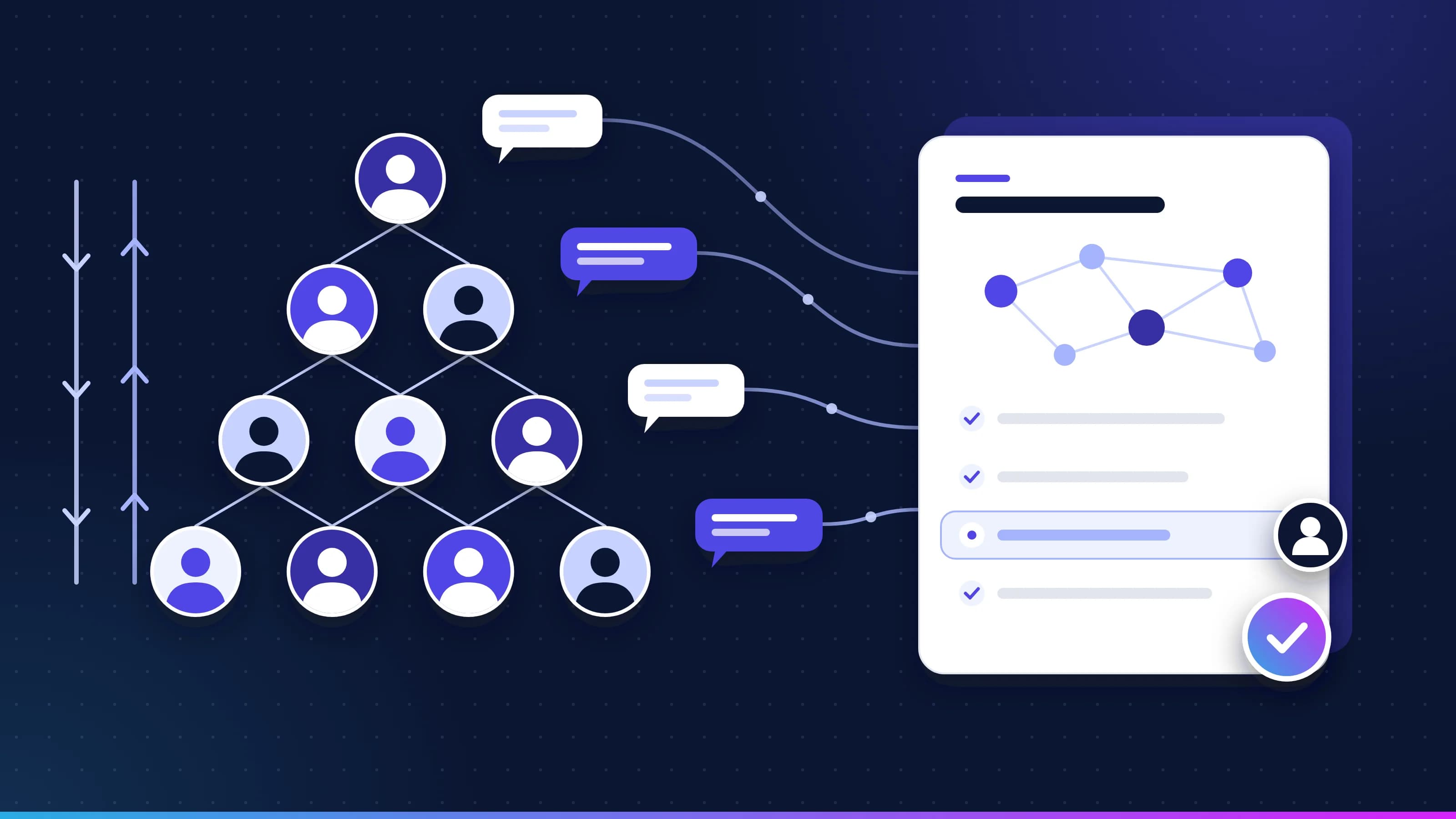
Every task traces to a goal
Each rule links up to the goal it serves and down to the Virtual Employees that follow it, with its reason one click away. The same pattern serves billing: when a time entry breaks a client’s billing guidelines, the AI holds Sam’s invoice and asks.
Where policy and practice part.
In his interview, Owen says every new matter runs a conflicts check on the client and the adverse parties. Nadia says: “We also check the other side’s parent companies and former names. We learned that the hard way.” Two other analysts agree. Inovagio flags the gap instead of guessing, and Owen decides, with the Ethics Partner as second approver: check the client, every adverse party, their parent companies and former names; any hit goes to the conflicts partner before the engagement letter goes out. That approved rule is now followed on every matter.
- The gap between policy and practice is where AI that only reads documents goes wrong.
- Every rule links back to the interviews and documents it came from.
- Nothing is used until an expert approves it.
Rule review · New matter conflicts
Calloway Finch · Intake
Stated rule
Every new matter runs a conflicts check on the client and the adverse parties.
General Counsel · interview
Actual practice
Analysts also check the other side’s parent company and former names.
Three analysts · interviews
Approved rule
Check the client, adverse parties, parents and former names. Any hit: conflicts partner first.
Approved by the General Counsel and the Ethics Partner
In force on every matter. The Virtual Employees follow version 2, and each check links back to the rule and the interviews it came from.
What Calloway Finch sees.
Every name and record here is an example.
- The card app its people use to decide and correct.
- A map of how its records connect.
- Search that finds the rule in other words.
- The workflow its Virtual Employees follow.
The AI drafts. Nadia decides every one.
Nothing goes out without a person. Every correction teaches the Virtual Employees, and they take on the routine searching one practice at a time, after go-live and as accuracy holds. Nadia still clears every matter.
A draft for every matter.
Each new matter arrives with the parties researched, the possible conflicts listed with their sources and the intake form filled, for Nadia to mark right or wrong.
Every correction teaches it.
When a draft is wrong, Nadia says why: a missed subsidiary, a former name. “It stopped making the same mistake twice.”
The firm stays in control.
It runs in the firm’s own cloud account, and Calloway Finch owns the data and the models. Client files never train a shared model.
Nadia’s new job.
The target: Nadia spends her day on the conflicts that need a judgment call. The “with Virtual Employees” column is what shadow mode measures before anything goes live: a target, never a result.
| Nadia’s work | Today | With Virtual Employees |
|---|---|---|
| Her day | Running searches name by name | The conflicts that need a judgment call |
| Routine matters | Every one by hand | Clears matters the Virtual Employees have already searched, reviews in depth only the ones with possible conflicts, and rates each result: right, wrong, and why |
| When the policy changes | Rechecks open matters by hand | Approves the rule changes her feedback raises |
New matters opened with a record of every check.
- Routine intake done inside rules the firm’s own experts approved.
- Fewer conflicts found late.
- The cost of every new matter shown beside what the same work costs today, counted the same way.
- Every decision shows the rule, the record and the person who approved it.
- The knowledge, the models trained on it and the record belong to the firm.
Further reading
Articles and guides that draw on this worked example.
Start with one workflow and the people who know it.
A 30-minute briefing on how Inovagio would learn one of your workflows, where your people approve, and the record it leaves.