
Series · Industry rules and AI
AI agents and CUI: keeping controlled information controlled
The federal rules for controlled unclassified information say who may see it, where it is kept and when it may be shared. An AI agent that reads a drawing or drafts a supplier letter has to follow them too. This guide covers what the rules ask and how to set up an agent that follows them.
Inovagio team · Published · 5 min read
On this page
An AI agent that reads, stores or sends controlled unclassified information (CUI) is handling it. Where a contractor's agreement with an agency brings in the federal CUI rules, those rules cover what the agent does: how it safeguards, marks and shares CUI. This guide is for security, program and engineering leaders at defense contractors and suppliers who want AI agents to help with work that involves CUI. It sets out what the rules ask and how to set up an agent that follows them.
An agent that reads a drawing, checks a part against a purchase order or drafts a letter to a supplier is handling the same information your security program protects. The rules already say how that information must be treated. They don't make an exception for software.
Note
Not legal advice. Your contract and the agency that designated the information set your obligations. Check them with your contracting officer and counsel.
AI agents and CUI: what the rules ask
#The CUI program is set out in 32 CFR part 2002. CUI is information the government creates or possesses, or that someone creates or possesses for it, and that a law, regulation or government-wide policy says an agency must or may protect with safeguarding or dissemination controls. The part binds federal agencies directly and reaches contractors through their agreements with an agency. Three sets of handling rules matter most for an AI agent.
- Safeguarding. Authorized holders must take reasonable precautions against unauthorized disclosure. They keep CUI in controlled environments, and outside one they keep it under their direct control or behind at least one physical barrier. Systems that process CUI Basic are categorized at no less than a moderate confidentiality impact level (32 CFR 2002.14).
- Marking. Holders mark CUI uniformly and conspicuously, with a banner that identifies it as CUI and lists any limited dissemination controls. If information qualifies as CUI, a missing marking does not excuse the holder from the handling rules (32 CFR 2002.20).
- Sharing. CUI may be shared only where it furthers a lawful government purpose and isn't restricted by a limited dissemination control or by law. Before sharing, the holder must reasonably expect that every intended recipient is authorized to receive it (32 CFR 2002.16).
Sources: 32 CFR 2002.4, 2002.14, 2002.16 and 2002.20, via Cornell Law School's Legal Information Institute.
What that means for an AI agent
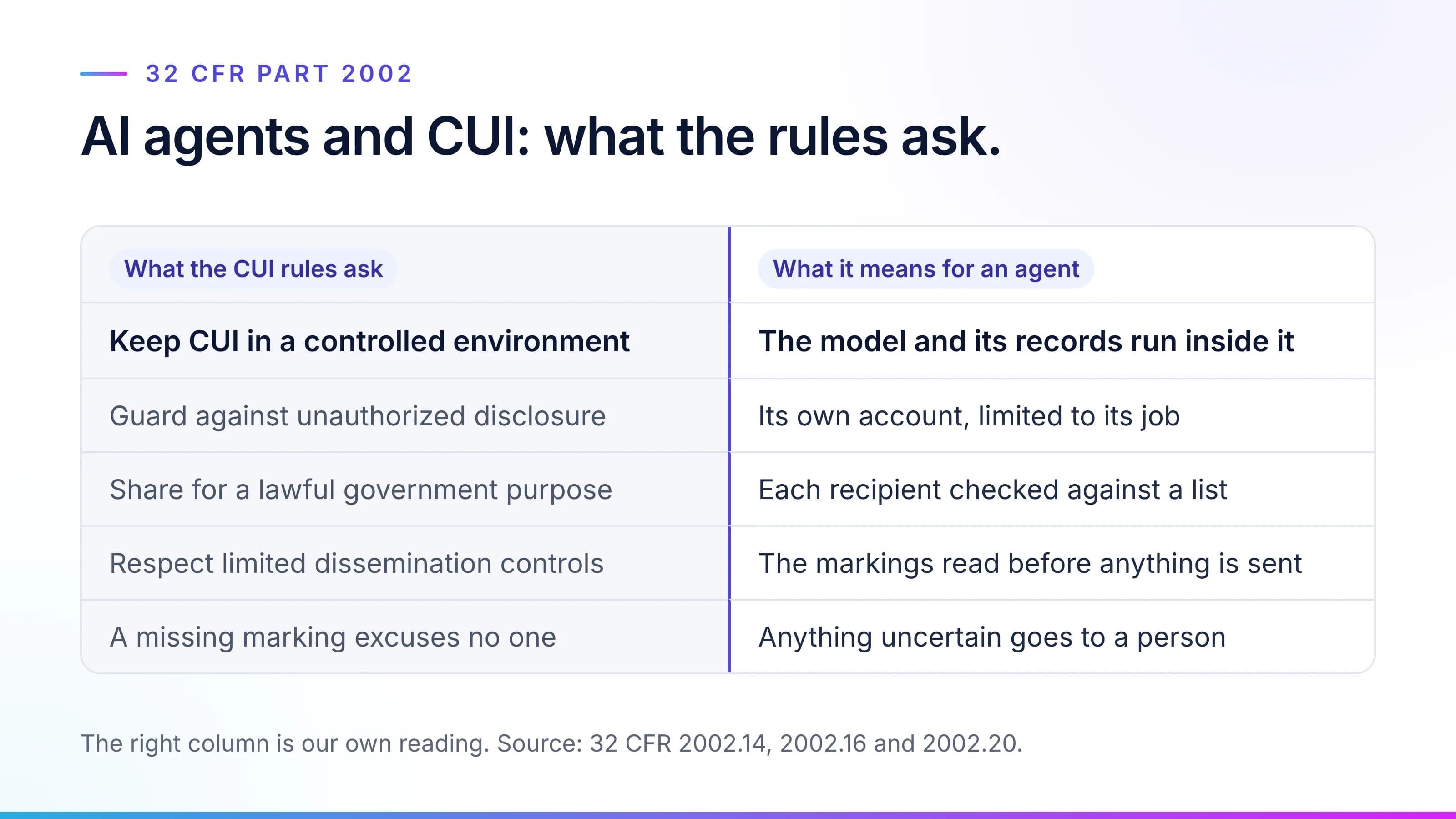
#Each of those rules turns into a question about the agent.
- Where does it run? If the agent sends a drawing to a model outside your controlled environment, the drawing has left it. The model, the agent and the store that keeps its records belong inside the boundary, on systems held to the same standard as the rest.
- What can it reach? An agent needs its own account, separate from any person's, limited to the files and systems its job needs. A shared service account makes it impossible to say who read what.
- Who can it share with? The sender has to reasonably expect that every recipient is authorized. An agent drafting a letter to a supplier should check the recipient against an approved list, and it must respect any limited dissemination control on the document.
- What does it do when it isn't sure? A missing or unclear marking does not make a document safe to share. An agent that can't confirm the category or the controls should stop and hand the document to a person.
- Can you show what it did? When a question comes up later, you need the record of every document the agent read and every message it sent, and the account that did each.
A worked example
#A Virtual Employee is an AI agent that takes on one kind of work for your team. It has its own account, and that account starts with no access. It follows the rules your experts approved, shows what each task cost and stops whenever you tell it to.
Take Keelstone Aerospace (Example company), a supplier that builds machined parts to its customers' drawings.
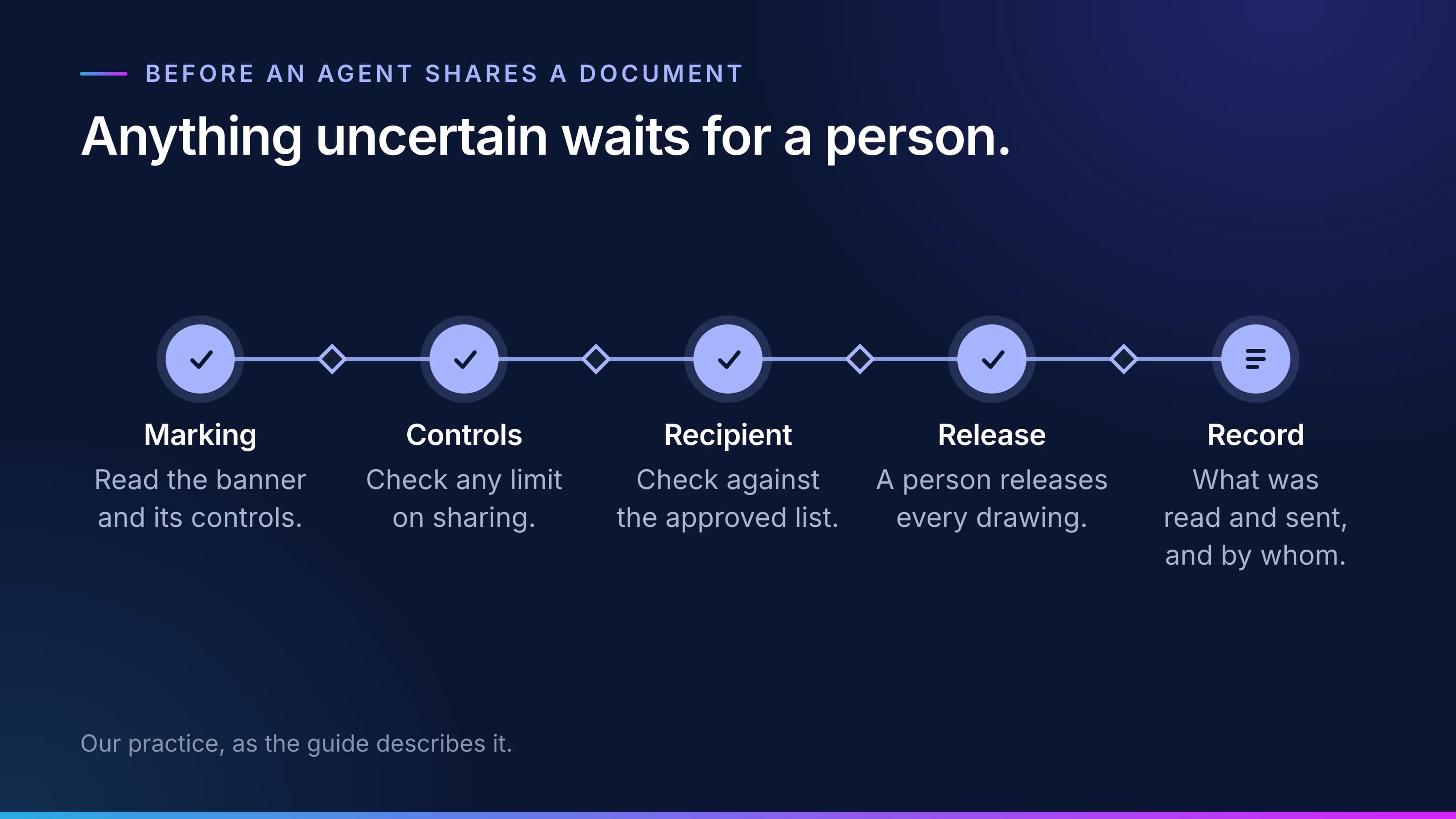
At Keelstone, a Virtual Employee checks each first article against the drawing and the purchase order, then drafts the report. When a drawing has to go to a sub-tier supplier, the Virtual Employee checks the supplier against the approved list and reads the drawing's markings. If the supplier isn't on the list, or a marking is missing or unclear, the release waits for Keelstone's reviewer, with the reason attached. A person releases every drawing that leaves the company.
How Inovagio is built for this work
#Inovagio runs where you decide. We can host it for you, or it can run in your cloud, in your own data center, or on a network with no internet connection. For controlled work, the models can run inside your controlled environment, so the agent has no need to send a drawing outside it.
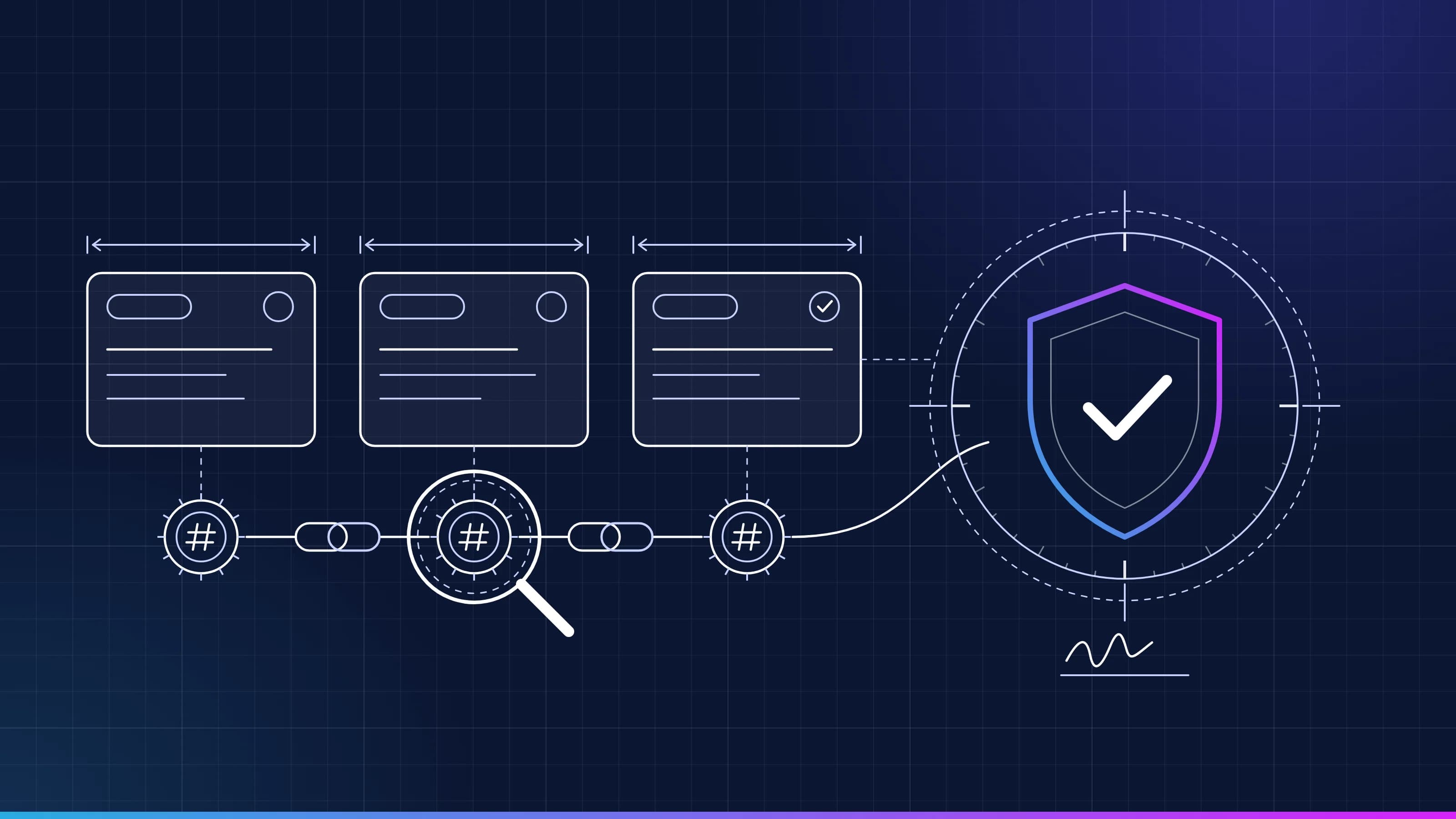
Each Virtual Employee has its own account in Auth, and you approve each kind of action it may take. Every call it makes to one of your systems goes through APIM, which allows only the destinations you approved. Every step it takes is recorded in Phylax in a hash-chained trail, so any later change to the record can be detected. Archon can stop one Virtual Employee, every Virtual Employee in a department, or all of them at once.
For the supplier and first-article work itself, see Virtual Employees for defense contractors. To talk through one of your workflows, book a briefing below.
Questions
What people ask.
Do the CUI rules apply to AI agents?
Part 2002 binds federal agencies directly and reaches contractors through their agreements with an agency. Where those agreements apply, an AI agent that reads, stores or sends CUI is handling it. The safeguarding, marking and sharing rules then cover what the agent does, and the people responsible for it answer for that.
Can an AI agent share CUI with a supplier?
An agent may share it only within the rules. CUI may be shared where it furthers a lawful government purpose and isn't restricted by a limited dissemination control, and the sender must reasonably expect every recipient is authorized. An agent should check the recipient and the markings, and hand anything uncertain to a person.
Is information without a CUI marking safe to share?
No, it isn't. Under 32 CFR 2002.20, the lack of a CUI marking on information that qualifies as CUI does not exempt the holder from the handling requirements. When a marking is missing or unclear, the safe course is to stop and ask a person.
The products, industries and examples it covers.
- Identity and sign-inAuthOne sign-in for every person, service and AI agent.
- API gatewayAPI ManagementOne governed door to every model, agent and API.
- Governance and auditPhylaxSign-in, policy, secrets and one audit trail from the screen to the disk, so you can show any examiner what happened.
- Agent control planeArchonSee every agent at work, and stop or start any of them.
- IndustryDefenseFirst articles checked against the drawing and purchase order, each supplier’s required cybersecurity level tracked, and outgoing drawings compared with your release rules. Engineers and reviewers decide.
Read next.
 Article · GovernanceIs it safe to give AI a login?Work that crosses systems needs a login, and a login is what a security team guards hardest. These are the five controls that make a Virtual Employee safe to credential, how the kill switch works, and the one number a security team should watch. · updated November 18, 2026 · 8 min read
 Article · GovernanceCan you turn your AI agents off? What examiners now askUS bank regulators have started asking how banks would shut their AI agents down, while the new model risk guidance leaves agents out of scope. Here's what examiners are asking, which deadlines arrive in Colorado and the EU, and what a working kill switch looks like. · updated November 18, 2026 · 11 min read
 Guide · AI audit trailRead a task recordEvery task Inovagio runs leaves a tamper-evident record. Here is what each line means, how the seals chain together, and how to replay a task end to end. · updated November 18, 2026 · 5 min read
See it on your work
See how one of your tasks runs, start to finish.
A 30-minute walkthrough of one of your workflows, the approval step and the audit record, with the people who build the platform.