

Series · Industry rules and AI
AI in Medicare Advantage coverage decisions: what CMS allows
CMS lets a Medicare Advantage plan use AI to help with coverage decisions. Each decision must rest on the member's own record and the plan's published criteria, and a physician or other qualified clinician must review any medical necessity denial before it goes out. Here is what to ask a vendor.
Inovagio team · Published · 5 min read

On this page
CMS allows AI in Medicare Advantage coverage decisions as a tool that assists the plan. Each decision must still rest on the member's own record and the published coverage criteria, a physician or other qualified clinician must review any medical necessity denial before it is issued, and the plan stays answerable for every decision.
We wrote this piece for utilization management, compliance and operations leaders at health plans who have been asked to bring AI into coverage review.
Note
Not legal advice. Check your obligations with counsel.
What CMS said about AI in Medicare Advantage coverage decisions
#On February 6, 2024, CMS sent every Medicare Advantage organization a memo answering common questions about its final rule, CMS-4201-F. The rule's coverage criteria and utilization management provisions apply to coverage beginning January 1, 2024. One of the questions asked whether the new rules mean plans can no longer use algorithms or artificial intelligence to make coverage decisions.
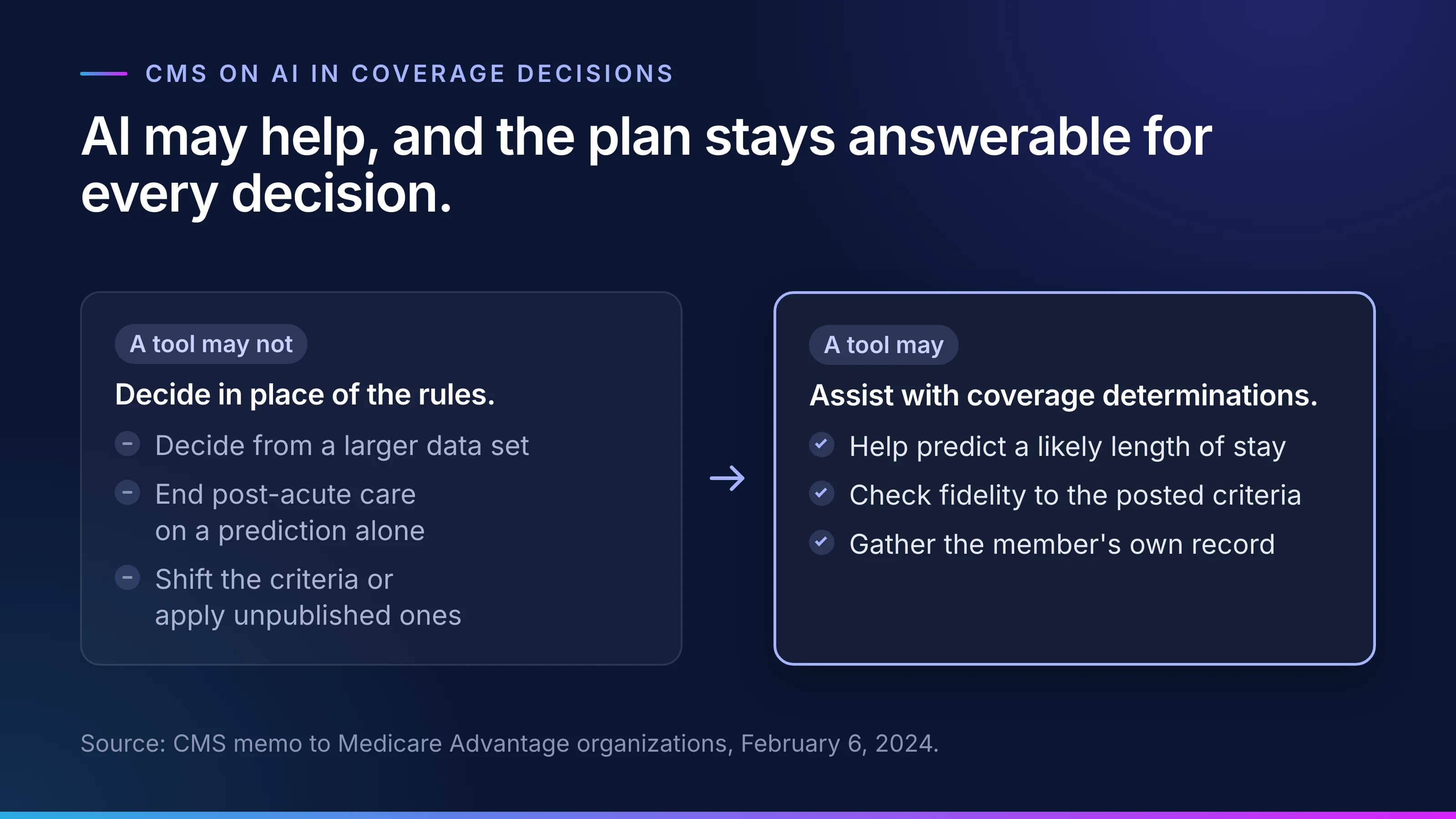
CMS answered that an algorithm or software tool can be used to assist a plan in making coverage determinations. It added that the plan is responsible for making sure the tool complies with every rule for how those determinations are made.
- The individual member. A medical necessity decision has to rest on the individual patient's circumstances, including the medical history, the physician's recommendations and the clinical notes. CMS said a tool that decides coverage from a larger data set instead would not comply.
- Post-acute care. A tool may help predict how long a member will need post-acute care, but that prediction alone can't be the reason to end it. The plan has to reassess the member's condition before it issues the termination notice.
- Inpatient stays. Algorithms or AI alone cannot be the basis for denying an admission or downgrading it to an observation stay.
- Published criteria. A plan may deny basic benefits only on grounds the rule allows, and internal criteria must be published. CMS said a tool should be used only to keep decisions true to the posted criteria. AI cannot be used to shift those criteria over time, and a tool cannot apply criteria that were never made public.
- Bias. CMS reminded plans of the nondiscrimination requirements in Section 1557 of the Affordable Care Act. It asked plans to make sure, before using a tool, that it does not perpetuate existing bias or introduce new bias.
The same memo restates who must review a denial. If a plan expects to issue a partially or fully adverse decision about medical necessity, a physician or other appropriate health care professional with expertise in the field must review it before the decision is issued. CMS also said its 2024 program audits would use physician reviewers to look at denied requests.
Source: CMS memo to all Medicare Advantage organizations, February 6, 2024 (copy hosted by the American Hospital Association), citing 42 CFR § 422.101(b) and (c) and § 422.566(d).
Where AI helps, and where a person decides
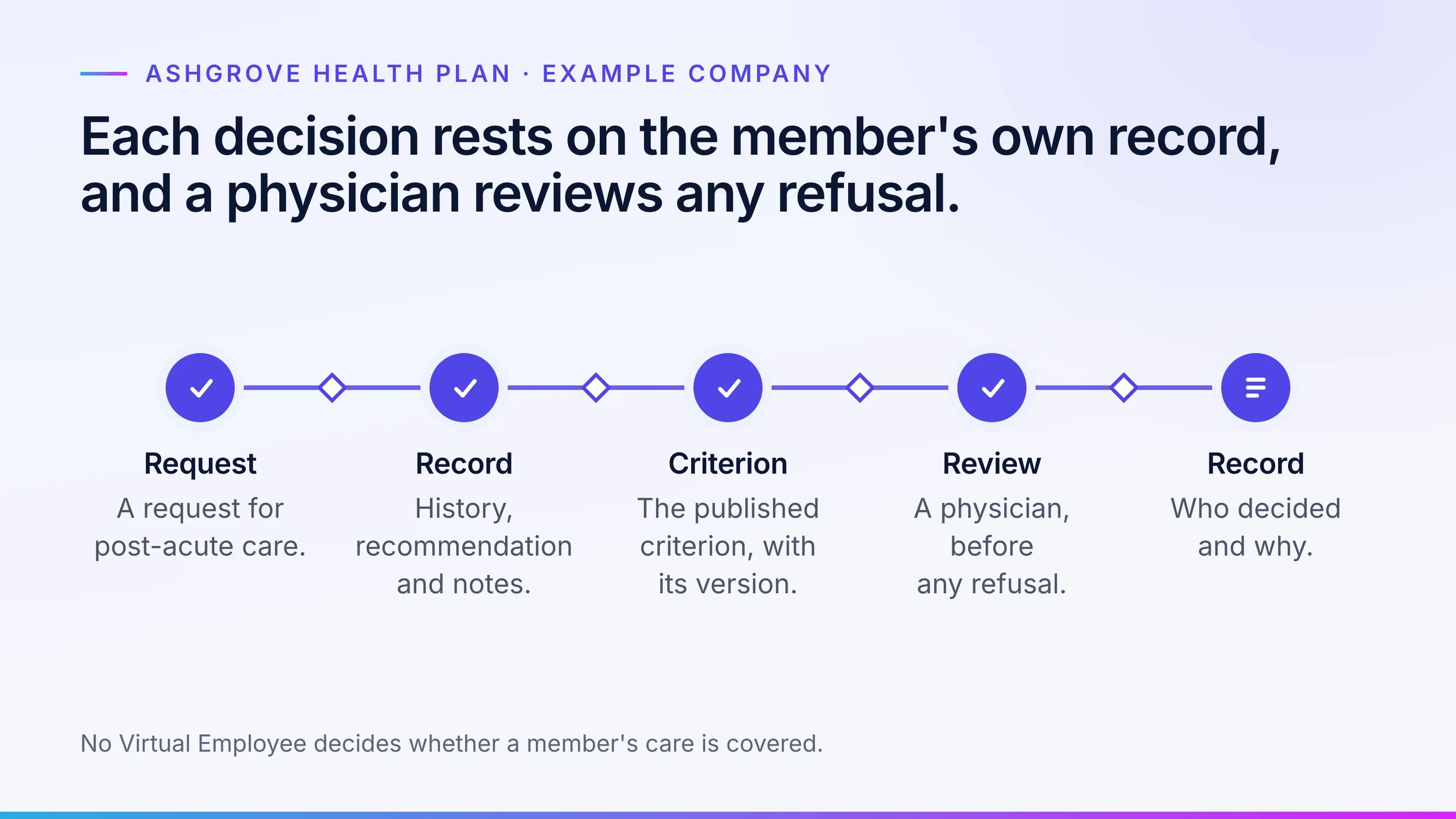
#Gathering the record, matching it to the right criterion and tracking each case's deadline is routine work. Deciding whether the care is medically necessary is a clinical judgment, and a physician or other qualified clinician reviews any denial.
A Virtual Employee is an AI agent that takes on one kind of work for your team. It has its own account, and that account starts with no access. It follows the rules your experts approved, shows what each task cost and stops whenever you tell it to.
Take Ashgrove Health Plan (Example company), a Medicare Advantage plan whose utilization management team reviews requests for post-acute care.
At Ashgrove, a Virtual Employee opens each request and gathers the member's history, the physician's recommendation and the clinical notes. It quotes the published criterion that applies, with its version, and marks anything missing from the record. Then it hands the case to a clinical reviewer with a note on what it found. When a case may not be approved in full, a physician reviews it, and the record names who decided and why. No Virtual Employee decides whether a member's care is covered.
Six questions to ask before an AI tool touches coverage review
#These questions follow from the CMS memo. Ask them of any vendor, including us.
- Does the tool read this member's history, the physician's recommendation and the clinical notes, or does it work from a score built on other patients?
- Can it show which published criterion it applied to each case, and which version of that criterion?
- Can anything in the tool change a criterion by itself, or does every change need a named person's approval?
- When a case may not be approved in full, who reviews it, and does the record show that person's name and field?
- How was the tool checked for bias before it was used, and who signed off on that check?
- Can you replay a past case step by step for a CMS auditor, from the request to the letter?
How Inovagio is built for this work
#Inovagio's Virtual Employees learn the job from your own people and follow the rules your experts approve. For a health plan, those rules come from the plan's published criteria. In Synesis, each rule names its source and the person who owns it, and a change takes effect only after that person approves it. So a Virtual Employee can't change the criteria you posted.
Before a Virtual Employee handles real cases, we test it on your past cases and run it in shadow mode beside your team. Anything it can't settle goes to a person, with the reason attached. Every step it takes is recorded in Phylax, so you can open a case and show an auditor the record, the criterion and the reviewer behind it. Your members' data never trains a model another customer uses.
For how this fits the rest of a plan's operations, see Virtual Employees for health plans. If your plan wants to help shape this work, apply to be a design partner.
Questions
What people ask.
Can a Medicare Advantage plan use AI to make coverage decisions?
Yes, a plan may use AI to help. CMS said on February 6, 2024 that an algorithm or software tool can assist a Medicare Advantage plan in making coverage determinations. The plan stays responsible for following every rule, including basing each decision on the individual member's own medical history, physician recommendations and clinical notes.
Who has to review a Medicare Advantage denial for medical necessity?
The review belongs to a physician or other appropriate health care professional with expertise in the field. Under 42 CFR 422.566(d), as CMS restated in its February 2024 memo, that person must review a partially or fully adverse medical necessity decision before the plan issues it.
Can AI change a Medicare Advantage plan's coverage criteria?
No, it can't. CMS said publicly posted coverage criteria are static, so AI cannot be used to shift them over time. A tool also cannot apply internal criteria that were never made public and adopted under the evidence standard in 42 CFR 422.101(b)(6).
The products, industries and examples it covers.
- Knowledge layerSynesisTurns your policies, procedures, records and your people’s know-how into a rulebook your experts approve, which you own and can take anywhere.
- Governance and auditPhylaxSign-in, policy, secrets and one audit trail from the screen to the disk, so you can show any examiner what happened.
- Role workersVirtual EmployeesVirtual Employees that plan, act and ask before anything leaves the building. Every plan is checked before it runs.
- IndustryHealth plansEnrollment and premium files reconciled line by line, directory entries verified on schedule, and appeal case files tracked on their clocks. A physician decides every medical appeal.
Read next.
 Article · GovernanceBusiness rules or AI guardrails? Why regulated work needs bothGuardrails filter what an AI model takes in and says. Business rules check what the work itself must satisfy. In regulated work you need both, plus a model's judgment for the messy parts. What each one catches, a worked example, and what to ask a vendor. · updated November 18, 2026 · 12 min read
 Guide · AI audit trailRead a task recordEvery task Inovagio runs leaves a tamper-evident record. Here is what each line means, how the seals chain together, and how to replay a task end to end. · updated November 18, 2026 · 5 min read
 Article · GovernanceCan you turn your AI agents off? What examiners now askUS bank regulators have started asking how banks would shut their AI agents down, while the new model risk guidance leaves agents out of scope. Here's what examiners are asking, which deadlines arrive in Colorado and the EU, and what a working kill switch looks like. · updated November 18, 2026 · 11 min read
Design partners
Teach AI one of your workflows, with your own people.
Tell us one workflow you would want AI to learn from your people. We reply to every application.